



Hartmetall- vs. Werkzeugstahl-Stanzstifte: Werkzeuglebenszeit, Risiko, und Kosten
Carbide does not automatically make a better punch pin, and tool steel is not always the cheaper long-term choice. Carbide is usually the stronger candidate when gradual abrasive wear, Dimensionsdrift, and frequent sharpening limit production. Tool steel is often safer when the punch faces impact, Biegen, Seitenbelastung, uncertain alignment, or frequent design changes.
The right choice depends on how the current punch fails and how much that failure costs. Material selection is only one part of the wider die decision covered in this Leitfaden für Stanzenwerkzeuge (Schlussfolgerung). Hier, the focus is narrower: selecting between cemented-carbide and tool-steel punch pins based on tool life, Bruchgefahr, Wartung, and cost per accepted part.
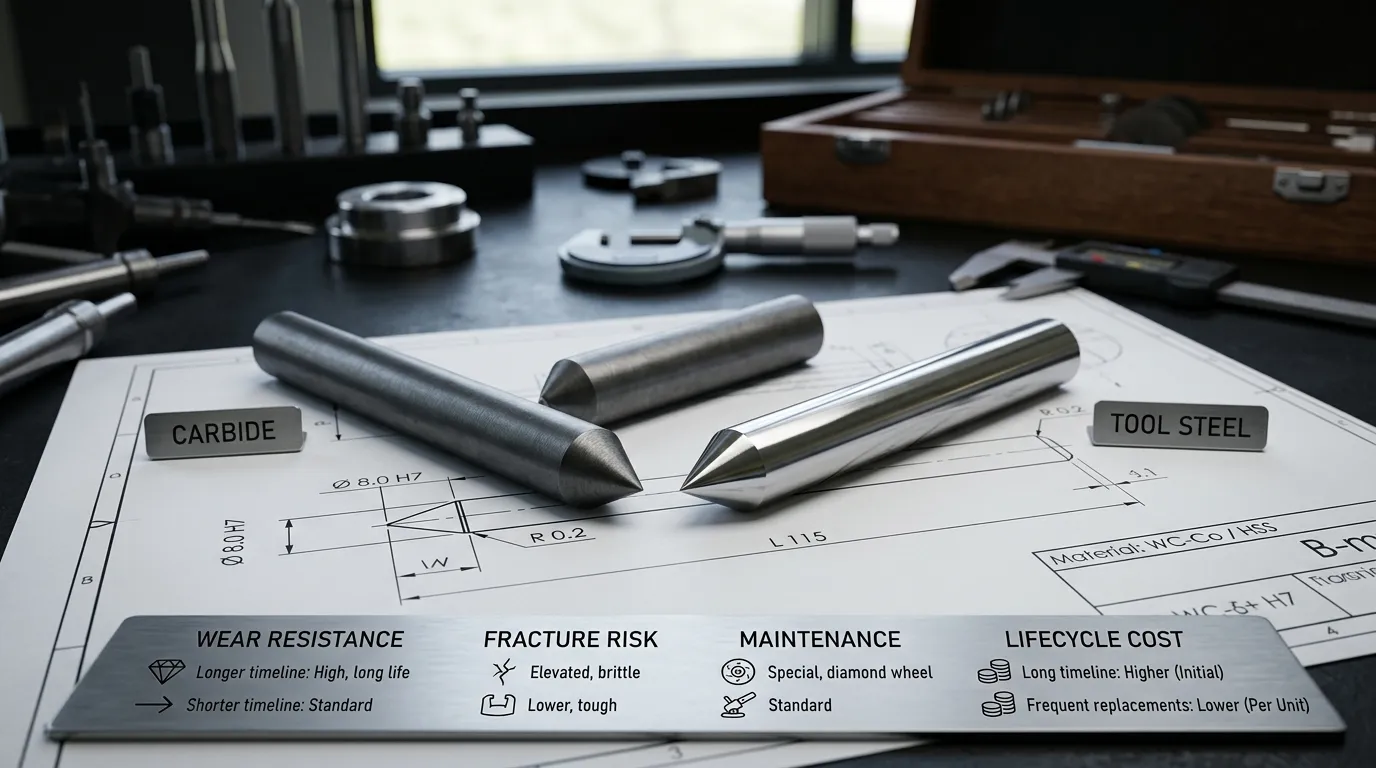
Hartmetall- vs. Werkzeugstahl-Stanzstifte auf einen Blick
| Vergleichsfaktor | Zementierter Hardmetall-Stanzstift | Werkzeugstahl-Stempelstift |
|---|---|---|
| Verschleißfestigkeit | Meistens höher, especially in abrasive and stable applications | Das hängt stark von der Stahlqualität und der Wärmebehandlung ab |
| Kantensicherung | Kann Abmessungen und den hochmodernen Zustand länger halten, wenn Verschleißkontrolle ausfällt | Es kann bei starken Abnutzungsbedingungen häufigeres Schärfen erforderlich sein |
| Absplitterung und Bruchtoleranz | Empfindlicher gegenüber Aufprallen, Seitenbelastung, and stress concentration | Generally more forgiving under shock, Biegen, and unstable conditions |
| Ausrichtungsanforderungen | Requires accurate guidance, Unterstützung, and uniform clearance | Toleriert in der Regel kleinere Betriebsschwankungen besser |
| Geometrische Eignung | Risk increases with slender sections, Nicht getragene Länge, and abrupt transitions | Oft bevorzugt für schwierige oder ausbiegeanfällige Geometrien |
| Nachschleifen | Possible, but normally requires suitable diamond-grinding equipment and experience | Im Allgemeinen ist es für einen konventionellen Werkzeugraum einfacher, neu zu schleifen oder zu modifizieren |
| Anfangskosten | Meistens höher | Meistens niedriger, though premium HSS and PM grades can narrow the difference |
| Best-Fit-Anwendung | Stable, repetitive, wear-dominated production | Impact-prone, changeable, short-run, or fracture-sensitive production |
| Wirtschaftlicher Test | Reduzierte Betriebsunterbrechungen müssen die höheren Ankaufs- und Wartungskosten rechtfertigen | Geringere Anschaffung und einfachere Wartung müssen kürzere Betriebsintervalle ausgleichen |
These are directional differences, not guaranteed outcomes. Hartmetallqualität, Stahlqualität, Stanzgeometrie, Werkstücksmaterial, die condition, Freigabe, lubrication, and maintenance practices can change the result.
Was "Hartmetall" und "Werkzeugstahl" in diesem Vergleich bedeuten
The comparison is between punch pins made from cemented tungsten carbide and punches made from hardened tool steel. A steel punch with a thin surface coating is not the same as a solid or predominantly carbide punch.
The term “tool steel” also covers several material families. A conventional D2- or SKD11-type punch does not offer the same performance balance as high-speed steel or a powder-metallurgy tool steel.
Cemented Carbide Is a Grade Family, Not One Fixed Material
Cemented carbide is a composite material. Hard tungsten-carbide particles provide much of its hardness and wear resistance, while a metallic binder holds those particles together and contributes toughness.
Laut CERATIZITs technische Erklärung von Zementkarbid, binder content and carbide grain size are two major variables controlling material properties. This means that specifying only “tungsten carbide” is incomplete.
A grade selected for maximum wear resistance may not provide the best resistance to chipping. A tougher carbide grade may survive impact or interrupted loading better, but it may not retain its edge as long in a purely abrasive application.
A responsible carbide specification should therefore consider:
- Binder content
- Karbid-Korngrößenklasse
- Erforderliche Verschleißfestigkeit
- Erwartete Stoß- und Biegebelastung
- Stanzquerschnitt und nicht unterstützte Länge
- Werkstücksmaterial und Oberflächenzustand
Tool Steel Includes Conventional, HSS, and PM Options
Tool steel should not be treated as one low-cost, low-performance category.
Conventional cold-work grades such as D2 or SKD11 are widely associated with good abrasive wear resistance and compressive strength. They can work well where loads are controlled and the geometry is sufficiently supported. Their suitability becomes less certain when severe chipping or shock resistance is required.
Hochgeschwindigkeitsstahl, including M2- or SKH51-type grades, is also part of the tool-steel family. It generally offers a different balance of wear resistance, Zähigkeit, and regrindability from conventional cold-work steel.
Powder-metallurgy tool steels can provide another intermediate option. Their finer and more uniform structure may improve the balance between wear resistance and toughness compared with conventional grades. Die AHSS-Richtlinien und Diskussion über Werkzeuge und Werkzeugverschleiß notes that tool selection must account for wear, Stoßfestigkeit, Steifigkeit, Zähigkeit, and the actual forming or cutting conditions.
Heat treatment remains critical for every steel option. The grade name alone does not establish final punch performance.
Which Material Delivers Longer Punch-Pin Life?
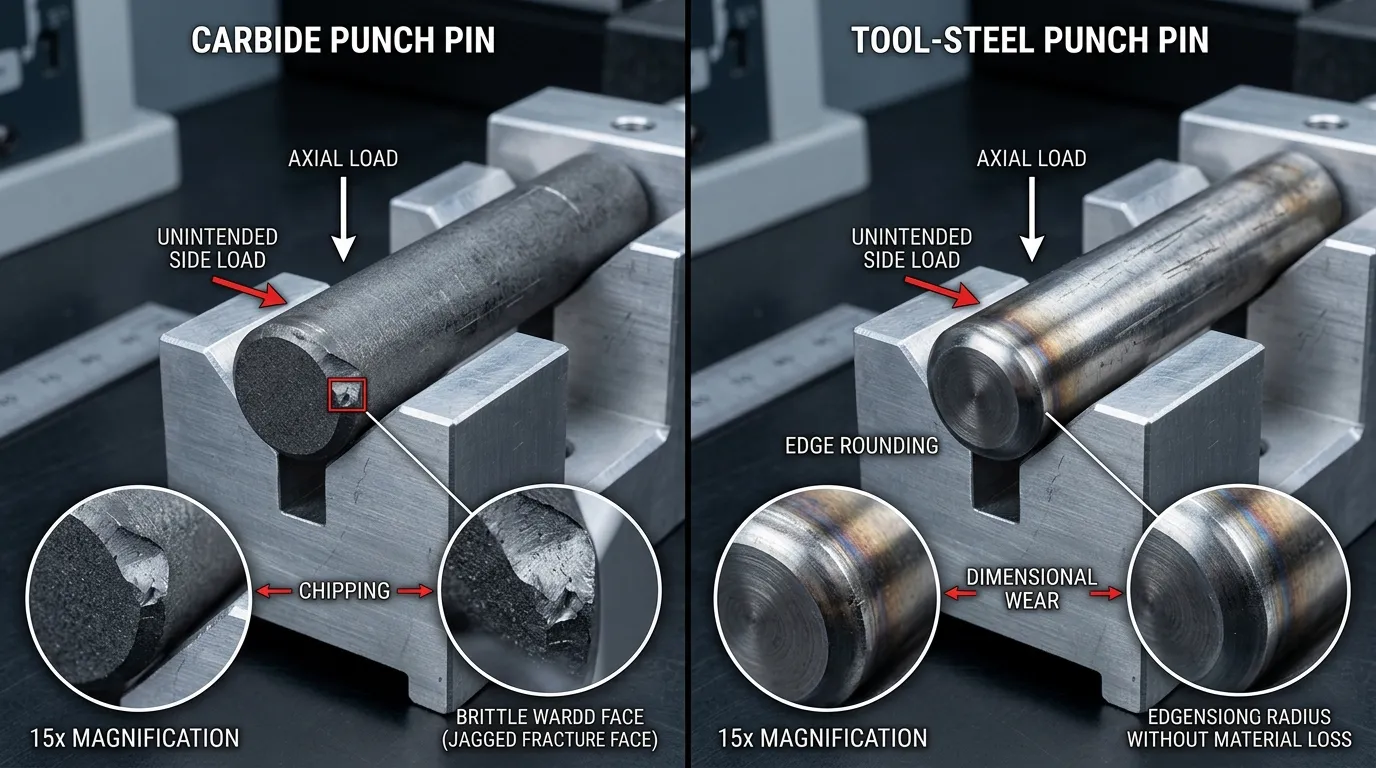
Carbide can deliver a much longer service interval when abrasive wear is the main reason the punch leaves production. It may not last longer when the real problem is chipping, Knacken, Biegen, misalignment, or unstable stripping.
Tool life should therefore be connected to a defined failure mode rather than a generic number of strokes.
Hartmetall hat den stärksten Fall, wenn Verschleißkontrolle das Versagen kontrolliert
Carbide is a strong candidate when the punch gradually loses its cutting profile instead of breaking suddenly.
Typical wear-dominated symptoms include:
- Progressive Kantenrundung
- Erhöhung der Grathöhe
- Allmähliche Lochgröße oder Merkmalsdrift
- Häufiges geplantes Schärfen
- Oberflächenverschleiß ohne größere Kantenabsplitterung
- Beständiger Ausfall nach ähnlichen Produktionsintervallen
These conditions allow carbide’s wear resistance to create measurable value. The benefit may appear as longer intervals between service, more stable dimensions, fewer tool changes, or lower inspection and adjustment demand.
The application must still be mechanically stable. High wear resistance cannot compensate for uneven clearance, Schlechte Führung, or a punch that bends during entry.
Werkzeugstahl kann länger halten, wenn der Bruch das Versagen kontrolliert
A tool-steel punch may be more reliable when sudden damage ends the tool’s service life.
Warning signs include:
- Abgeschlagene Schneidkanten
- Risse in der Nähe einer Durchmesseränderung
- Vollständiger Schlagbruch
- Wiederholtes Biegen oder Ablenken
- Ungleichmäßige Abnutzung auf einer Seite
- Schäden während des Rückzugs aus dem Blatt
- Ausfälle, die in inkonsistenten Abständen auftreten
In these conditions, additional hardness may not solve the problem. The punch may need greater toughness, Verbesserte Unterstützung, corrected alignment, a different transition radius, or a revised stripper arrangement.
Material-related fracture is only one part of the diagnosis. Der spezielle Leitfaden für Stanzbruch in Stempelwerkzeugen covers the wider causes and corrective actions.
Definieren Sie die Werkzeuglebensdauer, bevor Sie Materialien vergleichen
“Longer life” has little meaning unless the endpoint is defined.
Mögliche Endpunkte sind unter anderem:
- Maximal akzeptabler Mahlgrad
- Lochdurchmesser oder Profiltoleranz
- Oberflächendefektgrenze
- Erster sichtbarer Kantenchip
- Katastrophaler Bruch
- Planiertes Schärfintervall
- Anzahl der vor dem Einsatz akzeptierten Teile
Accepted parts are usually a better comparison measure than raw press strokes. A punch may complete many strokes while producing parts that no longer meet the drawing or burr requirement.
The same endpoint must be used for both materials. Comparing a steel punch until sharpening with a carbide punch until complete fracture produces a misleading result.
Warum Hartmetall länger halten kann – oder früher zerbrechen kann
Carbide performs best when the die system keeps the punch under controlled, predominantly axial loading. Its wear advantage becomes less useful when the punch is exposed to bending, Ungleichmäßiger Kontakt, or sudden impact.
Trasse, Freigabe, and Guide Condition
A punch should enter the die opening concentrically. Worn guide posts, loose bushings, Plattenbewegung, holder runout, or uneven clearance can move the load toward one side of the cutting edge.
That local load increases stress even when the average punching force appears acceptable. A steel punch may deflect or wear under these conditions. A carbide punch may chip or fracture with less visible warning.
SunshinePros Leitfaden für die Stanzenkomponenten erklärt, wie Schläge, Leitfäden, Buchsen, Verschleißkomponenten, and stripper systems interact. These components should be inspected before a steel punch is replaced with carbide.
Clearance also matters. Insufficient, excessive, or uneven punch-to-die clearance can change cutting force, Burr-Formation, Materialfluss, und Kantenbelastung. Carbide should not be used to hide a clearance problem.
Punch Geometry, Strippen, and Workpiece Conditions
Geometry strongly affects risk. A small-diameter punch with a long unsupported section is more sensitive to bending than a short, well-supported punch of the same material.
Risk can also increase with:
- Abrupte Durchmesseränderungen
- Scharfe innere Übergänge
- Unzureichende Kopf- oder Schulterstütze
- Ungleichmäßige Schneidegeometrie
- Hohe Strippkraft
- Materialanhebung während des Stanzrückzugs
- Slug-Ziehen
- Außermittiger Kontakt mit dem Blatt
The workpiece changes the loading environment as well. Stärke, Dicke, Beschichtung, Oberflächenrauheit, and abrasive particles can affect cutting force and wear. The AHSS Guidelines identifies tool material, Kontaktdruck, sheet strength, Oberflächenzustand, Beschichtung, lubrication, Temperatur, and sliding behavior as interacting wear variables.
This is why a material that performs well in one die may fail quickly in another, even when the punch dimensions look similar.
Wie man Kosten pro akzeptiertem Teil vergleicht
Carbide normally costs more to purchase, but initial price alone does not show which material is more economical.
A useful comparison includes every cost directly influenced by the punch:
- Erster Lochkauf
- Nachschleifen oder Schärfen
- Coating or recoating, Wo zutreffend
- Ersatzwerkzeuge
- Entfernungs- und Installationsarbeit
- Aufbau- und Anpassungszeit
- Pressepausen
- Schrott, der vor der Entdeckung eines abgenutzten oder beschädigten Stempels produziert wird
- Zusätzliche Inspektion
- Notfallwartung
- Akzeptierte Produktionsleistung
A basic calculation is:
Kosten pro akzeptiertem Teil = Gesamtausgaben des Stempels ÷ Anzahl der produzierten Teile
Zum Beispiel, two punches may have very different purchase prices. The more expensive punch can still cost less per part if it reduces planned service, emergency stoppages, Schrott, and adjustment time. The cheaper punch can remain the better choice when production demand is limited, maintenance is simple, or carbide fracture risk is high.
The calculation should use actual plant data where possible. Avoid assuming that carbide will last five, ten, or twenty times longer. Such multipliers cannot be transferred reliably between different workpiece materials, punch geometries, Pressen, clearances, and failure criteria.
A risk-adjusted comparison should model at least two carbide outcomes:
- Expected case: Carbide reaches the planned wear-based service interval.
- Adverse case: Carbide chips or breaks early because of side loading, Auswirkungen, or an unsuitable grade.
This prevents a favourable wear estimate from hiding the financial effect of one catastrophic failure.
When to Choose Carbide, Werkzeugstahl, or a Middle Option
| Produktionszustand | Stärkerer Startkandidat | Hauptgrund |
| Stable die, Abrasiver Verschleiß, häufiges Schärfen | Karbid | Verschleißfestigkeit kann die Dienstintervalle verlängern |
| Repeated chipping, Biegen, oder Einschlag | Härterer Werkzeugstahl | Bruchwiderstand ist wichtiger als die maximale Härte |
| Kurze Produktionszeit oder wechselndes Bauteildesign | Werkzeugstahl | Geringere anfängliche Verpflichtung und einfachere Modifikation |
| Langer, sich wiederholender Lauf mit kostspieliger Ausfallzeit | Karbid, after system checks | Eine reduzierte Intervention könnte die höheren Kosten rechtfertigen |
| Conventional steel wears too quickly, but carbide risk is high | HSS- oder PM-Werkzeugstahl | Mittelverschleiß-Zähigkeits-Balance |
| Verschiedene Stationen zeigen unterschiedliche Ausfallarten | Hybride Materialstrategie | Jede Station kann das Material verwenden, das für ihre Last geeignet ist |
Wählen Sie Hartmetall, wenn Verschleiß und Ausfallzeit dominieren
Carbide is a strong candidate when:
- The existing punch wears gradually rather than breaking.
- Guidance and clearance are stable.
- Punch geometry is well supported.
- The workpiece creates significant abrasive wear.
- Repeated sharpening interrupts valuable production time.
- Dimensional consistency between service intervals is important.
- A suitable carbide grade can be selected.
- Qualified carbide grinding and handling are available.
High production volume strengthens the economic case, but volume alone is not enough. A high-volume die with poor alignment can consume carbide punches faster than a well-selected steel alternative.
Wählen Sie Werkzeugstahl, wenn Zähigkeit und Flexibilität dominieren
Tool steel is often the safer choice when:
- The punch experiences impact or side loading.
- Geometry is slender or difficult to support.
- Alignment cannot be controlled closely.
- The die is used for prototypes, short runs, or changing designs.
- The punch may need local modification.
- In-house regrinding is important.
- A sudden carbide fracture could damage other die components.
- Current failures are cracks or chips rather than gradual wear.
The exact grade still matters. Conventional cold-work steel, HSS, and PM tool steel should not be grouped under one performance assumption.
Consider HSS, PM Tool Steel, or a Hybrid Die Strategy
The decision does not always need to be binary.
HSS may provide more wear resistance than a conventional tool steel while retaining useful toughness and easier regrinding than carbide. PM tool steel may offer another balance where both wear and chipping are concerns.
A hybrid die can also use different materials in different stations. Carbide may be justified at stable, high-wear piercing stations, while a tougher steel remains preferable where punches are slender, heavily stripped, or exposed to off-axis load.
Testing one high-wear station before converting a complete punch set can reduce technical and financial risk.
Überprüfe das Stempelsystem, bevor du auf Hartmetall umsteigst
Before replacing a steel punch with carbide, verify the following:
- Identify the present failure mode. Determine whether the punch wears, deforms, Chips, Risse, bends, or breaks.
- Inspect the guide system. Check guide posts, Buchsen, Kennzeichen, and holders for movement or uneven wear.
- Verify alignment and runout. Confirm that the punch enters the die opening concentrically.
- Check clearance around the full cutting perimeter. Do not rely on one measurement.
- Review punch support. Examine unsupported length, head support, diameter changes, and transition radii.
- Evaluate stripping conditions. Look for excessive stripping force, material lifting, or slug pulling.
- Confirm workpiece details. Record material grade, strength condition, Dicke, Beschichtung, und Schmierung.
- Review the maintenance process. Confirm that appropriate carbide grinding, Inspektion, and handling are available.
- Set a success criterion. Define the required burr, dimensional limit, service interval, and accepted-part target.
If these checks reveal a mechanical problem, correct it before changing material. A carbide upgrade should address a wear problem, not conceal a die-system fault.
Was man einem Lieferanten für eine verantwortungsvolle Materialempfehlung schicken sollte
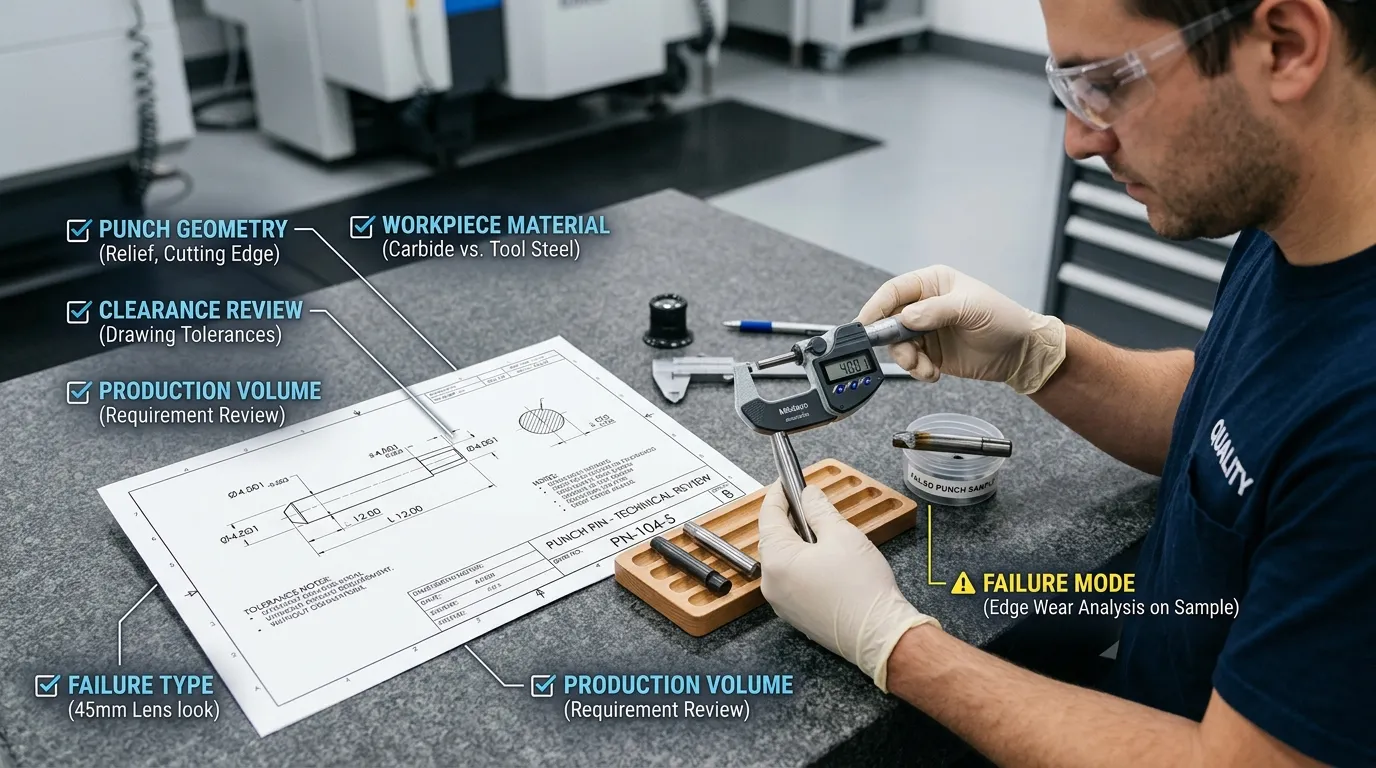
A supplier cannot make a defensible carbide-versus-tool-steel recommendation from the punch diameter alone.
Stellen Sie bereit:
- Maßgefertigte Lochzeichnung oder physikalische Probe
- Punch diameter, Länge, Kopfstil, and transition geometry
- Erforderliche Toleranzen und Oberflächenanforderungen
- Werkstücksmaterial und Sorte
- Werkstücksdicke und Festigkeitszustand
- Oberflächenbeschichtung oder Beschichtung
- Presstyp und Betriebsgeschwindigkeit, Wo relevant, wo relevant
- Stans-zu-Die-Freigabe
- Schmierbedingungen
- Stripper-Arrangement
- Erwartetes Jahres- oder Chargenvolumen
- Aktuelles Stanzmaterial und Wärmebehandlung
- Aktuelles Betriebsintervall
- Geschichte des Nachschleifens
- Fotos von abgenutzten oder gebrochenen Punches
- Beschreibung des Ausfallmodus
- Akzeptable Mahl- und Abmessungsgrenzen
- Auswirkungen von Ausfallzeiten oder Wechsel
SunshinePro lists carbide punches, die punch pins, and high-speed steel punches within its Stanzenwerkzeuge und -stifte. Its carbide punch information also lists grinding, EDM, Präzisionsbearbeitung, Individuelle Maße, und ausgewählte Beschichtungsoptionen. The exact material grade, Geometrie, Toleranz, Beschichtung, and process route still need confirmation against the drawing and application.
Final Decision Rule: Match the Material to the Failure Mode
Choose carbide when controlled alignment and stable geometry allow wear resistance to reduce service interruptions and cost per accepted part. Choose tool steel when toughness, repairability, Geometrie, or fracture control matters more than maximum wear resistance. Consider HSS or PM tool steel when the application falls between those positions.
The most reliable decision starts with the failed punch, the die condition, and the production data—not with hardness alone. To evaluate a custom requirement, Schick die Lochzeichnung, Werkstücksdetails, operating conditions, and failure history through SunshinePro’s Kontaktseite.
Teilen:



Geschrieben von Sunshine
Bei Sunshine, Wir sind ein professioneller Hersteller und Lieferant von Präzisionsformkomponenten, bietet ein breites Produktsortiment für Stange- und Spritzgussanwendungen. Unser Kernfokus liegt auf dem Stanzen von Stempeln, Auswurfstifte und -hülsen, sowie Führungspfosten und Buchsen. Mit fortschrittlicher CNC-Bearbeitung, Strenge Qualitätskontrolle, und starke Produktionskapazitäten, Wir sorgen für Zuverlässigkeit, Hochpräzisionsteile, zusammen mit vorrätigen Standardkomponenten für schnelle und effiziente weltweite Versorgung.
NACHRICHTEN
EMPFANG SERVICE
Mit hochwertigen Teilen für jedes Budget und freundlichem Personal, das geschult ist, um Ihren Besuch informativ und unkompliziert zu gestalten.
