



Medizinisches Spritzgießen: Anforderungen, Materialien, und QC-Checkliste
Medical injection molding produces plastic medical components under stricter cleanliness, Validierung, and quality-control standards than standard molding. Manufacturers use materials like polypropylene, Polycarbonat, TPU, and PEEK while following ISO 13485 workflows, traceability controls, and documented inspection procedures. Cleanroom production, mold validation, and detailed QC checkpoints help reduce contamination, dimensional defects, and regulatory risk in medical device manufacturing.
Medical devices need consistent quality, predictable performance, and reliable documentation. A small molding defect can affect assembly, sterilization, oder Patientensicherheit. That’s why medical molding projects involve tighter process controls than standard commercial production. This guide explains how medical injection molding works, which materials are commonly used, and what buyers should check before approving tooling or production.
Was ist medizinisches Spritzgießen?
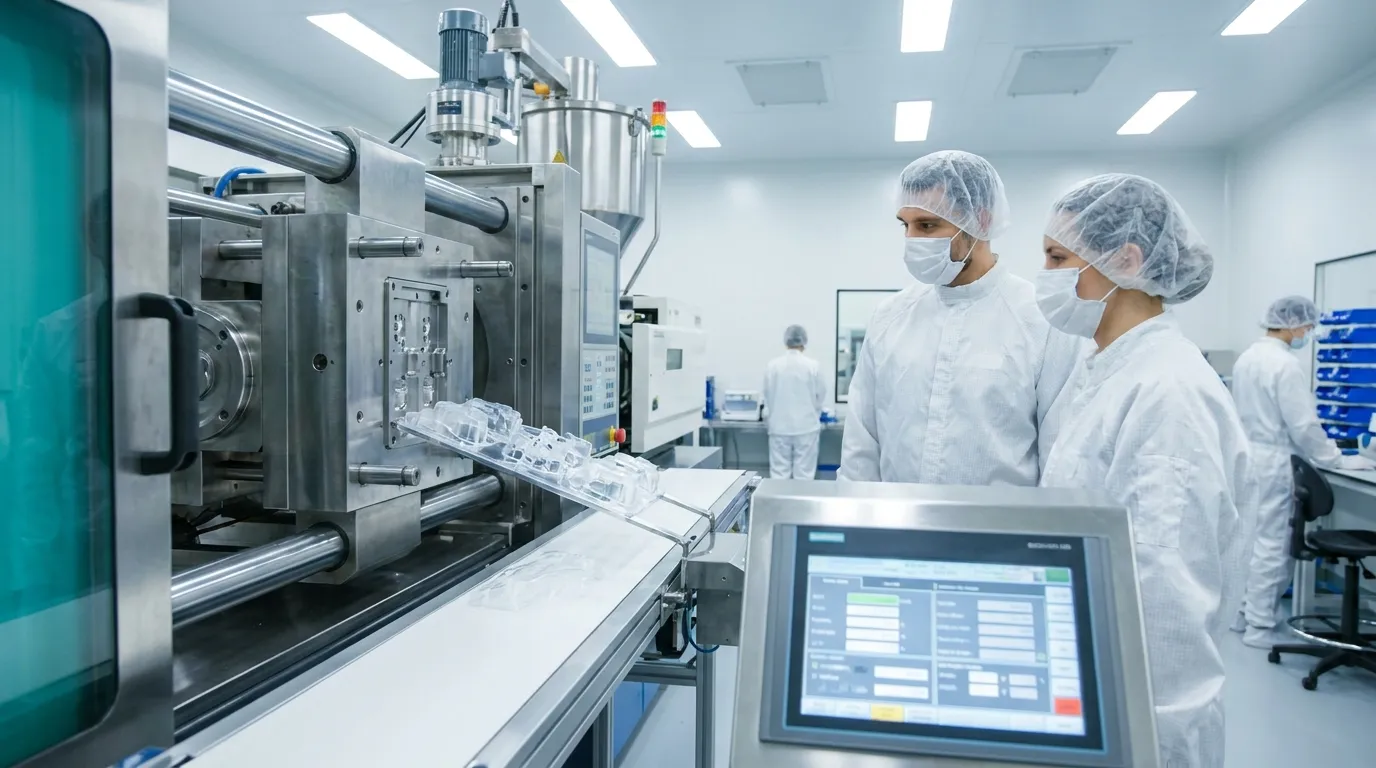
Medical injection molding produces plastic medical components under stricter quality, Rückverfolgbarkeit, and cleanliness standards than standard molding. It is commonly used for syringes, Diagnosegehäuse, surgical tools, and implant-support components that require repeatable precision and validated manufacturing controls.
Medical injection molding is a manufacturing process used to produce healthcare and medical device components with high consistency. The process injects melted plastic into a mold cavity, then cools and ejects the finished part. What changes in medical production is the level of control around materials, Inspektion, documentation, and contamination prevention.
Many disposable and reusable healthcare products rely on molded plastic parts. Gängige Beispiele sind Spritzengehäuse, IV-Steckverbinder, Gehäuse von Diagnosegeräten, inhaler components, and surgical handles. These parts often require tight tolerances because dimensional variation can affect sealing, Montage, or sterilization.
Manufacturers also maintain stronger process documentation than in standard molding projects. Material batches, inspection records, and validation reports are usually tracked throughout production. If you need a broader overview of the process itself, Sunshine Pros Leitfaden zu Grundlagen des Spritzgießens explains the standard production workflow in more detail.
Worin unterscheidet sich medizinisches Spritzgießen vom Standardguss?
Medical injection molding requires tighter process validation, material traceability, Kontaminationskontrolle, and inspection documentation than standard commercial molding. Manufacturers often operate under ISO 13485 systems and validated production workflows to reduce risk in healthcare applications.
The biggest difference is risk control. A cosmetic flaw on a consumer product may be acceptable, but a defect on a medical component can affect patient safety, Sterilität, or device function. Medical manufacturers use stricter controls to reduce those risks during production.
Viele Lieferanten folgen ISO 13485 quality-management standards. Production teams document material batches, machine settings, inspection records, and process changes. This creates traceability if a quality issue appears later in the supply chain.
| Standard-Guss | Medizinisches Spritzgießen |
|---|---|
| Begrenzte Rückverfolgbarkeit | Vollständige Losnachverfolgbarkeit |
| Grundinspektion | Dokumentierte Validierung und Qualitätskontrolle |
| Gewerbliche Materialien | Medizinische Harze |
| Allgemeine Produktionsfläche | Kontrollierte Reinraumumgebungen bei Bedarf |
| Schnellerer Genehmigungsablauf | Mehrstufiger Validierungsprozess |
Medical molding also includes stricter contamination control. Resin handling, Verpackung, and storage procedures are usually more controlled, especially for sterile or patient-contact applications.
This does not mean every medical part needs the most expensive production setup. Cleanroom molding and high-performance materials add cost. For many disposable products, polypropylene may be more practical than PEEK. Sunshine Pros Kunststoffgussverfahren guide explains the broader tooling and production fundamentals behind these decisions.
Which medical devices commonly use injection molding?
Injection molding supports a wide range of medical products because it produces consistent parts at high volumes. It works especially well for disposable devices, Wohnhäuser, Stecker, and precision plastic assemblies.
Common applications include syringes, inhalers, IV components, catheter fittings, test-kit housings, Chirurgische Griffe, and diagnostic equipment enclosures. Some implant-support components also use injection molding when precise geometry and repeatability matter.
| Medizinprodukt | Typisches Material | Produktionspriorität |
|---|---|---|
| Spritzengehäuse | Polypropylen | Hochvolumen-Ausgabe |
| Gehäuse für Diagnosegeräte | Polycarbonat | Dimensionsstabilität |
| Katheteranschlüsse | TPU | Flexibilität |
| Griffe von chirurgischen Werkzeugen | ABS oder PC | Haltbarkeit |
| IV-Steckverbinder | PVC oder PP | Chemische Beständigkeit |
A diagnostic device enclosure is a good example. The housing may need cosmetic consistency, stable dimensions, and resistance to cleaning chemicals. A poorly controlled molding process can create fit issues during final assembly.
For broader industry examples, Sunshine Pros Leitfaden zu Anwendungen im medizinischen Formen covers additional injection molding use cases across manufacturing sectors.
Which materials are used in medical injection molding?
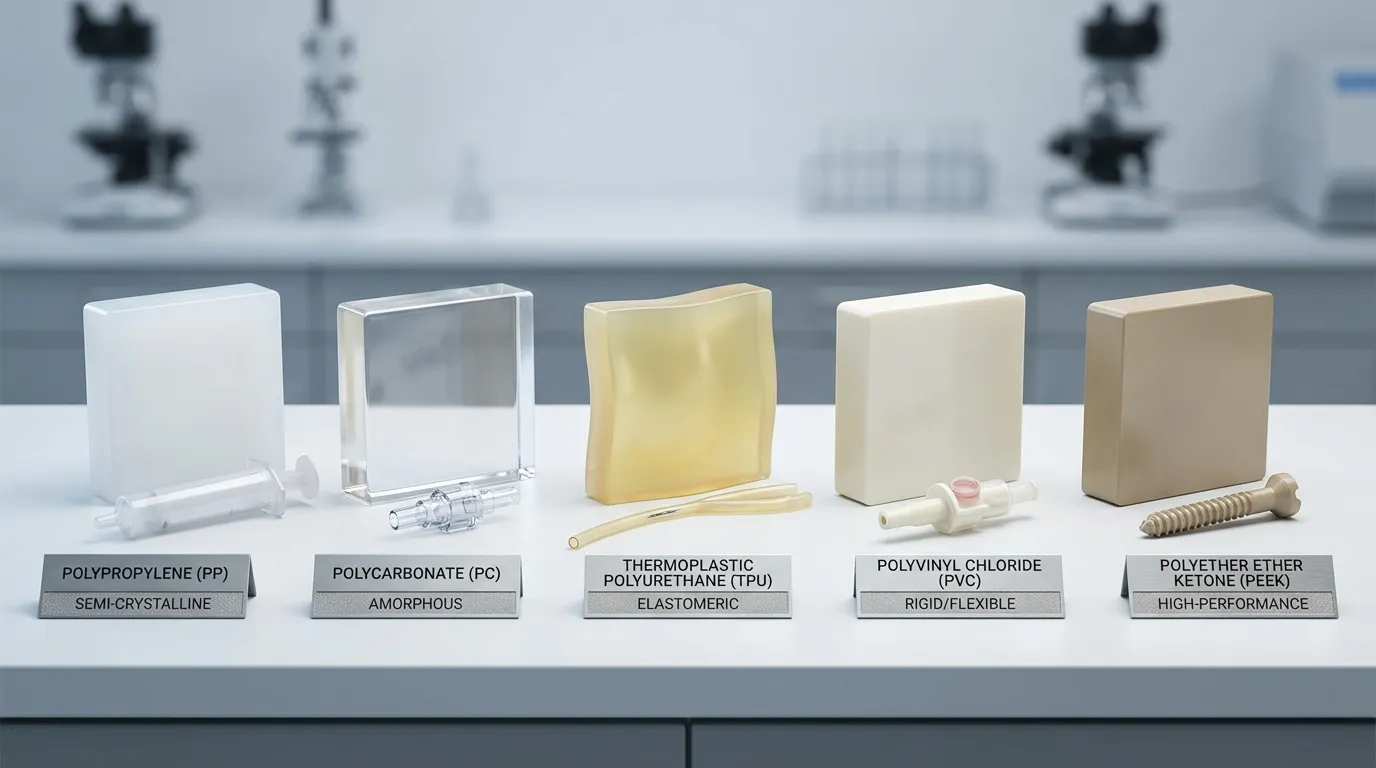
Polypropylen, Polycarbonat, PEEK, TPU, and PVC are among the most common medical injection molding materials. The right choice depends on sterilization method, Chemische Beständigkeit, Flexibilität, Stärke, transparency, and whether the part contacts the patient directly.
Material selection affects cost, Haltbarkeit, Sterilisationskompatibilität, and production speed. Medical-grade plastics are tested for manufacturing consistency and application suitability, especially in patient-contact environments.
A disposable syringe housing may prioritize low cost and gamma sterilization compatibility. A reusable surgical component may need higher heat resistance and dimensional stability. Choosing the wrong material can increase rejection rates or create sterilization problems later.
Wann sollte man Polypropylen in Medizinprodukten verwenden
Polypropylen (PP) is one of the most common medical molding materials because it balances cost, Chemische Beständigkeit, and production efficiency. It works well for disposable products such as syringes, specimen containers, and packaging components.
PP is not always the strongest option, but it performs well in high-volume production. For disposable devices, it often makes more sense than expensive engineering plastics.
Wenn Hochleistungskunststoffe wie PEEK Sinn machen
PEEK is used in demanding applications that require heat resistance, mechanical strength, or repeated sterilization cycles. It is common in advanced medical components and specialized surgical systems.
PEEK is not automatically the best choice. The material cost is much higher than polypropylene or polycarbonate. If the application does not require high-temperature performance or structural strength, a simpler resin may be more practical.
| Material | Sterilisationskompatibilität | Transparenz | Flexibilität | Chemische Widerstandsfähigkeit | Typische Verwendung |
|---|---|---|---|---|---|
| Polypropylen (PP) | Gut | Niedrig | Medium | Gut | Spritzen, Behälter |
| Polycarbonat (PC) | Gut | Hoch | Niedrig | Medium | Diagnostische Gehäuse |
| TPU | Moderat | Medium | Hoch | Gut | Katheterkomponenten |
| PVC | Gut | Medium | Medium | Gut | IV-Schläuche |
| PEEK | Ausgezeichnet | Niedrig | Niedrig | Ausgezeichnet | Chirurgische Komponenten |
Some suppliers also evaluate resin selection based on mold wear, cycle time, and long-term tooling maintenance. Sunshine Pros Medizinische Formmaterialien guide explains how tooling considerations can affect material performance.
What standards and regulations apply to medical molding?
Medical molding suppliers often work within ISO 13485 quality systems and follow FDA manufacturing expectations for process control, Rückverfolgbarkeit, documentation, and validation. Exact requirements depend on the medical device classification and target market.
Medical molding projects usually involve stricter documentation and process control than standard manufacturing. Suppliers may maintain validated production records, inspection reports, and material traceability throughout the project lifecycle.
Die FDA expects manufacturers to control production processes that affect medical device quality. Many suppliers also follow ISO 13485 quality-management systems to support consistency and traceability.
Grundlegende Checkliste zur Einhaltung der medizinischen Gussformen
- Rückverfolgbarkeit des Materialstücks
- Dokumentierte Inspektionsunterlagen
- Kontrollierte Prozesseinstellungen
- Validierungsverfahren
- Verpackungs- und Kontaminationskontrollen
- Dokumentation des Change-Managements
Warum Rückverfolgbarkeit in der medizinischen Herstellung wichtig ist
Traceability allows manufacturers to track which material batch and production lot produced each component. If a defect appears later, teams can isolate the affected production run more quickly.
This becomes important during recalls, audits, or customer complaints. Without traceability, manufacturers may need to quarantine much larger production volumes.
Do medical parts always require cleanroom molding?
Not every medical plastic part requires cleanroom molding. Cleanrooms are usually necessary when contamination control directly affects sterility, patient safety, Verpackungsintegrität, or regulatory requirements for the finished device.
Cleanrooms help reduce airborne particles, Kontamination, and environmental variation during production. They are common for sterile devices, implant-support components, and sensitive packaging applications.
Some buyers assume every medical component needs cleanroom production. That is not always true. Using a cleanroom without a contamination-driven requirement can increase manufacturing cost without adding practical value.
| If the Product Requires... | Reinraumbedarf |
|---|---|
| Sterile Verpackung | Üblicherweise erforderlich |
| Patientenkontaktflächen | Oft erforderlich |
| Einwegnicht-sterile Teile | Manchmal unnötig |
| Empfindliche diagnostische Baugruppen | Oft empfohlen |
| Nur kosmetische Kunststoffgehäuse | Das hängt vom Risikolevel ab |
Gängige Reinraumklassifikationen für medizinische Formen
Many suppliers use ISO cleanroom classifications to define environmental control levels. The required class depends on contamination sensitivity, assembly requirements, and customer specifications.
Zum Beispiel, catheter-related components packaged for sterile environments often need tighter contamination control than a non-sterile diagnostic equipment housing.
What quality checks matter most in medical injection molding?
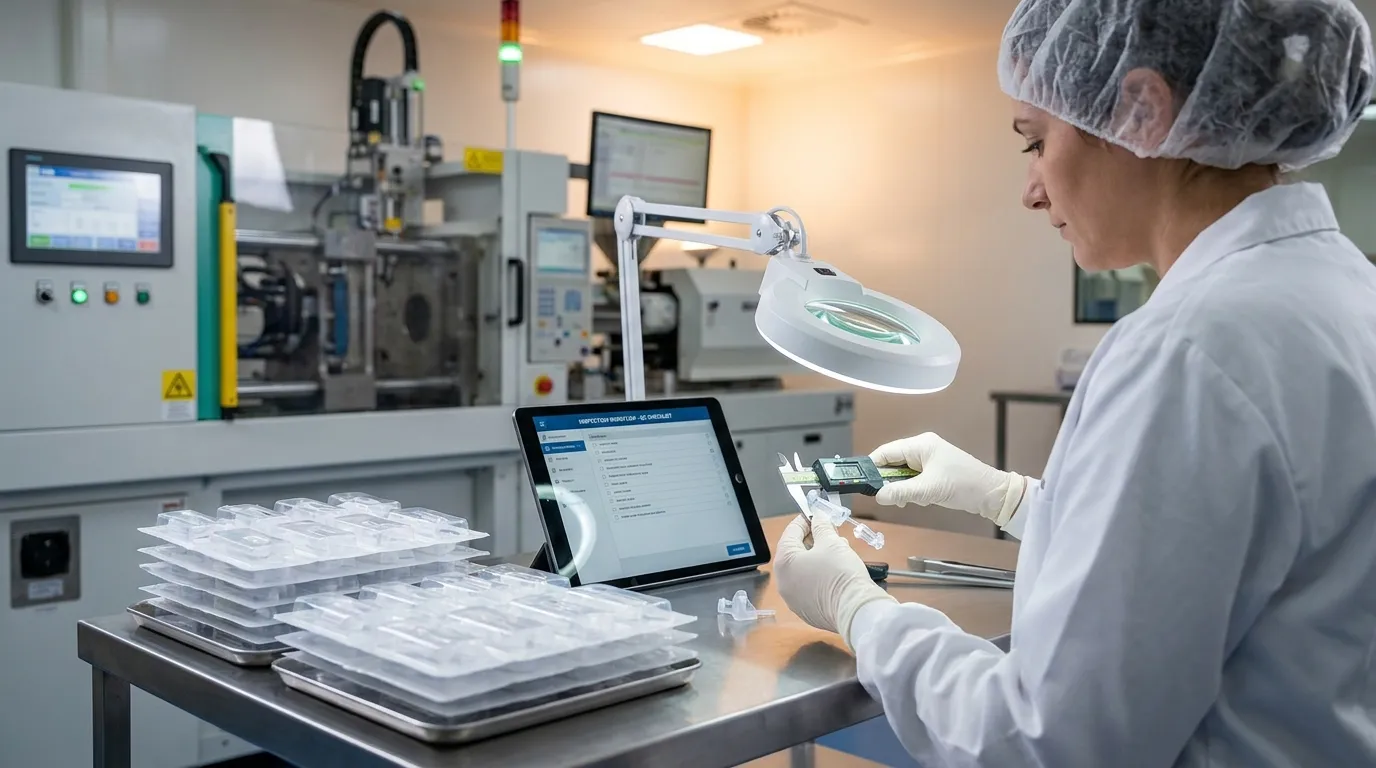
Medical injection molding quality control focuses on dimensional accuracy, Kontaminationsprävention, material traceability, Prozesskonsistenz, and documented inspection results. QC systems are designed to reduce patient risk and maintain repeatable production performance.
Medical molding quality checks begin before production starts. Teams often inspect incoming resin batches, verify material certifications, and confirm traceability records before molding begins.
Während der Produktion, inspectors monitor dimensions, Kosmetische Qualität, Flash, Sinkspuren, Kontamination, and assembly fit. First article inspection is common during setup approval and process validation stages.
Checkliste für medizinische Injektionsguss-Qualitätskontrolle
| QC-Schritt | Zweck |
|---|---|
| Eingehende Harzverifikation | Bestätigen Sie, dass das Material mit der Spezifikation übereinstimmt |
| Überprüfung der Nachverfolgbarkeit des Grundstücks | Serienserien der Streckenproduktion |
| Inspektion des ersten Artikels | Validierung von Startmaßen |
| Maßsinspektion | Toleranzen überprüfen |
| Oberflächeninspektion | Blitze oder Kontamination erkennen |
| Verpackungsinspektion | Vermeiden von Handhabungsschäden |
| Dokumentationsprüfung | Prozessaufzeichnungen bestätigen |
Häufige Formfehler, die Abstoßung verursachen
Flash, Kurzaufnahmen, Kontamination, burn marks, and dimensional variation are common rejection causes. A small defect can create sealing problems or assembly failures in medical products.
A catheter-related component is a good example. Even minor contamination inside the molded part can affect packaging integrity or downstream sterilization performance. That is why contamination-sensitive products often require tighter process controls.
Suppliers should also maintain documented inspection workflows. Sunshine Pros Schimmelinspektionspunkte guide explains how tooling condition and cavity performance affect part quality over time.
How are medical molds validated before production?
Medical mold validation confirms that tooling and processing conditions consistently produce compliant parts. Manufacturers commonly document installation qualification, operational qualification, and performance qualification before full production approval.
Validation helps confirm that the mold, machine settings, and production workflow can repeatedly produce acceptable parts. This process reduces variation before high-volume manufacturing begins.
Die FDA recommends process validation for manufacturing operations that affect product quality. In medical molding, validation usually follows a staged approval process.
Typischer Workflow zur Validierung medizinischer Formen
- Installation Qualification (IQ)
Teams verify that tooling, machines, and support systems are installed correctly. - Operational Qualification (OQ)
Engineers test process settings such as pressure, cooling time, and temperature ranges. - Performance Qualification (PQ)
Production runs confirm the process can consistently produce acceptable parts at normal operating conditions.
A tooling project can easily slow down if validation planning starts too late. One common issue is approving steel cutting before finalizing part geometry. If the customer changes dimensions after tooling begins, lead times can increase significantly.
Suppliers also need clear documentation during production transfers and shipping. Customs delays can affect launch schedules when paperwork or product classifications are incomplete.
For broader process guidance, Sunshine Pros Ablauf der Schimmelvalidierung resource explains how tooling and process planning fit together.
How should buyers evaluate a medical injection molding supplier?
Choosing a medical molding supplier involves more than checking machine capacity. Buyers should review validation capability, traceability systems, documentation practices, and contamination-control procedures before approving production.
Die ISO-Zertifizierung allein garantiert keine gute medizinische Formleistung. A supplier may hold certifications but still lack strong process validation or inspection discipline.
Checkliste zur Bewertung medizinischer Lieferanten
- ISO 13485 Qualitätsmanagementsysteme
- Validierungs-Workflow-Funktionalität
- Reinraumverfügbarkeit bei Bedarf
- Materialrückverfolgungsverfahren
- Erster Artikel-Inspektionsprozess
- Dokumentierte Änderungsmanagement-Kontrollen
- Produktionsvorlaufzeitplanung
- Verpackungs- und Versandkontrollen
Lead time management also matters. A shipment held at customs because of incomplete documentation can delay device launches and customer approvals. Suppliers should understand export paperwork, product classification, and medical-device shipping requirements before production begins.
Sunshine Pros Leitfaden zu Werkzeuge und Produktionsplanung explains how early planning decisions affect lead time, Werkzeugüberarbeitungen, and long-term manufacturing consistency.
Den nächsten Schritt richtig machen
Medical injection molding works best when material selection, validation planning, and quality control are aligned early in the project. Buyers who define inspection standards, contamination requirements, and traceability expectations before tooling begins usually avoid costly production delays later.
If you are evaluating suppliers, focus on process discipline instead of marketing claims alone. Ask how the supplier handles validation, inspection records, Materialverfolgung, and corrective actions. A strong medical molding partner should explain those systems clearly and support practical production decisions from sampling through full-scale manufacturing.
Häufig gestellte Fragen
Medical-grade plastic is a polymer tested for consistency and suitability in healthcare applications. The exact requirements depend on whether the material contacts patients, drugs, or sterile environments.
Polypropylen, Polycarbonat, TPU, PVC, and PEEK are common medical molding materials. The best option depends on sterilization needs, Flexibilität, Chemische Beständigkeit, and mechanical performance.
Nein, not every medical component requires cleanroom molding. Cleanrooms are mainly used when contamination control affects sterility, patient safety, or sensitive packaging requirements.
Many medical molding suppliers follow ISO 13485 quality systems and FDA manufacturing expectations. The exact requirements depend on device classification and target market regulations.
Flash, Kurzaufnahmen, Sinkspuren, Kontamination, and dimensional variation are common molding defects. These problems can affect assembly fit, Sterilität, or device performance.
Production timelines vary based on tooling complexity, Validierungsanforderungen, and sampling approvals. Tooling and validation can take weeks or several months depending on project scope.
Tooling revisions, failed validation runs, customs delays, and incomplete documentation commonly slow medical molding projects. Design changes after tooling approval can also extend production timelines significantly.
Freigeben:



Geschrieben von Sunshine
Bei Sunshine, Wir sind ein professioneller Hersteller und Lieferant von Präzisionsformkomponenten, bietet ein breites Produktsortiment für Stange- und Spritzgussanwendungen. Unser Kernfokus liegt auf dem Stanzen von Stempeln, Auswurfstifte und -hülsen, sowie Führungspfosten und Buchsen. Mit fortschrittlicher CNC-Bearbeitung, Strenge Qualitätskontrolle, und starke Produktionskapazitäten, Wir sorgen für Zuverlässigkeit, Hochpräzisionsteile, zusammen mit vorrätigen Standardkomponenten für schnelle und effiziente weltweite Versorgung.
NACHRICHTEN
EMPFANG SERVICE
Mit hochwertigen Teilen für jedes Budget und freundlichem Personal, das geschult ist, um Ihren Besuch informativ und unkompliziert zu gestalten.
