



Formbegrenzungsstifte für Automobilformen: Last, Verschleiß, und Präzision
Mold limit pins for automotive molds act as mechanical stops. They establish or restrict the travel of an ejector plate, Slider, side action, or another moving mold component. Their performance depends on more than pin diameter or material. The stopped mechanism, Kontaktgeschwindigkeit, pin support, Verbindungsfläche, Lastverteilung, and required endpoint all affect the result.
Limitstifte gehören zu einem größeren System von Formstandardteile (Schlussfolgerung), but they should not be selected using broad catalog criteria alone. A suitable stop must carry the intended reaction without bending, Lockerung, damaging the mating plate, or gradually changing the mechanism’s final position.
There is no universal pin diameter, Härte, Passform, or replacement interval for every automotive mold. Selection starts by defining the movement being controlled.
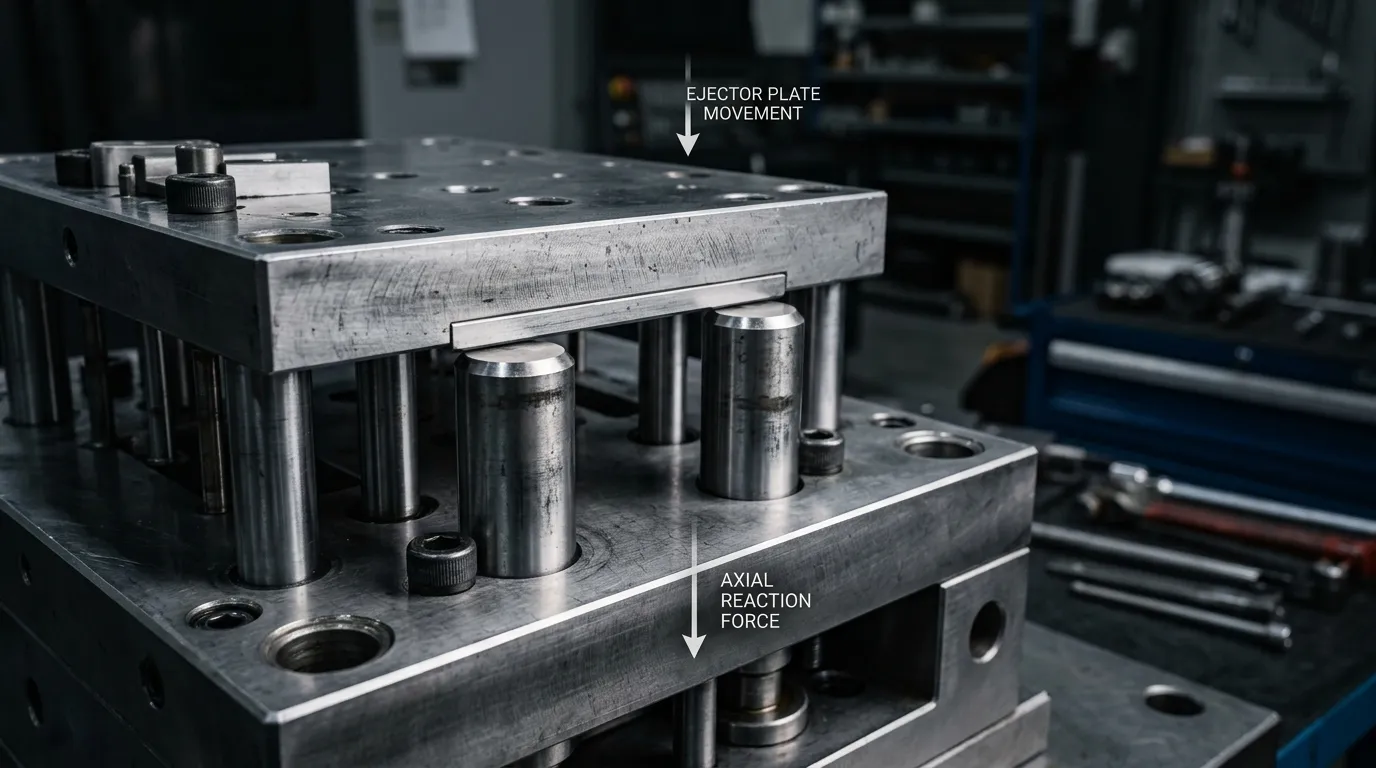
Was ein Schimmelbegrenzungsstift kontrolliert – und was er nicht kontrolliert
A mold limit pin is a fixed mechanical stop. When the moving mold component reaches the designed endpoint, it contacts the pin or a surface supported by the pin. The stop reaction then passes into the mounting plate and surrounding mold structure.
“Limit pin” and “stop pin” are often used for similar components, but supplier terminology is not always consistent. The drawing should therefore state the actual function:
- which component moves;
- the direction of movement;
- the required endpoint;
- which surfaces make contact;
- whether the stop sees gradual loading or repeated impact.
A limit pin should also be separated from other cylindrical mold components.
| Komponente | Hauptfunktion | Typische Interaktion | Hauptanliegen der Auswahl |
|---|---|---|---|
| Limit-Pin oder Stopp-Pin | Begrenzt die Reise an einem definierten Endpunkt | Bewegliche Platte oder Mechanismus berührt den Stopp | Kontaktlast, Unterstützung, Verschleiß, and effective stop length |
| Leitstift und Buchse | Führt und richtet die Formabschnitte während der Bewegung aus und richtet sie aus. | Der Führungsbolzen greift in die passende Buchse ein | Trasse, Verlobung, Freigabe, lubrication, und Verschleiß |
| Auswurfbolzen | Schiebt das geformte Bauteil aus dem Hohlraum oder Kern | Die Stiftfläche berührt das geformte Teil | Ejection force, Platzierung, surface marks, und Erhaltung |
| Rückgabestift | Gibt die Auswurfbaugruppe zurück oder setzt sie zurück | Das Schließen der Form oder ein Rücklaufmechanismus bewegt das Auswurfsystem zurück | Return stroke, Interferenz, and reliable reset |
| Limit Block | Bietet einen breiteren mechanischen Stopp | Die Platte oder der Mechanismus berührt eine größere Registerfläche | Kontaktbereich, space, Unterstützung, and replacement access |
Guide pins and bushings are responsible for guided mold movement and mold-half alignment. Their design belongs to the separate subject of Formstifte und Buchsen. A limit pin may help maintain a repeatable mechanism endpoint, but that does not make it a substitute for a guide system.
Definieren Sie den Mechanismus der Automobilform, bevor Sie den Stopp auswählen
The first design question is not “Which pin size should be used?” It is “What movement must be stopped?”
An automotive mold may contain several moving systems, each with different loading conditions:
- an ejector plate reaching the end of its stroke;
- a slider reaching its open or closed position;
- a side-action mechanism stopping after core withdrawal;
- a moving support or auxiliary plate reaching a controlled endpoint.
Before selecting a stop, Definieren Sie:
- The moving component and its direction of travel.
- The total stroke and required final position.
- The moving mass.
- The expected velocity when contact occurs.
- Any hydraulic, Frühling, Maschine, or mechanical force still acting at the endpoint.
- The number and location of stop points.
- The available plate thickness and pin support depth.
- The mating-surface material and contact geometry.
- Access for installation, Inspektion, Anpassung, und Ersatz.
- Any OEM, Tier, or customer-specific tooling requirements.
Automotive customer specifications may set their own rules for mechanical stops, Verschleißplatten, Führungssysteme, movement controls, Materialien, or documentation. Those requirements should be checked before generic design guidance is applied.
Auswurfplatten-Stopps
An ejector plate is usually broad and relatively stiff, but it may still deflect under load. If several limit pins are used, their position and effective height affect how the plate reaches the endpoint.
A practical ejector-plate stop arrangement should consider:
- whether the stops are distributed around the loaded area;
- whether the plate can contact all stops at nearly the same time;
- whether one region of the plate bends before another;
- whether the stop reaction is transferred into adequately supported mold structure;
- whether the pins remain accessible after assembly.
If one pin is slightly taller or better supported than the others, it may contact first and carry a disproportionate part of the reaction.
Slider, Side-Action, and Moving-Plate Stops
Horizontal or angled mechanisms introduce additional concerns. A stop pin may receive side load if the slider is not guided correctly or if the contact faces are not square to the direction of travel.
For these mechanisms, Verifizieren:
- whether the stop controls the open or closed position;
- whether the contact is axial or angled;
- whether a wear plate or replaceable insert is needed;
- whether an adjustable endpoint is required;
- whether dirt, Schmiermittel, or molding residue can enter the contact area;
- whether the stop can be inspected without major disassembly.
The guide system should control the path of the slider. The stop should control its endpoint. Combining both functions in one unsupported pin increases the risk of bending and uneven wear.
Wie die Last durch das Limit-Pin-System reist
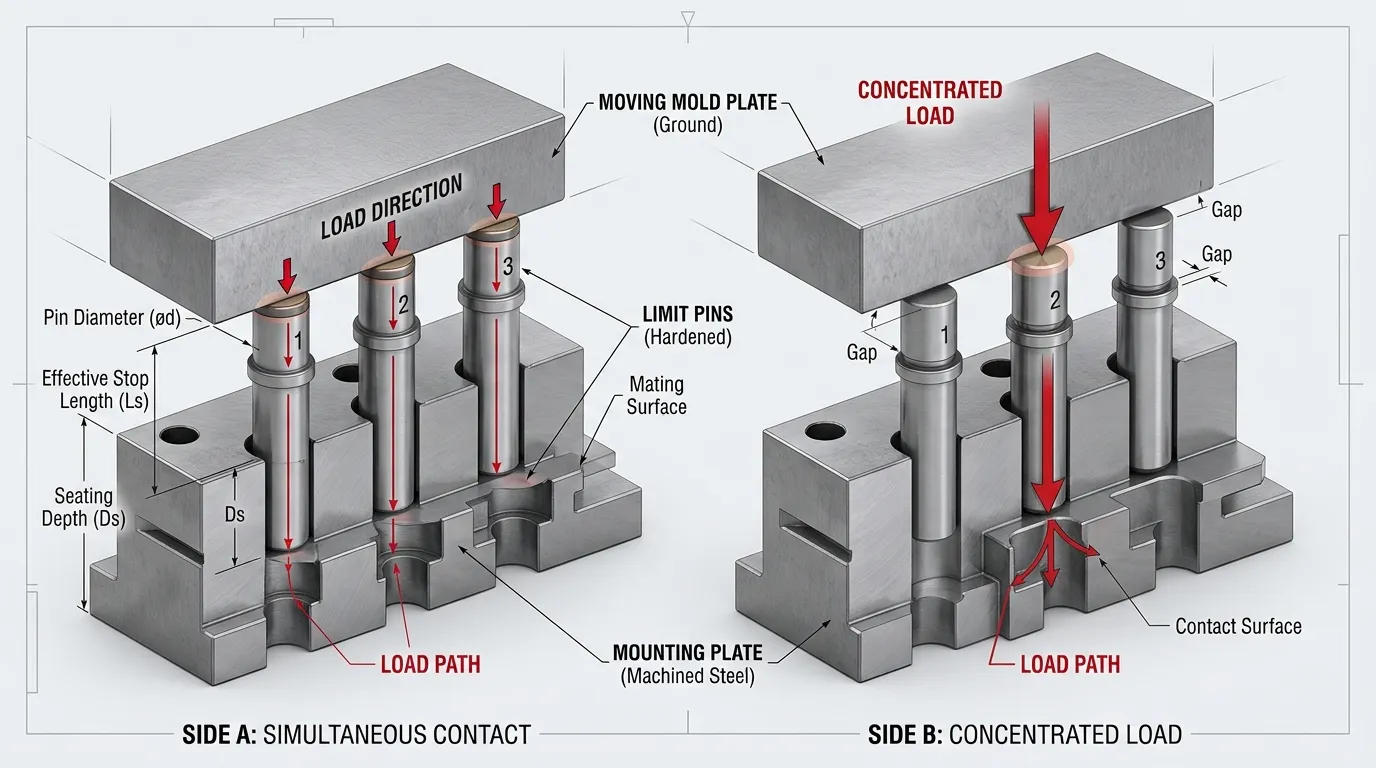
A limit pin does not carry load independently. It is one part of a load path:
Beweglicher Mechanismus → Kontaktfläche → Begrenzungsstift oder Stopp → Stiftsitz → Befestigungsplatte → Formstruktur
Every part of that path must support the reaction.
A pin loaded directly along its axis mainly sees compression. A pin contacted off-center or at an angle may also see bending. Bending becomes more significant when the exposed length is large, the mounting support is shallow, or the contact force is not aligned with the pin axis.
The mating surface matters as much as the pin. A small pin end creates a concentrated contact area. Even when the pin itself remains intact, the opposing plate may indent or wear. That indentation changes the effective stopping position.
The surrounding plate must also be stiff enough to support the stop. A strong pin mounted in a thin or flexible plate may still produce inconsistent contact because the plate deflects.
Statischer Kontakt versus Aufprall am Endschlag
A mechanism that settles gradually against a stop creates a different condition from one that strikes the stop at speed.
| Kontaktbedingung | Hauptmerkmale | Selektionsbedenken |
| Allmählicher oder statischer Kontakt | Die Last steigt langsam an und kann am Endpunkt verbleiben | Kompression, Plattenstütze, long-term indentation, und Stabilität |
| Wiederholter Aufprall | Die bewegte Masse erreicht den Stopp mit messbarer Geschwindigkeit | Impact severity, Zähigkeit, Lockerung, Verformung, and mating-surface damage |
| Kontrollierter oder gedämpfter Kontakt | Die Bewegung wird verlangsamt, bevor sie den mechanischen Stopp erreicht | Residual force, control reliability, and emergency stop capacity |
Moving mass and contact velocity influence the energy reaching the stop. Deceleration distance, Dämpfung, machine control, and structural flexibility also affect the contact condition. A final pin design should not be approved from static force alone when repeated impact is possible.
Warum mehrere Limit-Pins die Last nicht gleichmäßig teilen
Using four stops does not guarantee that each carries one quarter of the load.
Unequal sharing can result from:
- small differences in effective pin height;
- uneven seating;
- Plattenablenkung;
- non-parallel contact surfaces;
- asymmetric stop placement;
- different support stiffness beneath each pin;
- wear or indentation at one contact point.
The tallest or stiffest-supported pin may contact first. It then begins carrying load before the other stops engage. Im Laufe der Zeit, this can create a repeating pattern: one pin wears or indents faster, the endpoint shifts, and the remaining pins begin contacting under different conditions.
Effective stop height, Sitzplätze, Plattensteifigkeit, and contact pattern should therefore be evaluated together.
Geometrie, Material, and Fit Determine Wear and Endpoint Stability
Catalog dimensions describe the part, but they do not fully describe its performance. Durchmesser, Effektive Länge, exposed length, Montagenaht, Kontaktgeometrie, Materialzustand, and the opposing surface all influence the stop.
Durchmesser, Effective Length, and Unsupported Length
Several dimensions have different functional roles:
| Dimension oder Merkmal | Funktionaler Effekt |
| Stiftdurchmesser | Influences stiffness, bearing area in the mounting hole, and resistance to bending |
| Gesamtlänge | Definiert die Gesamtgröße der Komponenten, muss aber nicht der funktionalen Stoppdimension entsprechen |
| Effektive Registerlänge | Kontrolliert den Endpunkt des Endmechanismus |
| Nicht unterstützte Länge | Einflüsse, die Empfindlichkeit und Starrheit beugen |
| Sitztiefe | Beeinflusst Unterstützung und Positionsstabilität |
| Endgeometrie | Kontrolliert Kontaktfläche und lokalen Druck |
| Schulter- oder Retentionsmerkmal | Affects seating, Montage, Entfernung, and repeat positioning |
A long pin with a small exposed diameter is more sensitive to lateral force than a short, well-supported pin of the same material. Increasing hardness alone does not correct an unfavorable load direction or excessive unsupported length.
The mounting-hole fit also needs to match the intended service method. A permanently retained pin, a replaceable maintenance item, and an adjustable stop do not require the same mounting arrangement.
Härte, Zähigkeit, and the Mating Surface
Hardness can improve resistance to indentation and abrasive wear, but it is not the only material property that matters. Repeated impact also requires adequate toughness. A harder component is not automatically a safer component if it becomes more sensitive to cracking or transfers damage into a softer plate.
The pin and mating surface should be treated as a contact pair. Check:
- pin material and heat-treated condition;
- pin hardness;
- mating-surface material and hardness;
- end-face contact area;
- contact angle;
- expected impact severity;
- whether the mating surface is replaceable.
A hardened wear plate or replaceable insert may be more practical than allowing the stop to contact an expensive mold plate directly. It can localize wear in a serviceable component, provided the insert is adequately supported and secured.
Heat treatment should be defined by the required material condition, not by a generic claim that heat-treated parts are always better. The target hardness, treatment method, distortion control, and verification requirements should be stated where they are functionally important.
Fit, Sitzplätze, and Functional Precision
For a limit pin, useful precision means the mechanism reaches a stable, repeatable endpoint. That result depends on more than a tight diameter tolerance.
Important factors include:
- the pin’s effective stop length;
- Montagenaht;
- full seating against the reference surface;
- perpendicularity of the pin to the contact direction;
- flatness and condition of the opposing surface;
- height consistency between multiple stops;
- resistance to loosening;
- repeatability after replacement.
Die ISO-286-System für Toleranzen und Passungen provides standardized terminology for linear-size tolerances and hole-and-shaft relationships. It does not identify one universal fit for every limit pin. The required fit depends on retention, Ersatz, Laden, Temperatur, Plattenmaterial, und Wartungsbedarf.
Surface texture should also be specified only where it affects fit, Kontakt, Messung, oder tragen. Broader information about tolerance, Stahl, and inspection planning belongs with Präzisionsformteile.
Verschleißmuster zeigen, wo das Stoppsystem versagt
A worn pin is often a symptom of a wider stop-system problem. Visual damage should be treated as evidence to investigate, not as a complete diagnosis.
| Beobachtung | Mögliche Mitwirkende | Funktionales Risiko | Was zu überprüfen ist |
| Endflächen-Einkerbung | High local contact pressure, soft material condition, Auswirkungen, small contact area | Verringerte effektive Anschlaghöhe | Kontaktbereich, Härte, impact condition, Verbindungsfläche |
| Pilz-Pin-Ende | Plastische Verformung durch konzentrierte oder wiederholte Belastung | Geänderter Endpunkt und schwierige Entfernung | Material condition, Auswirkungsschwere, Endgeometrie |
| Gebogener Stift | Seitenladung, off-axis contact, Übermäßige ununterstützte Länge, Schlechte Führung | Fehlausrichtung des Kontakts und instabiler Endpunkt | Lastrichtung, support depth, Führungszustand |
| Einseitige Abnutzung | Tilted contact, Seitenbelastung, Plattenablenkung, Schlechte Sitzplätze | Ungleichmäßige Lastübertragung | Kontaktmuster, Senkrecht, Plattensteifigkeit |
| Punktewertung | Gleitkontakt, Kontamination, Fehlstellung, raue Verbindungsfläche | Beschleunigter Verschleiß und möglicher Krampffall | Contact direction, Trümmer, lubrication, Oberflächenzustand |
| Loser Stift | Incorrect fit, Wiederholter Aufprall, damaged mounting hole, poor retention | Endpunktbewegung und weitere Plattenschäden | Mounting fit, hole condition, Retentionsmethode |
| Einvertiefte Verbindungsplatte | Pin harder than the opposing surface, small contact area, Unzureichende Unterstützung | Endpunktdrift selbst wenn der Pin akzeptabel erscheint | Plattenhärte, insert condition, Unterstützung, Kontaktgeometrie |
| Ungleichmäßige Abnutzung zwischen mehreren Nadeln | Height mismatch, unequal support, Plattenablenkung | Eine Haltestelle trägt zuerst die Last | Effective heights, Sitzplätze, Abstand, contact sequence |
Wear changes the geometry of the stop system. Material loss from the pin, indentation in the mating surface, or movement inside the mounting hole can all alter the final position without producing a complete fracture.
Replacement should therefore be based on functional condition, Dimensionsänderung, Kontaktmuster, and application requirements—not a universal number of molding cycles.
Choose the Right Stop Architecture: Pin, Block, or Adjustable Stop
A cylindrical limit pin is useful when space is limited, the contact direction is controlled, and the required endpoint can be established with a fixed component. It is not automatically the best stop for every mechanism.
| Stoppoption | Am besten geeignet für | Hauptvorteile | Hauptbeschränkungen |
| Fester Grenzstift | Kompakt, defined stop points with controlled axial contact | Einfache Geometrie, replaceable, available in standard or custom forms | Limited contact area; sensitive to side load and support conditions |
| Limit Block | Breiterer Kontakt oder höherer Bedarf an Lastverteilung | Larger contact area, robust support, easier use of replaceable wear faces | Benötigt mehr Platz und präzise Montageflächen |
| Verstellbarer Register | Endpunkt, der Einrichtung oder kontrollierte Korrektur erfordert | Ermöglicht eine Positionsanpassung während des Werkzeugaufbaus oder der Wartung | Needs secure locking, Zugang, and verification after adjustment |
| Verschleißeinsatz mit Stopp | Teure Platte, die eine wartbare Kontaktfläche erfordert | Schützt die Hauptplatte und vereinfacht die Wartung | Adds components, attachment requirements, and tolerance interfaces |
Sensors or switches may confirm that a mechanism reached a position, but position detection does not automatically replace a correctly designed mechanical stop. The control and mechanical systems should have clearly defined roles.
Wann ein Standard-Pin ausreicht – und wann eine Anpassung gerechtfertigt ist
A standard pin may be suitable when its geometry, Materialzustand, Passform, Effektive Länge, Kontaktgesicht, and replacement method match the mold requirement.
Customization may be justified when the application needs:
- a non-standard effective length;
- a special shoulder or mounting feature;
- a larger or shaped contact end;
- a specified material or heat-treated condition;
- tighter control of a functional dimension;
- replacement compatibility with an existing mold;
- customer-specific documentation;
- improved installation or removal access.
Custom does not automatically mean better. It is justified when the standard component cannot satisfy the defined function without compromise.
Was man auf die Zeichnung oder die Ausschreibung schreiben sollte.
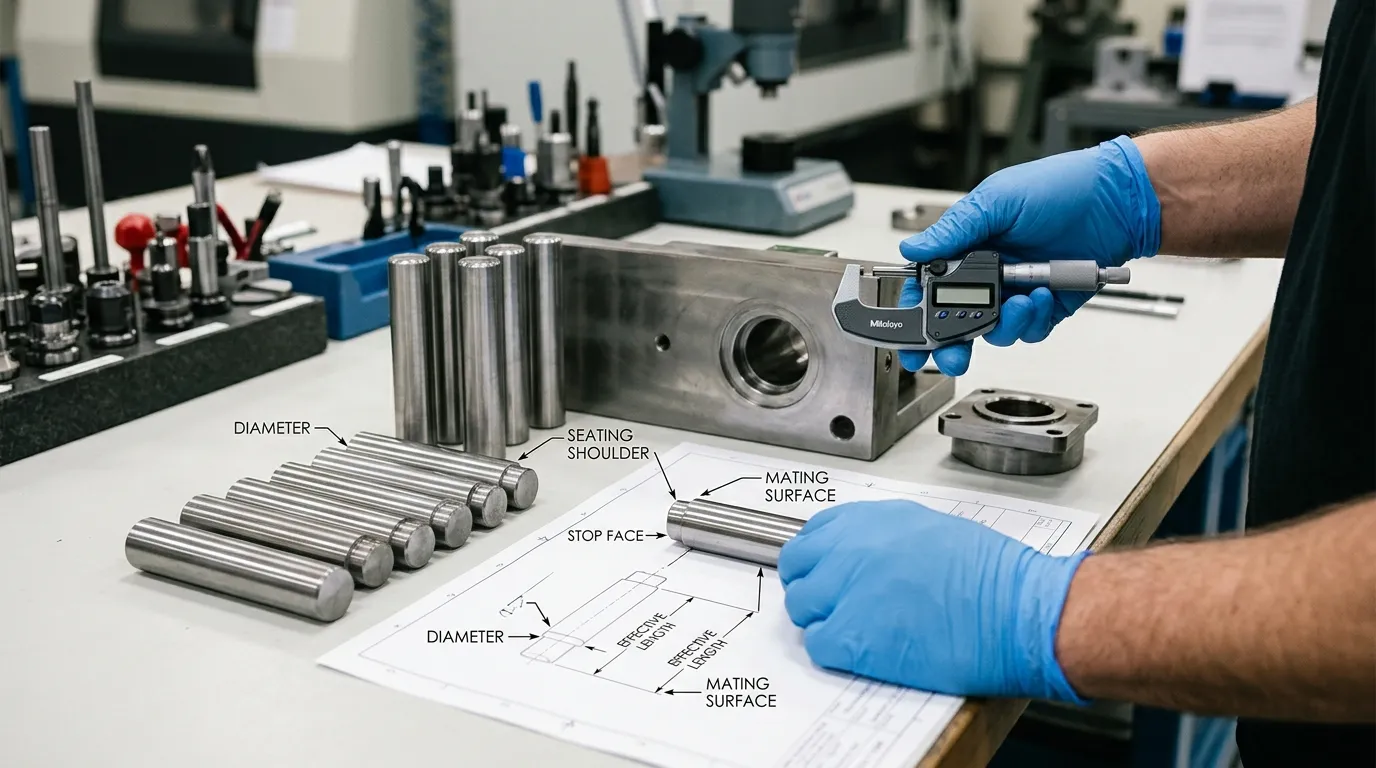
A useful RFQ should describe both the part and the mechanism in which it will operate. Sending only a nominal diameter and length leaves important engineering decisions undefined.
Anwendungsinformationen
Einbeziehen:
- type of moving mechanism;
- stopped component;
- direction of travel;
- total stroke;
- required final position;
- bewegte Masse;
- expected contact velocity or impact condition;
- external hydraulic, Frühling, Maschine, or mechanical force;
- number and spacing of stops;
- operating temperature and contamination conditions where relevant;
- applicable automotive customer or tooling specification.
Komponentendefinition
Spezifizieren:
- Stiftdurchmesser;
- total length;
- effective stop length;
- unsupported or exposed length;
- Endgeometrie;
- shoulder and seating dimensions;
- mounting-hole relationship;
- fit or retention requirement;
- removal feature if replacement is expected;
- geometric controls needed for seating or contact.
Material- und Prozessanforderungen
State:
- material grade and condition;
- heat-treatment requirement;
- target hardness where justified;
- functional surface requirements;
- mating-surface material and hardness;
- need for a wear plate or replaceable insert.
Inspektion und Dokumentation
Depending on the project, request:
- dimensional inspection results;
- Härteverifikation;
- Materialdokumentation;
- drawing revision control;
- part or batch identification;
- first-article or sample approval;
- confirmation of replacement interchangeability;
- customer-specific automotive records.
IATF 16949 concerns automotive quality-management systems. Certification may support process control, but it does not prove that a particular limit-pin geometry, Material, or load rating is correct for the mold.
SunshinePro states that it supports custom mold parts based on customer drawings and lists standard and non-standard mold limit pin options. Its published Mold Limit Pin configuration uses S45C, with stated diameter and length tolerances, 15–17 HRC hardness, Präzisionsschleifen, und Vakuumwärmebehandlung. These are product-page specifications, not universal design criteria for every automotive application.
The listed configuration should be checked against the actual mechanism load, Unterstützung, Verbindungsfläche, Passform, endpoint requirement, and customer specification. Readers who have completed these checks can review SunshinePro’s Möglichkeiten für Schimmelbegrenzungsstifte oder Reichen Sie eine Zeichnung und Bewerbungsanforderungen ein for quotation.
Freigeben:



Geschrieben von Sunshine
Bei Sunshine, Wir sind ein professioneller Hersteller und Lieferant von Präzisionsformkomponenten, bietet ein breites Produktsortiment für Stange- und Spritzgussanwendungen. Unser Kernfokus liegt auf dem Stanzen von Stempeln, Auswurfstifte und -hülsen, sowie Führungspfosten und Buchsen. Mit fortschrittlicher CNC-Bearbeitung, Strenge Qualitätskontrolle, und starke Produktionskapazitäten, Wir sorgen für Zuverlässigkeit, Hochpräzisionsteile, zusammen mit vorrätigen Standardkomponenten für schnelle und effiziente weltweite Versorgung.
NACHRICHTEN
EMPFANG SERVICE
Mit hochwertigen Teilen für jedes Budget und freundlichem Personal, das geschult ist, um Ihren Besuch informativ und unkompliziert zu gestalten.
