



Formersatzteile: Was man lagern sollte, um Ausfallzeiten zu reduzieren
Mold spare parts such as ejector pins, Quellen, Führungsbuchsen, and wear inserts should be kept in stock to reduce production downtime. The right inventory depends on failure frequency, replacement lead time, and mold cycle volume. Critical spare components with long shipping or customs delays should always have backup inventory available before failure occurs.
Unexpected mold downtime usually starts with a small component failure. A worn ejector pin or damaged spring can stop production for hours, sometimes days, if replacement parts are not available. That’s why maintenance and procurement teams need a practical spare-parts strategy, not just a supplier contact list. This guide explains which mold components deserve shelf space, how to prioritize inventory, and where stocking decisions often go wrong.
Which mold spare parts should always be kept in stock?
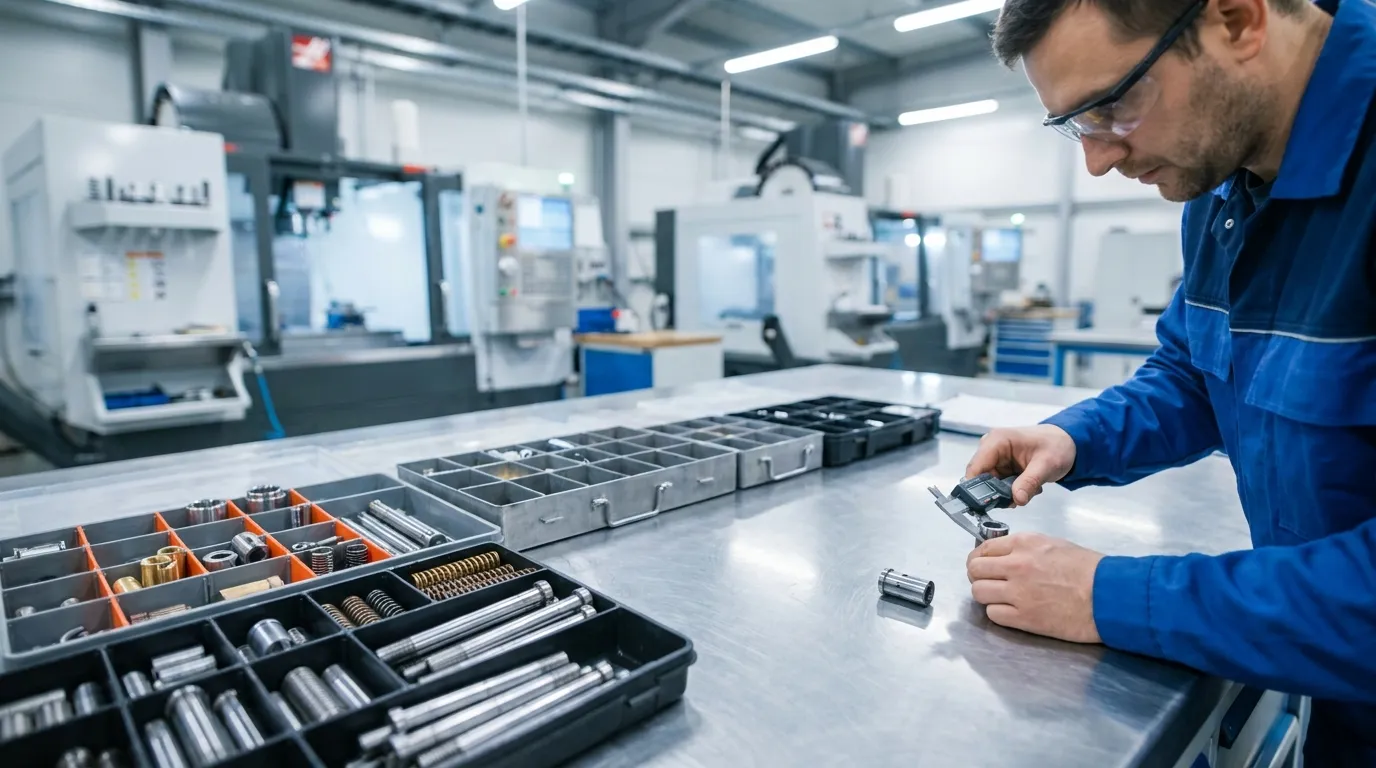
The most important mold spare parts to keep in stock are ejector pins, Quellen, Buchsen, Leitkomponenten, and wear inserts. These parts experience frequent wear and can stop production immediately if replacements are unavailable.
The best spare inventory focuses on components with high wear rates and short replacement windows. Small parts often create the biggest downtime risk because they fail more often than structural mold components. If production depends on one mold running continuously, even a low-cost part can become a serious bottleneck.
Most maintenance teams start with consumable components from their regular service schedule. These parts are easier to predict because wear patterns appear after repeated production cycles.
Prioritäts-Checkliste für Ersatzteile für die Gussform
- Auswurfstifte
- Quellen
- Führungsbuchsen
- Leitfäden
- Verschleißeinsätze
- Hüllen
- Standardbefestigungen
- O-Ringe und Dichtungen
A high-volume automotive mold may replace ejector pins every two months due to constant cycling pressure. Keeping several matched replacements on-site prevents emergency downtime and avoids rushed machining work.
Nicht jedes Formteil benötigt einen Ersatzbestand. Expensive structural parts with low failure rates are often better ordered on demand. For standard replacement items, keeping a dedicated stock of Standardgussteile usually provides faster recovery when failures happen unexpectedly.
For broader mold structure planning, das Vollständiger Leitfaden für Formkomponenten explains how these systems work together inside the mold assembly.
What mold components fail most often during production?
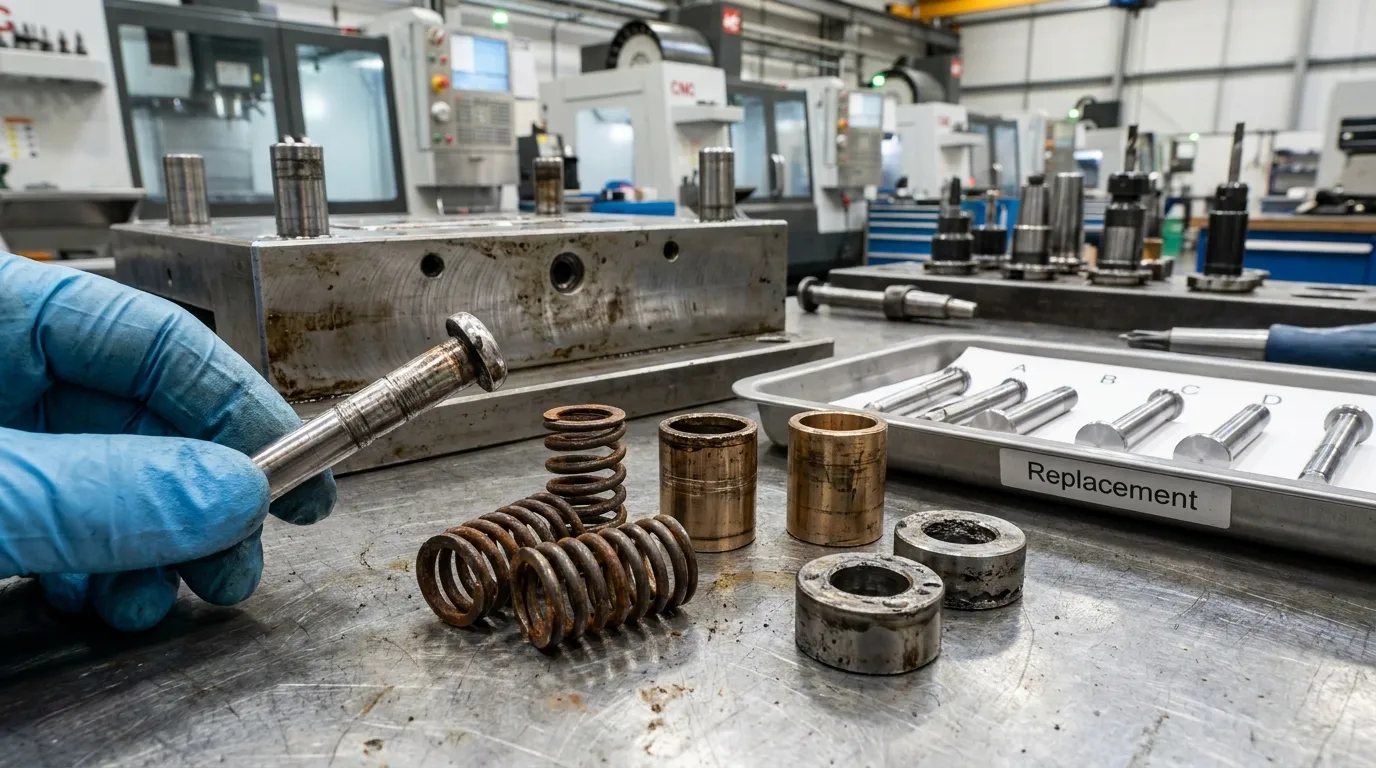
Ejektorsysteme, Leitkomponenten, and springs are among the most commonly replaced mold spare parts because they operate under repeated stress, Reibung, and alignment pressure during every production cycle.
Production molds run through thousands or even millions of cycles. Repeated motion creates friction, Hitze, and alignment wear. Im Laufe der Zeit, small dimensional changes can affect part quality or stop the mold completely.
The most failure-prone components are usually moving parts. Springs lose tension, guide bushings wear unevenly, and ejector systems develop alignment problems after long production runs.
| Bestandteil | Häufige Ursache des Scheiterns | Ausfallrisiko | Ersatzfrequenz |
|---|---|---|---|
| Auswurfstifte | Reibung und Biegung | Hoch | Häufig |
| Quellen | Ermüdungs- und Kompressionsverlust | Hoch | Häufig |
| Führungsbuchsen | Abnutzung der Achsverschluss | Mittel-hoch | Moderat |
| Verschleißeinsätze | Oberflächenabschleiß | Medium | Moderat |
| Hüllen | Wärme und Reibung | Medium | Moderat |
A maintenance team running high-cycle packaging molds reduced stoppages after stocking extra springs and wear inserts locally. Before that change, replacement delays regularly interrupted weekend production shifts.
Cheap aftermarket replacements are not always cost-effective. Poor tolerance control can create alignment issues and increase wear on nearby components. Precision matters, especially for moving assemblies and tight-clearance molds. Choosing reliable Präzisionsformkomponenten helps maintain stable production over longer cycles.
Which spare parts are critical versus optional?
Critical mold spare parts are components that can stop production immediately when they fail. Optional spare parts may reduce efficiency or quality but usually do not shut down the entire mold.
The smartest inventory plans separate critical components from lower-risk replacements. This prevents overspending while still protecting production capacity. A low-cost part with high downtime risk deserves more attention than an expensive component that rarely fails.
Critical spare parts should always be available locally if replacement lead times are unpredictable. Optional components can often be ordered after wear is detected during maintenance inspections.
Kritische vs. optionale Ersatzteile
| Bauteiltyp | Produktionsauswirkungen | Typische Besetzungspriorität |
|---|---|---|
| Ejektorsysteme | Einstellung der Produktion | Hoch |
| Quellen | Stoppt die Bewegung der Schimmel | Hoch |
| Führungskomponenten | Verursacht Ausrichtungsprobleme | Hoch |
| Verschleißeinsätze | Kann die Qualität zuerst verringern | Medium |
| Strukturplatten | Seltenes sofortiges Scheitern | Niedrig |
| Kosmetische Zierteile | Begrenzter Einfluss auf die Produktion | Niedrig |
A delayed imported guide bushing shipment once forced a molding facility to pause production for several days. The replacement itself was inexpensive, but the lost production time cost far more than maintaining backup inventory.
Fast supplier delivery is not a replacement for critical spare inventory. Shipping disruptions, supplier delays, and customs reviews can still interrupt production unexpectedly. Keeping backup Formersatzteile for high-risk components gives maintenance teams more control during urgent repairs.
How many mold spare parts should you keep?
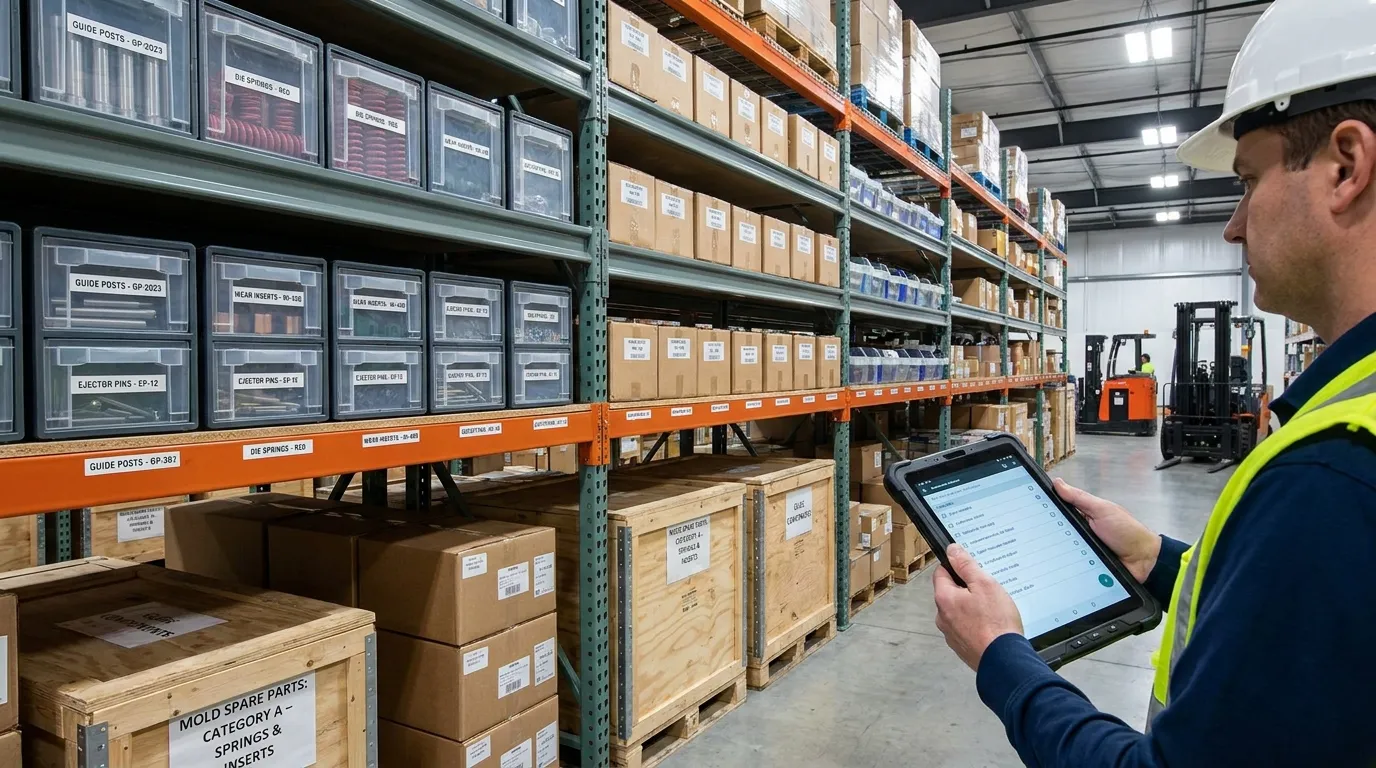
The right spare inventory depends on cycle volume, lead time risk, und Ersatzfrequenz. High-cycle molds and imported components usually require larger backup inventory.
There is no universal inventory number for every mold. A low-volume mold used once a month needs a different stocking strategy than a mold running continuously across multiple shifts. Maintenance history usually gives the clearest answer.
Supplier reliability also matters. If replacement parts consistently arrive within days, inventory requirements stay lower. If imported components take weeks to replace, keeping additional stock becomes safer.
Wenn ein Backup-Teil genug ist
- Die Komponente fällt selten aus
- Lokale Lieferanten können schnell versenden
- Die Form hat ein geringes Produktionsvolumen
- Die Ausfallzeitkosten sind handhabbar
Wenn mehrere Ersatzmaßnahmen notwendig sind
- Der Schimmel läuft täglich
- Fehler passieren regelmäßig
- Komponenten werden importiert
- Produktionsverträge haben strenge Fristen
- Die Ausfallzeitkosten übersteigen die Wiederbeschaffungskosten
A procurement manager tracking supplier performance noticed imported sleeves regularly exceeded quoted lead times. After calculating average delays, the company increased safety stock from one sleeve to four units for each active mold.
Prioritätstabelle für kritische Ersatzteile
| Bestandteil | Ausfallfrequenz | Risiko der Vorlaufzeit | Empfohlene Backup-Menge |
|---|---|---|---|
| Auswurfstifte | Hoch | Medium | 5-10 |
| Quellen | Hoch | Niedrig | 10-20 |
| Führungsbuchsen | Medium | Hoch | 2-4 |
| Verschleißeinsätze | Medium | Medium | 2-3 |
| Hüllen | Medium | Hoch | 2-4 |
Using maintenance history with supplier lead times gives more accurate stocking decisions than guessing. Teams working with specialized Formpräzisionskomponenten often review inventory every quarter to adjust for wear trends and supplier changes.
How do customs and shipping delays affect mold spare inventory?
Customs inspections, international freight delays, and compliance reviews can extend mold spare-part delivery times unexpectedly. Keeping critical components in stock reduces the risk of long production stoppages.
Many mold components move through international supply chains before reaching production facilities. Delays can happen during customs inspections, freight congestion, or document verification. Recent customs compliance updates have increased review pressure in some shipping routes, according to the Aktualisierung der Zollanweisungen von Bangladesch und logistische Berichterstattung aus NG-Terminal.
These delays matter most for precision components with limited suppliers. A factory may have enough material, operators, and machine time ready, but production still stops if one small mold component is unavailable.
One packaging manufacturer avoided repeated delays by shifting several imported wear components into local safety stock. The added inventory cost was lower than the financial loss from emergency shutdowns and rescheduled deliveries.
Should you buy OEM, Norm, or custom replacement parts?
OEM parts work best when molds require exact compatibility or strict tolerances. Standard components are usually faster and less expensive to replace. Custom replacements make sense for specialized tooling that cannot use standard dimensions.
The right option depends on production requirements, not just purchase price. A cheaper component may save money initially but create alignment issues or shorter service life later.
| Ersatztyp | Bester Anwendungsfall | Hauptvorteil | Hauptrisiko |
|---|---|---|---|
| OEM | Formen mit enger Toleranz | Exakte Passform | Höhere Kosten |
| Norm | Gängige Schimmelsysteme | Schnellere Lieferung | Begrenzte Anpassungsmöglichkeiten |
| Gewohnheit | Spezialisierte Werkzeuge | Entwickelt für einzigartige Formen | Längere Vorlaufzeit |
A factory switching from custom ejector pins to standardized components shortened replacement lead time from three weeks to four days. That change improved maintenance scheduling and reduced emergency orders during peak production.
Standard mold parts are often the safer choice for high-turnover consumables. For specialized tooling systems, custom components may still be necessary to maintain dimensional accuracy. Das Führer für Kunststoffspritzgussformen explains how mold structure and tolerance requirements affect component selection.
For buyers building faster replacement systems, keeping local inventory of Standard-Schimmelinventar can simplify emergency maintenance planning.
What does a practical mold spare-parts checklist look like?
A practical spare-parts checklist tracks component condition, inventory levels, and supplier risk in one place. The goal is to identify downtime threats before production stops.
Most effective checklists separate high-frequency consumables from emergency-only replacements. This keeps inventory organized and makes reorder decisions easier for both maintenance and procurement teams.
Checkliste für Risiken bei Schimmelausfallzeiten
| Artikel | Was man verfolgen sollte | Rezensionsfrequenz |
|---|---|---|
| Auswurfstifte | Abnutzung und Biegung | Wöchentlich |
| Quellen | Verdichtungsfestigkeit | Wöchentlich |
| Führungsbuchsen | Abnutzung der Achsverschluss | Monatlich |
| Verschleißeinsätze | Oberflächenzustand | Monatlich |
| Inventarzählung | Verbleibender Bestand | Wöchentlich |
| Lieferanten-Vorlaufzeit | Lieferkonsistenz | Vierteljahresausgabe |
| Notfall-Backup-Status | Kritische Engpässe | Monatlich |
The checklist should also include supplier history. A component with unpredictable delivery times deserves more safety stock than one with stable local availability.
Some teams also create color-coded inventory levels for critical components. Green means stocked, yellow signals reorder planning, and red identifies immediate risk. Keeping organized records for Präzisionsersatzteile helps prevent rushed purchasing decisions during urgent repairs.
Was als Nächstes zu tun ist
Reducing downtime starts with identifying the mold spare parts that fail most often and replacing guesswork with a clear inventory plan. Focus first on high-wear, production-critical components such as ejector systems, Quellen, and guide parts. Then review supplier lead times, shipping risks, and maintenance history to decide how much backup inventory makes sense.
A small inventory investment can prevent expensive production interruptions later. If your current replacement process depends entirely on emergency orders, it’s probably time to build a more reliable spare-parts system.
Häufig gestellte Fragen
What mold spare parts wear out the fastest?
Auswurfstifte, Quellen, Buchsen, and guide components usually wear out the fastest because they operate continuously under friction and mechanical stress. High-cycle molds typically require these parts to be replaced more frequently than structural mold components.
How many spare mold components should be stocked?
The right quantity depends on production volume, Ersatzfrequenz, and supplier lead times. High-volume molds or imported components usually require more backup inventory to reduce downtime risk.
Why do mold spare-part shipments get delayed?
Mold spare-part shipments can be delayed by customs inspections, incomplete documentation, freight congestion, or supplier production delays. Imported precision components often face longer replacement timelines than standard local inventory.
Which mold spare parts are considered critical?
Critical spare parts are components that stop production immediately when they fail, including ejector systems, guide assemblies, and certain wear inserts. These parts should usually be stocked before failures occur.
Are standard mold parts better than custom replacements?
Standard mold parts are often faster and cheaper to replace, but custom components may still be necessary for specialized molds or tight tolerances. The best choice depends on compatibility, Produktionsvolumen, and lead-time risk.
Freigeben:



Geschrieben von Sunshine
Bei Sunshine, Wir sind ein professioneller Hersteller und Lieferant von Präzisionsformkomponenten, bietet ein breites Produktsortiment für Stange- und Spritzgussanwendungen. Unser Kernfokus liegt auf dem Stanzen von Stempeln, Auswurfstifte und -hülsen, sowie Führungspfosten und Buchsen. Mit fortschrittlicher CNC-Bearbeitung, Strenge Qualitätskontrolle, und starke Produktionskapazitäten, Wir sorgen für Zuverlässigkeit, Hochpräzisionsteile, zusammen mit vorrätigen Standardkomponenten für schnelle und effiziente weltweite Versorgung.
NACHRICHTEN
EMPFANG SERVICE
Mit hochwertigen Teilen für jedes Budget und freundlichem Personal, das geschult ist, um Ihren Besuch informativ und unkompliziert zu gestalten.
