



Präzisionskomponenten für Formen: Wenn Genauigkeit und Verschleißfestigkeit eine Rolle spielen
Precision components for molds are high-tolerance parts that improve alignment, Wiederholbarkeit, and wear resistance in injection mold systems. Components such as guide posts, Auswurfstifte, and bushings need tight dimensional control to reduce flash, ungleichmäßiger Verschleiß, and part variation. The right material, Beschichtung, and inspection process can extend mold life and maintain stable production quality across long manufacturing runs.
A mold can look well-built on paper and still fail in production because of small component inaccuracies. Fehlstellung, Oberflächenverschleiß, and tolerance drift often start with the parts that guide, position, and eject material inside the mold. For manufacturers running high-volume production, precision components are not just about tighter machining. They affect maintenance costs, scrap rates, and long-term mold stability.
What are precision components in mold manufacturing?
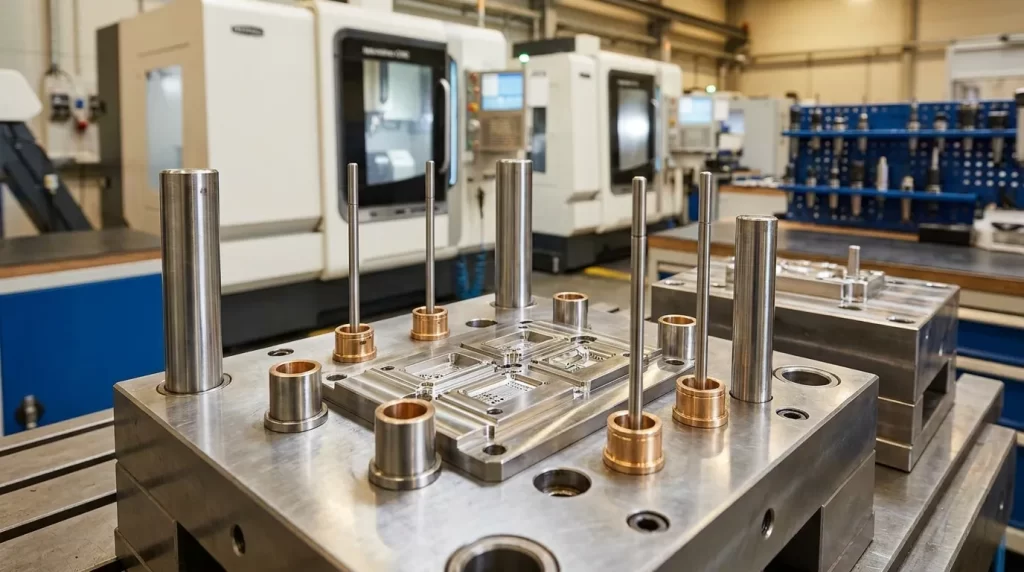
Precision components in molds are high-tolerance parts designed to maintain alignment, Wiederholbarkeit, and dimensional accuracy during repeated production cycles. They reduce variation, minimize wear-related defects, and improve mold lifespan.
In der Formherstellung, precision components refer to parts that must maintain exact positioning under repeated mechanical stress. These components include guide posts, Buchsen, Auswurfstifte, Sleeves, and cavity inserts. Even a small dimensional shift can create flash, Sticking, or inconsistent plastic parts.
The need for precision becomes more obvious in high-cycle molds. A mold producing thousands of parts each day cannot rely on loose-fitting components. Wear increases quickly when alignment drifts, especially in molds processing abrasive resins or thin-wall parts.
Manufacturers often use hardened tool steels, Präzisionsschleifen, EDM-Bearbeitung, and advanced inspection systems to maintain dimensional consistency. A broader overview of mold systems and component categories is available in this Vollständiger Leitfaden für Formkomponenten.
For buyers comparing suppliers, the key issue is not just machining capability. It is whether the supplier can maintain repeatability over long production runs using properly engineered Präzisionsformkomponenten.
Which mold components require the highest precision?
Führungssysteme, ejector components, and cavity alignment parts usually require the highest precision because even small dimensional variation can create flash, Fehlanpassung, Frühzeitiger Verschleiß, or unstable part quality.
Not every mold component needs micron-level tolerances. Some areas are far more sensitive to dimensional variation than others. Guide systems and moving parts usually experience the highest stress and alignment pressure during production.
Führungssysteme
Guide posts and bushings control mold alignment during opening and closing. If these parts wear unevenly, cavity surfaces may no longer match correctly. That often causes flash on finished parts or visible mismatch lines.
Automotive trim molds are a common example. A guide-post tolerance difference as small as ±0.01 mm can affect visible surface quality on exterior plastic parts.
Ejektorsysteme
Ejector pins and sleeves require smooth movement and consistent positioning. Excess friction or slight misalignment increases wear and can damage molded parts during ejection.
In high-volume electronics production, ejector pins often fail early because of short cycle times and repeated friction contact. Poor alignment accelerates galling and surface scoring.
| Formkomponenten | Warum Präzision wichtig ist | Häufiges Ausfallrisiko |
|---|---|---|
| Leitfäden | Aufrechterhält die Ausrichtung der Form | Flash und Mismatch |
| Buchsen | Kontrolliert die Bewegungsstabilität | Ungleichmäßiger Verschleiß |
| Auswurfstifte | Unterstützt saubere Teilfreigabe | Stecknadeln |
| Kern-Einsätze | Erhält die Maßgenauigkeit | Teilinkonsistenz |
| Sleeves | Verringert die Reibungsbewegung | Oberflächenwertung |
Herstellerquellen Formausrichtungsteile should focus on repeatability and wear performance instead of chasing the tightest possible tolerance everywhere.
What tolerance range is considered high precision for mold components?
High-precision mold components commonly operate within ±0.01 mm tolerance or tighter depending on mold complexity, Harztyp, and production volume requirements.
Tolerance requirements depend on the mold application. Thin-wall packaging molds and medical molds usually require tighter dimensional control than general consumer products. Laut Attur International, precision machining applications often operate within ±0.01 mm tolerance ranges.
That does not mean every component should be machined to the tightest possible limit. Ultra-tight tolerances are not automatically better. If the mold application does not require them, they can increase cost without improving production stability.
| Anwendungstyp | Typische Toleranzanforderung |
|---|---|
| Allgemeine Formkomponenten | ±0.02 mm |
| Präzisionsausrichtungsteile | ±0.01 mm |
| Dünnwandleisten | ±0.005 mm |
| Medizinische oder Mikroformung | Below ±0.005 mm |
Tolerance planning should match actual production conditions. High-volume molds processing abrasive materials usually benefit more from stable wear resistance than from unnecessary ultra-fine tolerances.
Why does wear resistance matter in injection molds?
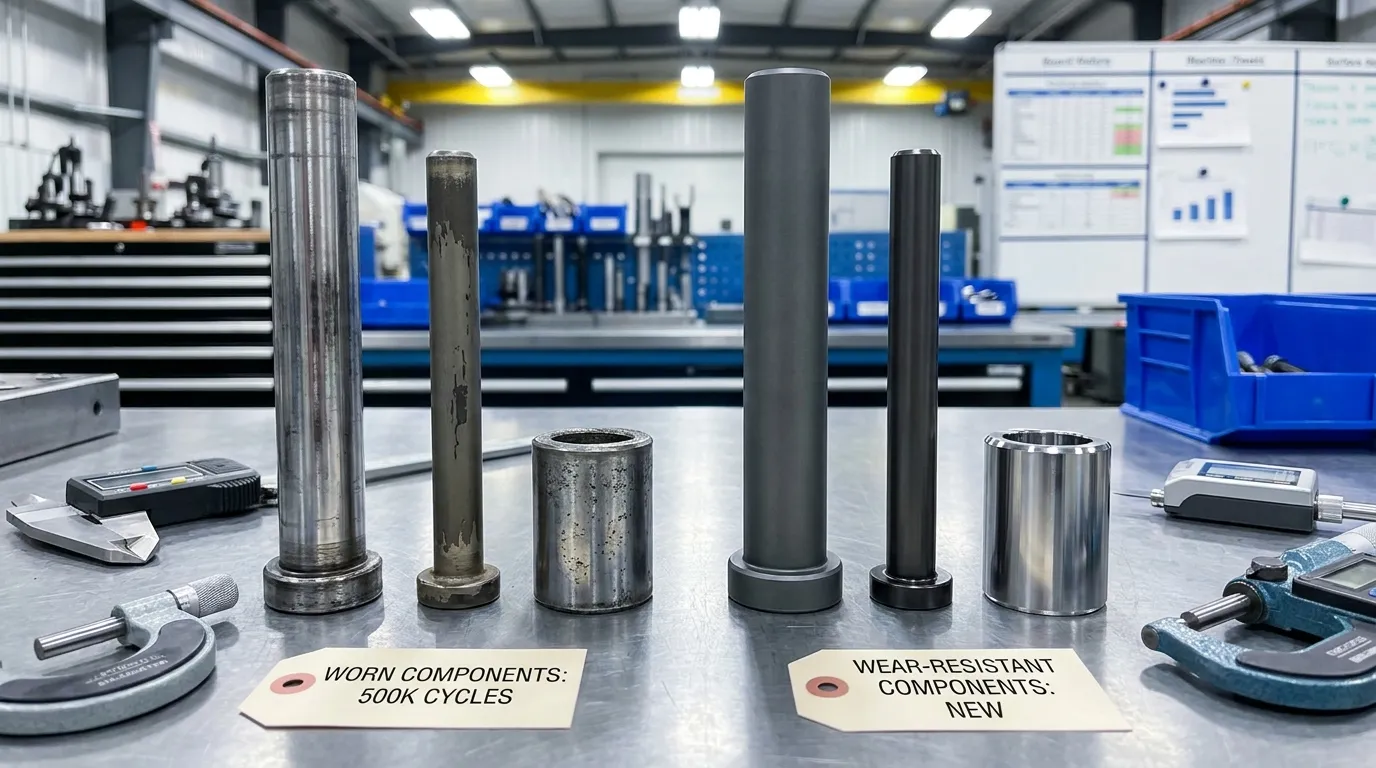
Wear resistance directly affects mold lifespan, Zyklusstabilität, und Teilkonsistenz. Poor wear performance increases maintenance frequency, Dimensionsdrift, and the risk of flash or sticking during production.
Mold components experience repeated friction, Druck, and heat during production. Im Laufe der Zeit, these forces remove material from contact surfaces and reduce alignment accuracy. Once wear begins, dimensional variation spreads quickly through the entire mold system.
Abrasive plastics make the problem worse. Glass-filled resins and engineering plastics create higher friction loads that accelerate surface damage. Components that start with weak hardness or poor surface treatment often fail much earlier than expected.
Häufige Abnutzungspunkte
The most common wear locations include:
- Führpfosten und Buchsen
- Auswurfstifte
- Gleitende Kerne
- Absperrflächen
- Hülsen und bewegliche Einsätze
Coatings help, but they cannot compensate for poor alignment or weak base material selection. A nitrided surface on a poorly fitted guide system will still wear unevenly under repeated load.
Checkliste für Schimmelverschleißversagen
| Warnzeichen | Wahrscheinliche Ursache | Empfohlene Maßnahmen |
|---|---|---|
| Blitz auf geformten Teilen | Abnutzung der Achsverschluss | Inspektionsführungssystem |
| Stecknadeln | Oberflächengalling | Auswurfstifte ersetzen oder beschichten |
| Ungleichmäßige Höhlenabnutzung | Schlechte Härte | Aufwertungsmaterialqualität |
| Oberflächenwertung | Reibungsschäden | Verbesserung der Schmierung |
| Häufige Wartung | Schwacher Verschleißwiderstand | Überprüfung der Beschichtungsstrategie |
Für Hersteller, die vergleichen Verschleißfeste Formteile, the better long-term choice is often the component that reduces downtime rather than the one with the lowest purchase price.
Which materials and coatings improve mold component lifespan?
High-grade tool steels combined with surface treatments like nitriding or PVD coatings improve hardness, Reibung reduzieren, and extend the operating life of precision mold components under repeated production stress.
Material selection affects both wear resistance and dimensional stability. Hardened tool steels are common because they maintain strength under repeated mechanical load. Surface treatments improve resistance to friction and abrasion without changing the entire component structure.
Nitriding is widely used because it hardens the outer surface while maintaining core toughness. PVD coatings reduce friction and improve release performance on moving parts.
| Material oder Beschichtung | Hauptvorteil | Typische Verwendung |
|---|---|---|
| Werkzeugstahl | Hohe Härte | Kernkomponenten |
| Nitritern | Oberflächenverschleißfestigkeit | Führungssysteme |
| PVD-Beschichtung | Geringere Reibung | Auswurfstifte |
| Wärmebehandlung | Dimensionsstabilität | Strukturelle Teile |
A supplier comparison often shows the real value of coatings. One production facility using coated bushings reduced maintenance intervals compared with untreated steel bushings operating under the same cycle conditions.
Custom precision components are valuable for high-cycle or complex molds, but standard parts are often the smarter choice for easier maintenance and replacement. Buyers evaluating Langlebige Formkomponenten should balance lifespan, Ersatzgeschwindigkeit, and total operating cost.
How are precision mold components inspected and verified?
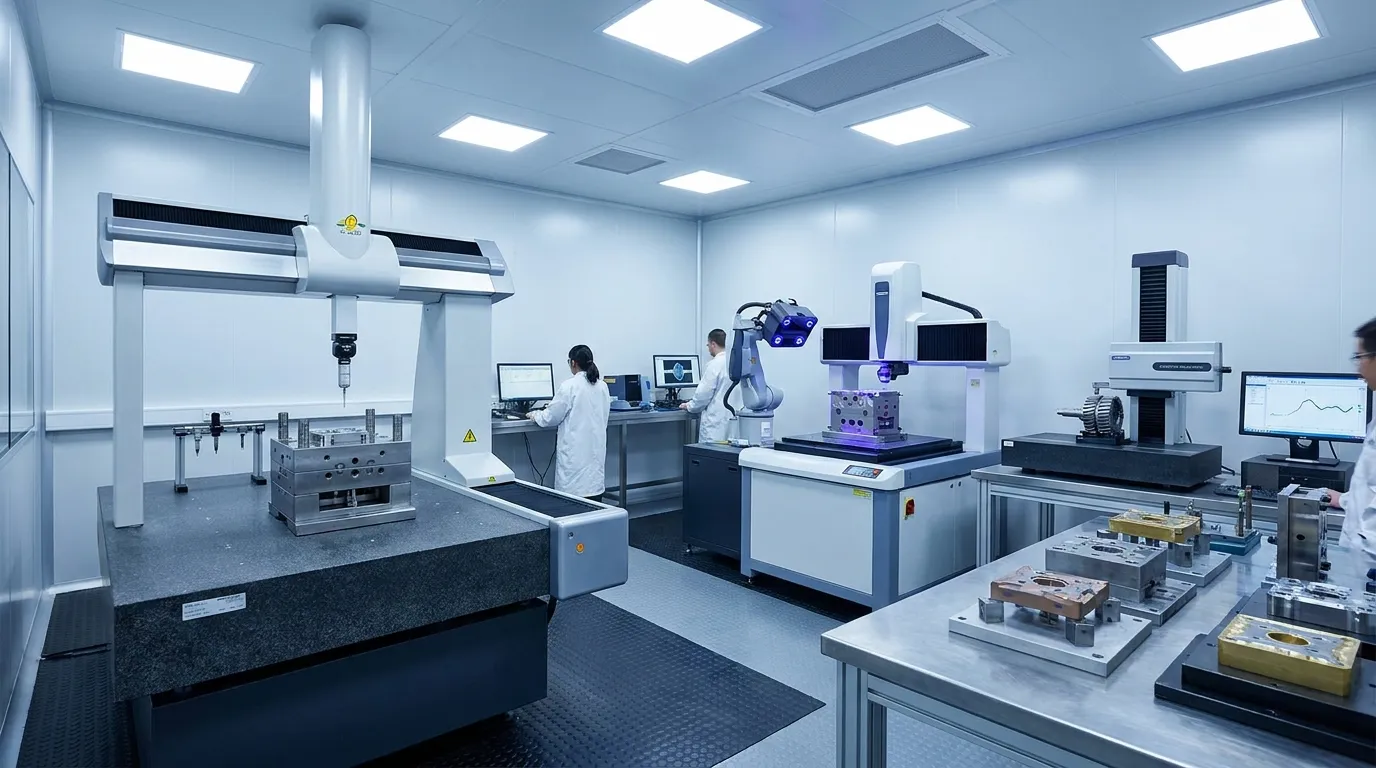
Manufacturers verify precision mold components using contour measurement systems, optical inspection, and dimensional metrology tools to confirm tolerance accuracy and surface conformity before production use.
Inspection matters because even small dimensional variation can affect mold performance. Most suppliers use multiple verification methods depending on component complexity and tolerance requirements.
Laut MinebeaMitsumi, precision manufacturing depends heavily on dimensional consistency and stable machining accuracy.
Typischer Inspektionsprozess
- Anfängliche Maßmessung mit Bremssätteln oder Mikrometern
- Präzisionsverifikation mit CMM- oder Konturmesssystemen
- Oberflächeninspektion auf Abnutzungsspuren oder Oberflächenmängel
- Endgültige Wiederholbarkeitsvalidierung vor dem Versand
Optical inspection systems are common for smaller components with complex geometry. Contour measuring equipment helps verify profiles and edge accuracy on inserts and precision-fit parts.
Inspection also helps identify process drift before it becomes a production issue. In thin-wall molding, a ±0.01 mm alignment variation can create inconsistent cavity fill and visible defects across thousands of parts.
Are custom precision components always better than standard parts?
Custom precision components are not always the best choice. They work well for demanding molds with tight tolerances or unusual geometry, but standard components are often easier to replace and maintain during regular production.
The decision depends on production volume, Komplexität, und Wartungsstrategie. A custom component may improve cycle stability in a high-volume automotive mold, but it can also increase lead time and replacement cost.
Entscheidungstabelle für Präzision vs. Standardkomponenten
| Lage | Bessere Wahl | Warum |
|---|---|---|
| Großserienproduktion | Maßgefertigte Präzisionsteile | Bessere langfristige Stabilität |
| Einfache Konsumgüter | Standardteile | Schnellerer Ersatz |
| Formen mit engen Toleranzen | Sonderteile | Verbesserte Ausrichtung |
| Häufige Wartungsumgebungen | Standardteile | Easier sourcing |
| Komplexe Formgeometrie | Sonderteile | Bessere Passform und Leistung |
A buyer producing low-volume consumer products may gain little value from expensive custom alignment systems. Andererseits, medical or electronics molds often justify higher precision because downtime and defect rates carry much higher production costs.
The smarter approach is matching component strategy to production conditions instead of assuming tighter tolerance always improves results.
How do sourcing and customs delays affect precision component supply?
Precision mold components often have longer sourcing timelines because they require specialized machining, Inspektion, and export documentation. Customs delays can add another layer of risk when replacement parts are needed quickly.
Shipment documentation matters more in 2026 because import systems are stricter in several regions. The EU’s Import Control System 2 (ICS2) requires more detailed shipment information for imported goods.
A common problem is vague shipment labeling. One supplier described mold components simply as “machine parts,” which delayed customs clearance because the classification lacked enough detail.
Checkliste für den Präzisionskomponentenversand
- Bestätigen Sie die Genauigkeit des HS-Codes vor dem Versand
- Verwenden Sie detaillierte Bauteilbeschreibungen
- Überprüfen Sie die materielle Dokumentation
- Fügen Sie bei Bedarf Maßspezifikationen hinzu
- Bestätigung der Zielkonformitätsanforderungen
- Überprüfen Sie die Importunterlagen vor dem Versand
Laut DHL-Hinweise zu Zollverzögerungen und jüngste CBP-Handelsbulletins, incomplete documentation remains a major cause of shipping disruption.
Was als Nächstes zu tun ist
Choosing the right precision components comes down to production stability, Verschleißfestigkeit, and realistic tolerance requirements. The best option is not always the tightest or most expensive part. It is the component that maintains accuracy over time without creating unnecessary maintenance cost or sourcing delays.
If you are reviewing mold performance problems, start with alignment systems, ejector components, and wear surfaces first. Those areas usually reveal the earliest signs of dimensional drift. For a broader understanding of mold systems and applications, Genau das Führer für Kunststoffspritzgussformen provides additional context on how molds are designed and used across production environments.
Häufig gestellte Fragen
What are precision components used for in molds?
Precision components maintain alignment, Maßgenauigkeit, and repeatability inside mold systems. They help reduce defects, improve consistency, and extend mold lifespan during repeated production cycles.
What tolerance is considered high precision in mold manufacturing?
High precision in mold manufacturing commonly means tolerances around ±0.01 mm or tighter depending on the application. Critical mold areas may require even smaller variation for stable production.
Which mold components wear out the fastest?
Auswurfstifte, guide systems, and high-friction contact surfaces usually experience the fastest wear. Schlechte Schmierung, Fehlstellung, and abrasive materials accelerate failure.
Are coated mold components worth the cost?
Coated components often last longer and reduce friction in high-cycle production environments. The added cost is usually justified when downtime or replacement frequency becomes expensive.
How are precision mold parts inspected?
Manufacturers use contour measuring systems, optical inspection equipment, and dimensional metrology tools to verify tolerances and surface quality. Inspection confirms repeatability before production use.
Can standard mold components replace custom precision parts?
Standard components work well for many general applications, but custom parts are often necessary for tight tolerances, unusual geometries, or high-volume production stability.
Freigeben:



Geschrieben von Sunshine
Bei Sunshine, Wir sind ein professioneller Hersteller und Lieferant von Präzisionsformkomponenten, bietet ein breites Produktsortiment für Stange- und Spritzgussanwendungen. Unser Kernfokus liegt auf dem Stanzen von Stempeln, Auswurfstifte und -hülsen, sowie Führungspfosten und Buchsen. Mit fortschrittlicher CNC-Bearbeitung, Strenge Qualitätskontrolle, und starke Produktionskapazitäten, Wir sorgen für Zuverlässigkeit, Hochpräzisionsteile, zusammen mit vorrätigen Standardkomponenten für schnelle und effiziente weltweite Versorgung.
NACHRICHTEN
EMPFANG SERVICE
Mit hochwertigen Teilen für jedes Budget und freundlichem Personal, das geschult ist, um Ihren Besuch informativ und unkompliziert zu gestalten.
