



D2 vs. M2 Stahl für Stempelstifte: Verschleiß, Zähigkeit, und Speed
For punch pins, D2 and M2 solve different combinations of wear, Auswirkungen, and thermal stress. D2 is often a practical choice when gradual abrasive wear is the main concern and the die operates under controlled cold-work conditions. M2 may be the stronger candidate when the punch faces repeated edge chipping, difficult stock, long production runs, slender geometry, or sustained heat at the cutting edge.
Neither material is automatically better. Press speed alone does not determine the answer, and a harder punch is not always a more durable punch. Freigabe, Wärmebehandlung, Geometrie, Ausrichtung, lubrication, and the actual failure pattern can matter as much as the steel grade.
Material selection is also only one part of a complete die system. The broader relationship between punches, dies, Freigabe, and tooling requirements is covered in SunshinePro’s Leitfaden für Stanzenwerkzeuge (Schlussfolgerung).
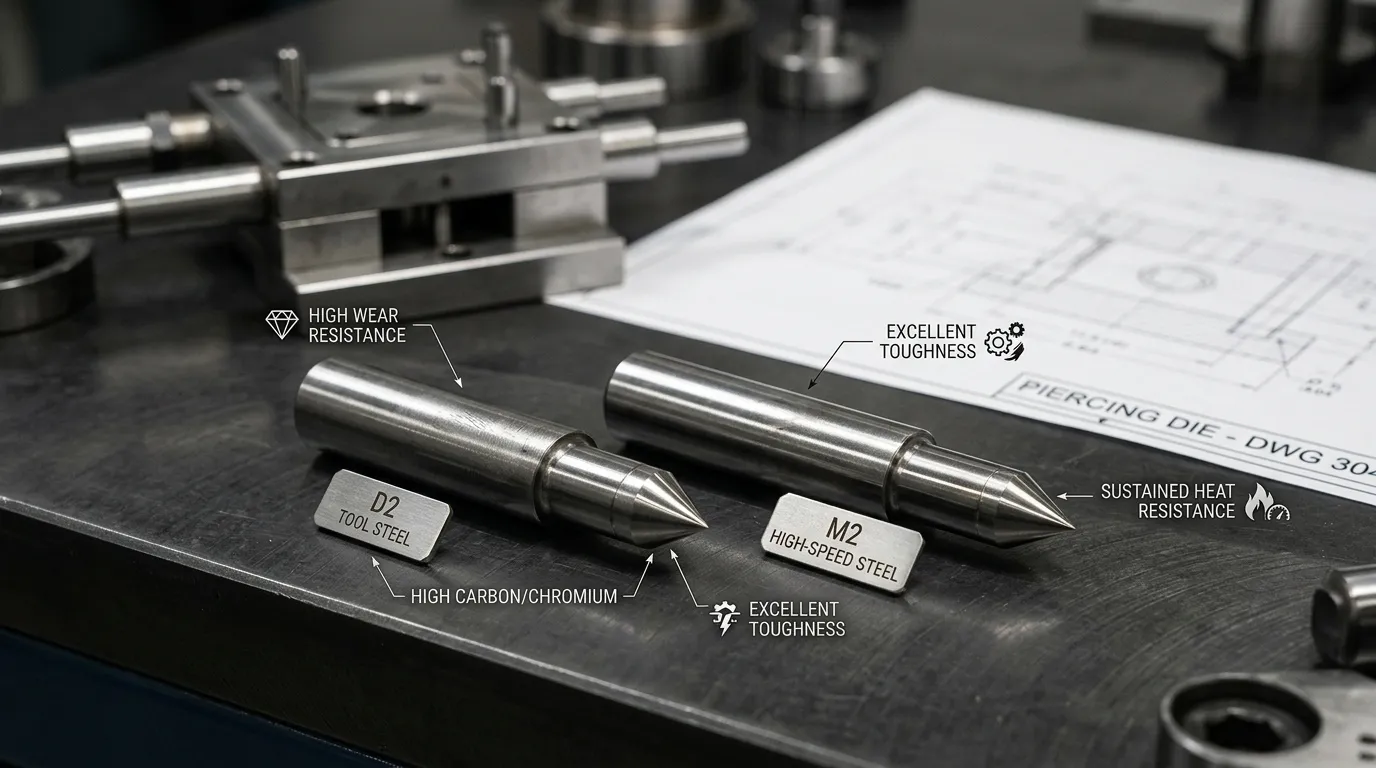
Vergleich von D2 vs. M2 Punch Pin auf einen Blick
| Vergleichsfaktor | D2-Werkzeugstahl | M2 Hochgeschwindigkeitsstahl |
|---|---|---|
| Stahlfamilie | Kaltbearbeitungswerkzeugstahl | Hochgeschwindigkeitsstahl |
| Typische Selektionsstärke | Starke Verschleißfestigkeit unter kontrollierten Kältebedingungen | Balanced wear resistance, Kantenstabilität, Zähigkeit, and hot hardness |
| Hauptbegrenzung | Can become vulnerable to chipping or fatigue when the hardness, Geometrie, or loading is too aggressive | Höhere Material- und Verarbeitungskosten sind in leichten Anwendungen möglicherweise nicht gerechtfertigt |
| Abrasiver Verschleiß | Oft ein starker Kandidat, bei dem allmählicher, abrasiver Verschleiß dominiert | Also wear resistant, especially where wear occurs with heat or repeated impact |
| Zähigkeit und Absplittern | Anwendungsabhängig; geometry and heat treatment must be controlled | Oft gilt es als Situation, in der D2 unter ansonsten stabilen Bedingungen wiederkehrendes Edge-Chipping erlebt |
| Anhaltende Hitze | Weniger geeignet für Anwendungen, bei denen die Schneide über lange Zeit heiß bleibt | Bekannt für die Erhaltung der Härte auch bei erhöhten Einsatztemperaturen |
| Bestgeeignete Bedingungen | Stable alignment, suitable clearance, controlled impact, moderate thermal demand | Long runs, difficult stock, higher thermal demand, Schlanke Schläge, or expensive downtime |
| Kostenrichtung | Allgemein als der wirtschaftlichere Ausgangspunkt angesehen | In der Regel wird bewertet, wenn eine verbesserte Zuverlässigkeit die zusätzlichen Kosten ausgleichen kann |
| Erforderliche Überprüfung | Genaue Steigung, Wärmebehandlung, Härte, Geometrie, und Produktionsbedingungen | Genaue Steigung, Wärmebehandlung, Härtungsbedingung, Härte, und Produktionsbedingungen |
These are selection tendencies, not guaranteed performance rankings. A poorly supported M2 punch can fail before a correctly designed D2 punch, while an over-hardened or misaligned D2 punch can chip before its wear resistance becomes useful.
Warum sich D2 und M2 in einem Schlag unterschiedlich verhalten
D2 is a high-carbon, high-chromium cold-work tool steel. It is commonly associated with wear resistance, compressive-load capability, and dimensional stability in tools operating without sustained high-temperature exposure. Die Datenblatt BÖHLER K110, which covers a D2-family grade, lists punching and stamping tools among its applications.
M2 belongs to the molybdenum high-speed-steel family. Its alloy system is designed to retain hardness and cutting performance under greater thermal demand. Die Datenblatt BÖHLER S600, covering an M2-family grade, emphasizes wear resistance, Zähigkeit, Kantenstabilität, Druckfestigkeit, and red hardness.
The difference cannot be reduced to a single Rockwell hardness value. Two punch pins at a similar HRC may still behave differently because of:
- Legierungszusammensetzung und Hartmetallverteilung
- Austenitisierung, Abschrecken, and tempering conditions
- Erhaltene Mikrostruktur
- Schleif- und EDM-Oberflächenzustand
- Lochgeometrie und Stütze
- Temperatur während der Produktion
- Die Art des auftretenden Verschleißes oder Bruchs
The agreed material standard therefore matters. ASTM A681 covers alloy tool steels such as D2, während ASTM A600 covers high-speed tool steels such as M2.
Bewertungsnamen, die Käufer nicht als automatische Äquivalente behandeln sollten
Worldwide sourcing often involves several designation systems. D2 may be discussed alongside SKD11 or 1.2379, while M2 may be cross-referenced with SKH51, SKH9, or 1.3343.
These names should not be accepted as interchangeable without checking the applicable standard, Chemie, production route, and final heat-treated condition. The drawing or purchase specification should identify the agreed grade rather than relying on a general trade name.
DC53 also should not be described as another name for standard D2. It is a separate modified cold-work steel with its own processing and performance characteristics.
Verschleißfestigkeit: Identify the Wear Mechanism Before Choosing
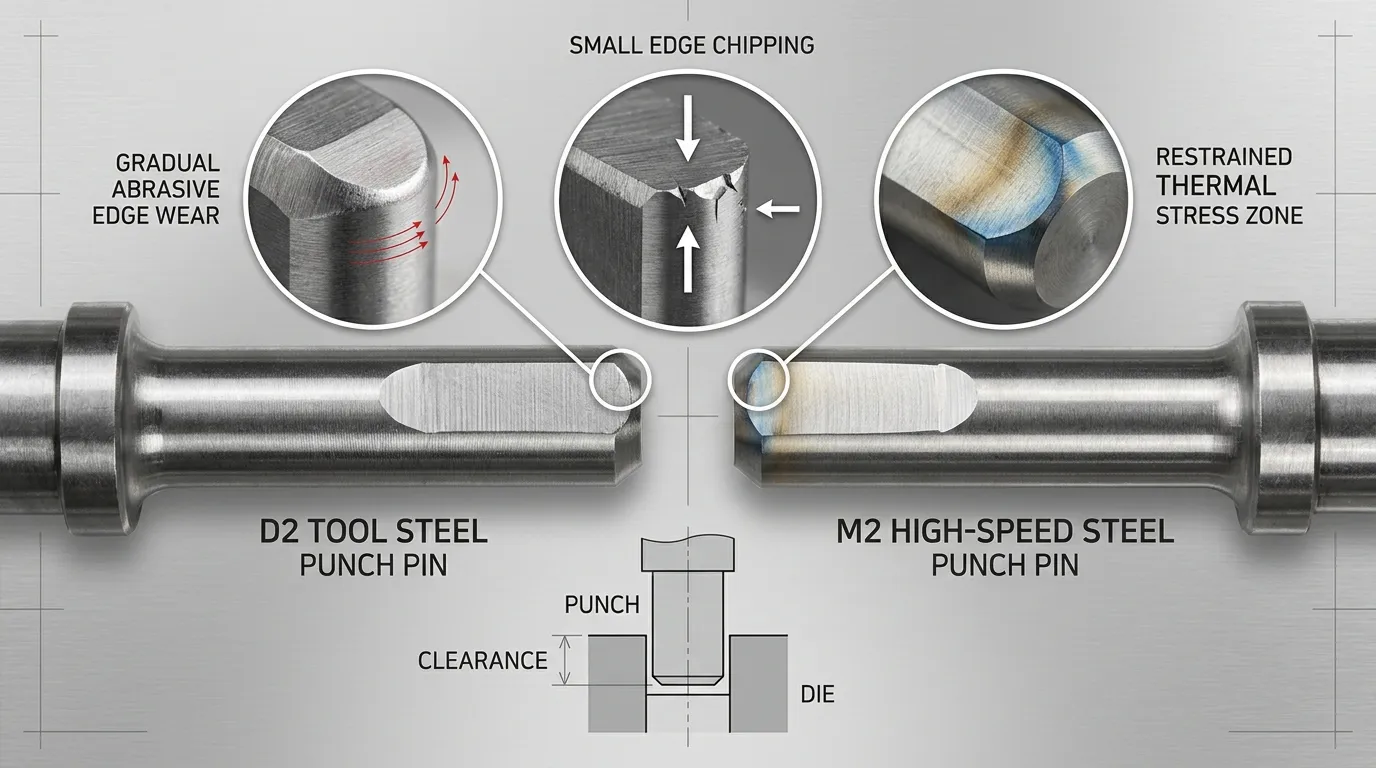
Asking which steel has “better wear resistance” is incomplete until the wear mechanism is known.
Abrasiver Verschleiß gradually removes material from the punch edge or flank. It may be driven by hard particles, Maßstab, an abrasive workpiece, or repeated sliding contact. D2 is often considered when this predictable, gradual wear is the primary problem and shock loading remains controlled.
Klebstoffverschleiß und Galling involve material transfer, Pickup, or local seizure between the punch and workpiece. These problems are influenced heavily by workpiece material, Oberflächenoberfläche, lubrication, Freigabe, und Beschichtung. Changing from D2 to M2 may not correct galling if friction and material adhesion remain the real causes.
Verschleiß kombiniert mit Absplittern oder Hitze creates a different selection problem. M2 may provide a more useful performance balance where the edge must resist abrasion while also tolerating repeated stress and sustained temperature.
Before changing steel, inspect how the existing punch is deteriorating:
| Beobachteter Zustand | Wahrscheinliches Thema, das untersucht werden sollte | Materielle Implikation |
| Smooth, gradual edge recession | Abrasiver Verschleiß | D2 may remain suitable; compare maintenance interval and total cost |
| Materialaufnahme oder grobe Ablagerungen | Galling, Finish, lubrication, Beschichtung | Korrekte Oberflächenbedingungen, bevor man Bulk-Stahl verantwortlich macht |
| Kleine Stücke, die vom Rand abbrechen | Chipping, Übermäßige Härte, Geometrie, Freigabe, Seitenbelastung | M2 kann berücksichtigt werden, nachdem die Systemursachen kontrolliert sind |
| Schneller Verschleiß bei langen, ununterbrochenen Fahrten | Kombinierte Abrieb und Wärme | Die Hot-Hardness-Fähigkeit von M2 könnte relevanter werden |
SunshinePro’s die punch pin page lists precision grinding and TiN and TiCN coating options. These processes can support surface condition and wear control, but a coating cannot compensate for unsuitable steel, Schlechte Ausrichtung, Falsche Freigabe, or weak punch support.
Zähigkeit, Chipping, and Punch Geometry
Punch toughness is not determined by the steel name alone. The final hardness, Wärmebehandlung, edge shape, Nicht getragene Länge, and loading direction all affect whether the punch bends, Chips, or develops fatigue cracks.
A large, well-supported round punch and a long, narrow punch do not place the same demands on the material. Small-diameter punches, sharp internal features, narrow points, and long unsupported sections create greater stress concentration and bending risk.
Repeated chipping can result from:
- Übermäßige Härte für die Geometrie
- Falsche Stans-zu-Die-Freigabe
- Schlechte Führung oder Ausrichtung
- Seitenbelastung
- Unzureichende Kopf- oder Körperunterstützung
- Schleifschaden
- Eine unkontrollierte EDM-Recast-Schicht
- Wärmebehandlungsfehler
- Lokale Überlastung durch Bestandsvariationen
A published failure analysis of an AISI D2 punch found that punch damage could involve fatigue, carbide cracking, excessive loading, heat-treatment issues, backup-plate wear, Freigabe, and guiding conditions. The study reinforces a basic rule: changing the material without correcting the mechanical cause may only move the failure to another location. Siehe die Studie auf Ermüdungs- und Verschleißschaden bei einem AISI D2-Schlag.
M2 may deserve evaluation when a D2 punch repeatedly chips despite correct alignment, suitable clearance, stable heat treatment, and adequate support. It should not be treated as a substitute for investigating the die system. A more complete diagnosis of side loading, Freigabe, Führung, and fracture causes belongs in the guide to Stanzbruch in Stempelwerkzeugen.
Wenn die Druckgeschwindigkeit die heiße Härte des M2 relevant macht
The term “high-speed steel” often leads to an oversimplified rule: fast press equals M2. Actual punch conditions are more complicated.
Strokes per minute affect the number of loading events, but they do not directly state the cutting-edge temperature. Thermal demand also depends on:
- Durchgehende Laufzeit
- Werkstücksstärke und -dicke
- Lochgröße und Lochgeometrie
- Stans-zu-Die-Freigabe
- Reibung und Galling
- Schmierung
- Wärmeabgabe zwischen den Schlagen
- Dauer und Häufigkeit der Produktionspausen
A fast press running short batches of thin, manageable stock may produce less sustained edge heat than a slower press running thick, high-strength material continuously.
M2’s hot hardness becomes more valuable when the cutting edge remains hot enough for ordinary cold-work performance to deteriorate. That condition may appear during long progressive-die runs, difficult stock punching, Hochreibung, or inadequate cooling between cycles.
D2 can still be suitable at a high numerical press speed when thermal load, Auswirkungen, and chipping risk remain controlled. M2 should therefore be selected because of the complete duty cycle, not because the press specification contains a high strokes-per-minute number.
D2 or M2? Choose by Failure Mode and Application
The following table provides a starting direction. It is not a substitute for examining the die, Werkstück, Wärmebehandlung, and failed punch.
| Anwendungszustand | Wahrscheinlicher Startkandidat | Grund | Überprüfe, bevor du dich entscheidest |
| Stable, gradual abrasive wear | D2 | Eine starke Kaltarbeitsverschleißfähigkeit könnte ausreichend sein | Härte, Schärfintervall, stock abrasiveness |
| D2-Kante chippt wiederholt | M2 kann bewertet werden | Ein breiteres Widerstands- und Kantenstabilitätsgleichgewicht kann helfen | Freigabe, Ausrichtung, Geometrie, Wärmebehandlung |
| Lange, ununterbrochene Produktion mit anhaltender Kantenhitze | M2 | Die heiße Härte wird relevanter | Actual temperature drivers, Reibung, lubrication |
| Kleiner oder schlanker Stempel | M2 kann bewertet werden | Die Geometrie erfordert möglicherweise eine größere Widerstandsfähigkeit gegen Absplittern und Ermüdung | Nicht unterstützte Länge, Führung, Kopfstütze |
| Mittelvolumen-Weich- oder Kohlenstoffstahl-Stanzen | D2 könnte ausreichen | Thermische und Schlagnachfrage rechtfertigen M2 möglicherweise nicht | Stock thickness, Freigabe, desired maintenance interval |
| Edelstahl- oder gallenanfälliges Material | Anwendungsabhängig | Reibung, Adhäsion, and heat may dominate | Schmierung, Oberflächenoberfläche, Beschichtung, Freigabe |
| Dickes oder stärkeres Blatt | M2 könnte einen Vorteil bieten | Höhere Lasten können die Kantenspannung und Hitze erhöhen | Stanzdurchmesser, press force, Unterstützung, hole geometry |
| Ausfallzeiten sind deutlich teurer als die Werkzeugkosten | M2 könnte wirtschaftlich gerechtfertigt sein | Zusätzliche Anfangskosten können akzeptabel sein, wenn sich die Zuverlässigkeit verbessert | Produktionsaufzeichnungen und kontrollierte Studienergebnisse |
Typische Bedingungen, bei denen D2 ausreichen kann
D2 remains a reasonable candidate when the punch experiences predictable wear under stable cold-working conditions. Suitable clearance, strong guidance, adequate support, and controlled hardness allow its wear resistance to be used without excessive chipping.
It can be a practical choice for moderate production duties where current sharpening intervals are acceptable and the application does not create sustained heat or severe impact.
Bedingungen, bei denen M2 seine höheren Kosten rechtfertigen könnte
M2 becomes more attractive when a punch must maintain its edge under combined wear, repeated stress, and thermal demand. Examples include long production runs, difficult or higher-strength stock, slender punch geometry, and applications where recurring D2 chipping continues after system problems have been corrected.
The economic case is strongest when unplanned breakage or press downtime costs much more than the difference in punch material and processing.
Steel Grade Alone Will Not Fix Clearance, Trasse, or Heat-Treatment Problems
Before replacing D2 with M2, confirm that the current punch is being tested fairly. Mindestens, Rezension:
- Stans-zu-Die-Freigabe
- Konzentrizität und Ausrichtung des Stempels
- Zustand von Führungspfosten und Buchse
- Punch-Unterstützung und ungestützte Länge
- Unterschied in Werkstücksdicke und Härte
- Schmierkonsistenz
- Schleifverbrennungen oder Kantenschäden
- EDM-Oberflächenzustand
- Endhärte und Anlassbedingungen
- Beschichtungszustand
- Verschleißmuster an der Stanz- und Stanzöffnung
Incorrect clearance can increase cutting load, Burr-Formation, edge stress, und Abschlagen. Misalignment can place bending loads on a punch designed mainly for compression. Grinding or EDM damage can also provide a starting point for fatigue cracks.
A punch works as part of a larger assembly. The relationship between the punch, Gefolgsgeld, Führer, Buchsen, die insert, and support components is covered more broadly in the Leitfaden für die Stanzenkomponenten.
Compare Cost by Downtime and Maintenance, Not Steel Price Alone
D2 may have a lower initial cost in many sourcing situations, but purchase price does not show the complete economic result. M2 may cost more to purchase, Maschine, heat-treat, or grind, yet still be worthwhile if it reduces expensive production interruptions.
A useful comparison should include:
| Kostenfaktor | Frage zu bewerten |
| Anfangsstanzkosten | What is the delivered cost in the specified grade and condition? |
| Schärfen | How many hits occur between scheduled sharpening events? |
| Ungeplanter Bruch | Does the punch wear predictably or fail without warning? |
| Ausfallzeit | How much production is lost during replacement and die adjustment? |
| Schrott | Does edge deterioration affect burrs, Abmessungen, or part quality? |
| Inventar | How many spare punches are required to protect production? |
| Instandhaltungsarbeit | How much toolroom time is spent inspecting, Schärfen, and replacing punches? |
M2 is not automatically the lower-cost choice. It becomes economically attractive only when its performance under the actual application reduces enough maintenance, failure, Schrott, or downtime to offset the added cost.
Was man angeben sollte, bevor man einen D2- oder M2-Lochstift anfordert
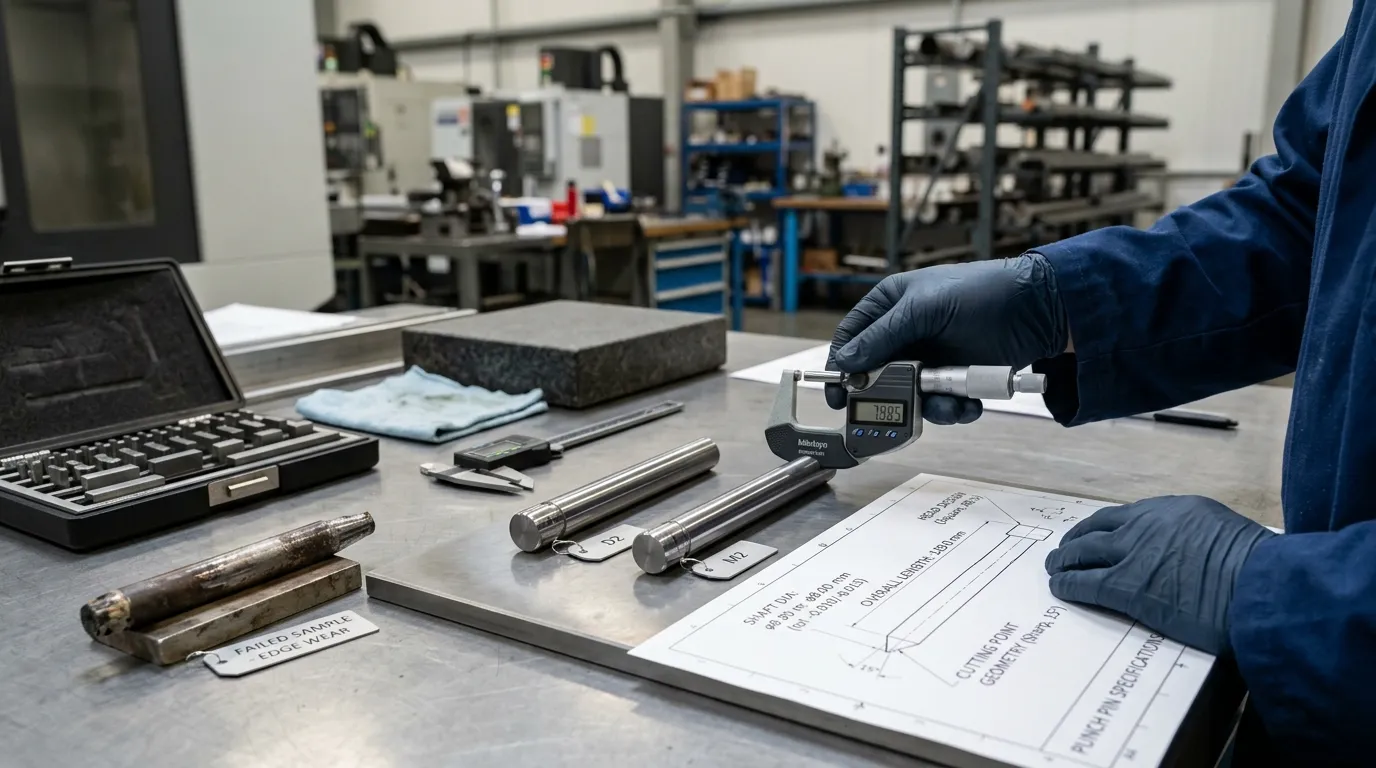
A supplier cannot make a reliable material recommendation from the punch diameter alone. The RFQ should describe both the component and its operating conditions.
Stellen Sie bereit:
- Eine dimensionierte Zeichnung
- Stanzdurchmesser, Länge, and unsupported length
- Kopfkonstruktion und Stützanordnung
- Point shape, corner radii, and special cutting features
- Werkstücksmaterial und Sorte
- Blechdicke
- Lochmaße und -form
- Stans-zu-Die-Freigabe
- Presstyp und Betriebsgeschwindigkeit
- Durchgehende Laufzeit
- Erwartete jährliche Trefferzahl
- Schmiermittel und Anwendungsmethode
- Vorhandenes Stanzmaterial und gemessene Härte
- Current failure symptom: Verschleiß, Ärger, Chipping, Biegen, oder Ermüdung
- Fotos oder fehlgeschlagene Proben, wo verfügbar,
- Erforderliche Beschichtung
- Vereinbarte Materialbezeichnung und Standard
- Erforderliches Materialzertifikat
- Wärmebehandlungsdokumentation
- Härteprüfungsanforderung
- Akzeptanzkriterien für einen Produktionstest
SunshinePro states that non-standard components can be produced from customer drawings. Es Produktseite für Stanzstifte lists custom diameter, Länge, Kopfdesign, Material, und Beschichtungsoptionen, together with SKH51, SKH9, DC53, ASP-Noten, und Karbid. The page also mentions CNC machining, Präzisionsschleifen, EDM, und Vakuumwärmebehandlung.
That information does not confirm AISI D2 availability. Buyers requiring D2 should ask the supplier to confirm the exact material designation, applicable standard, Wärmebehandlungsbedingung, and documentation before ordering.
A controlled trial remains the most reliable final check. Compare D2 and M2 using the same drawing, Freigabe, Presse, workpiece batch, Schmiermittel, Beschichtungsstatus, und Inspektionsmethode. Record the hit count and actual failure mechanism rather than judging only by whether the punch still appears usable.
Wenn weder konventionelle D2 noch M2 die richtige Antwort sind
If both materials fail after clearance, Unterstützung, Ausrichtung, lubrication, Geometrie, and heat treatment have been corrected, the application may require a different solution.
Possible next steps include reviewing:
- Pulvermetallurgie Hochgeschwindigkeitsstahl
- Karbid
- Ein anderes Beschichtungssystem
- Überarbeitete Lochgeometrie
- Verbesserte Führung oder Unterstützung
- Änderungen an Freiraum oder Schmierung
SunshinePro lists ASP grades and carbide among its punch-pin material categories, but these alternatives should be evaluated against the same application data rather than treated as automatic upgrades.
For a material review or quotation, submit the punch drawing, Werkstücksdetails, Produktionsbedingungen, and current failure evidence through the SunshinePro-Kontaktseite. The strongest recommendation will come from matching the steel, Wärmebehandlung, Geometrie, and die conditions to the failure mode the punch must actually survive.
Teilen:



Geschrieben von Sunshine
Bei Sunshine, Wir sind ein professioneller Hersteller und Lieferant von Präzisionsformkomponenten, bietet ein breites Produktsortiment für Stange- und Spritzgussanwendungen. Unser Kernfokus liegt auf dem Stanzen von Stempeln, Auswurfstifte und -hülsen, sowie Führungspfosten und Buchsen. Mit fortschrittlicher CNC-Bearbeitung, Strenge Qualitätskontrolle, und starke Produktionskapazitäten, Wir sorgen für Zuverlässigkeit, Hochpräzisionsteile, zusammen mit vorrätigen Standardkomponenten für schnelle und effiziente weltweite Versorgung.
NACHRICHTEN
EMPFANG SERVICE
Mit hochwertigen Teilen für jedes Budget und freundlichem Personal, das geschult ist, um Ihren Besuch informativ und unkompliziert zu gestalten.
