



Press Fit vs. Slip Fit Stempelstifte: Erhaltung und Einsatzfähigkeit
A press-fit punch pin uses controlled interference between the punch shank and its mounting bore. This can provide firm engagement and a compact mounting arrangement, but removal normally requires more force, Zugang, or disassembly. A slip-fit punch uses controlled clearance, making installation and replacement easier, but it needs a separate feature to retain, Lokalisieren, and orient the punch correctly.
Neither option is universally better. The correct choice depends on stripping force, Seitenbelastung, positional requirements, punch-change frequency, Wartungszugang, and the design of the complete retainer system. Für umfassendere Informationen über Punches, Pins, Buchsen, and related tooling parts, Siehe die Leitfaden für die Stanzenkomponenten (Schlussfolgerung).
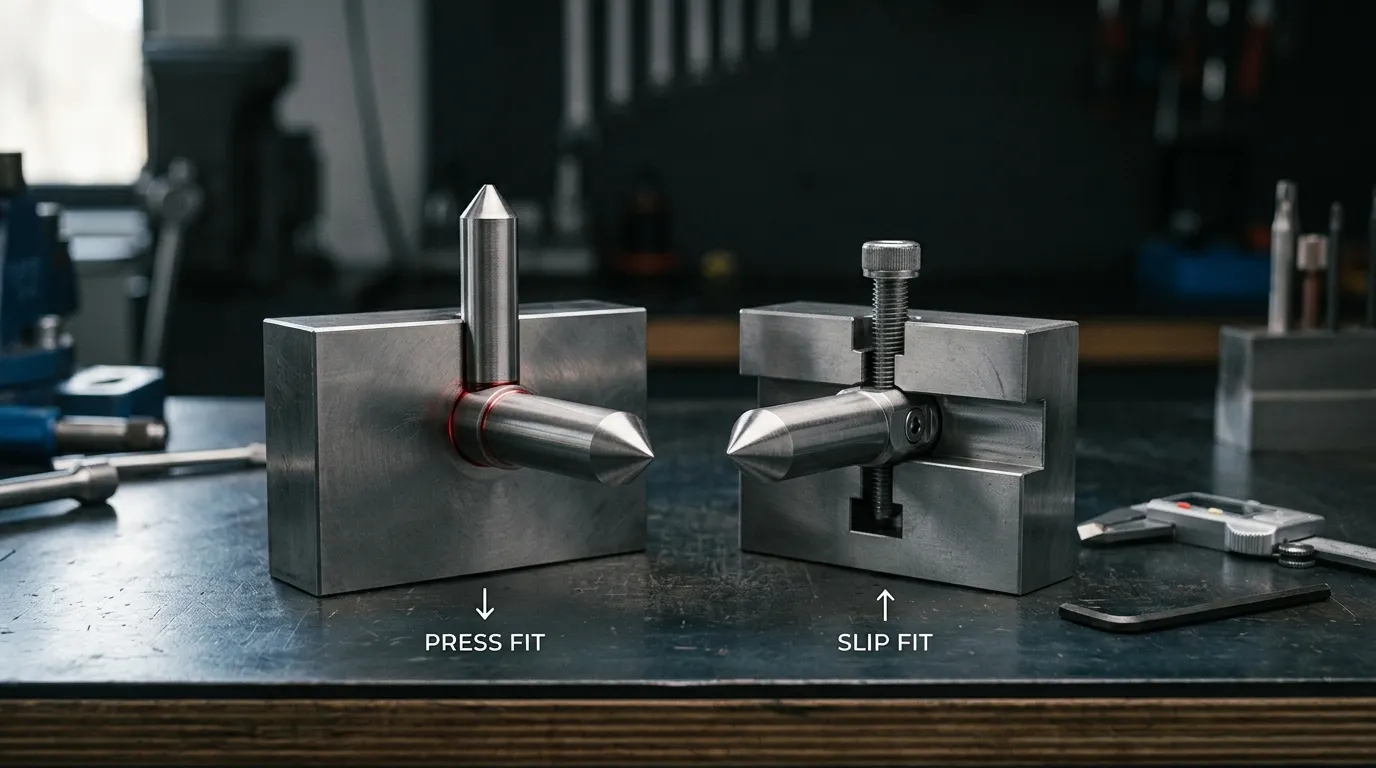
Was bedeutet Press Fit und Slip Fit in einer Stanzmontage
The fit being compared is the dimensional relationship between the punch shank and the bore in the punch plate or retainer. It is not the cutting clearance between the punch tip and die opening.
Die allgemeine Terminologie stammt aus Limits-and-Fits-Systemen wie ISO 286-1, but the standard does not prescribe one universal fit for punch pins. The appropriate dimensions must be chosen for the actual punch diameter, Materialien, plate construction, Laden, Montagemethode, und Wartungsstrategie.
Presseanpassung: Interference Between the Punch Shank and Bore
With a press fit, the punch shank is intentionally larger than the effective mounting bore within specified limits. Installation therefore requires controlled force or another approved assembly method.
The interference can help resist relative movement between the punch and plate. It may also contribute to positional stability. Aber, the interference should not automatically be treated as the complete retention system. A headed punch, Flansch, Rückplatte, Schulter, or another feature may still carry part of the axial load or prevent withdrawal.
Too much interference can increase assembly force and create a risk of scoring, Verformung, oder Dimensionsänderung. Too little may not produce the intended engagement.
Slip Fit: Controlled Clearance With Separate Retention
A slip fit provides intentional positive clearance between the punch shank and its mounting bore. The punch can normally be inserted or removed without pressing it through the plate.
This does not mean the punch should move freely during stamping. A properly designed slip-fit arrangement uses another feature to provide positive axial retention and, where necessary, angular orientation. Depending on the tooling system, that feature may be:
- Ein Lochkopf oder Flansch
- Ein Verschluss oder Verstellstift
- Ein Schlüssel oder ein geformter Halter
- Ein dedizierter Gefolgsmann
- Ein Kugelschlossmechanismus
- Eine separate Anti-Rotationsfunktion
Ball lock is one example of a removable punch-retention system. It is not a synonym for every slip-fit punch.
Fit, Erhalt, Lage, and Guidance Are Separate Functions
Several functions must be considered independently:
| Funktion | Was es kontrolliert |
|---|---|
| Fit | Freiraum oder Interferenz zwischen Stansschaft und Bohrung |
| Erhalt | Resistance to axial withdrawal, including stripping force |
| Lage | Position der Stanzachse in der Stanzebaugruppe |
| Ausrichtung | Winkelposition von geformten oder nicht-runden Schlagstöcken |
| Anleitung | Kontrolle des Stempels in der Nähe seines Arbeitswegs |
| Begleitung | Übertragung der Druckstanzlast in die Matrizenstruktur |
One component may perform more than one function. Zum Beispiel, a punch plate may both locate and hold a press-fit punch. In another design, a retainer may hold the punch while a stripper plate guides it closer to the working end. MISUMI’s technical reference on Stanz- und Matrizenmontagemethoden shows both press-fit mounting and clearance-fit arrangements with separate guidance or retention features.
Press Fit vs. Slip Fit Stempelbolzen auf einen Blick
| Vergleichsfaktor | Presseanpassung | Slip Fit |
| Beziehung zwischen Schenkel und Bohrer | Kontrollierte Interferenz | Kontrollierte Freigabe |
| Installation | Erfordert kontrolliertes Pressen oder eine andere kraftunterstützte Methode | In der Regel ohne Drücken eingesetzt |
| Entfernung | May require pressing, rear access, or partial disassembly | Normalerweise ist es einfacher, wenn die Freigabefunktion zugänglich ist |
| Axiale Retention | Fit may contribute, often combined with a head or backing feature | Erfordert eine positive Zurückhaltung, die von der Freigabe getrennt ist |
| Positionskontrolle | Kann festes Eingreifen ermöglichen, wenn die Bohrungsgeometrie korrekt ist | Depends more visibly on retainer accuracy, guiding features, and tolerance stack |
| Austauschfrequenz | Besser geeignet, wenn der Austausch relativ selten ist | Oft bevorzugt dort, wo die Schläge regelmäßig gewechselt werden |
| Risiko bei wiederholtem Einsatz | Der Zustand des Bohrers oder der Schaft kann sich nach wiederholter Entfernung ändern | Retainer, locking feature, and guiding surfaces must be checked for wear |
| Positionierung mit geformtem Stempel | May rely on press-fit geometry plus a head, Flach, or key | Benötigt in der Regel ein definiertes Antirotations- oder Orientierungsmerkmal |
| Best-Fit-Szenario | Stabile Montage mit kontrolliertem Bauaufbauzugriff | Betriebsfähiges System mit positiver Retention und zuverlässiger Führung |
The most important distinction is not simply “tight” versus “loose.” It is whether the complete assembly provides enough retention, Lage, Anleitung, and service access for the intended application.
Wie der Pressanschluss die Stanzenbindung und -pflege beeinflusst
A press fit creates contact around the punch shank and mating bore. In a well-designed assembly, this can help prevent relative movement and keep the punch firmly engaged with the mounting plate.
The working load still has to pass through the complete die structure. A punch head, Schulter, Rückplatte, or retainer surface may support the punch under compressive load. Stripping force acts in the opposite direction when the stock is removed from the punch, so the design must also prevent axial withdrawal.
Dayton Progress distinguishes one of its headed press-fit systems from quick-change ball-lock tooling, noting that the press-fit arrangement requires more retainer disassembly during replacement. That is useful as a system example, but it should not be treated as a rule for every press-fit punch design.
Wo der Pressfit am nützlichsten ist
Press fit may be suitable when:
- The punch is not expected to be changed frequently.
- The punch plate and bore can be manufactured and inspected consistently.
- Controlled installation and removal access are available.
- A compact mounting arrangement is preferred.
- The punch head, backing surface, and guidance system already provide the required load support.
- The mating bore is intended to remain stable through the planned service life.
The decision should still be based on the complete assembly. Production volume alone is not enough to determine the fit.
Dienst- und Ersatzbeschränkungen
A press-fit punch may require access behind the plate, a controlled press-out operation, or removal of other retainer components. Before fitting a replacement, the maintenance team should inspect both the punch shank and the mounting bore.
Important checks include:
- Rohrdurchmesser und Rundung
- Punktewertung, Mahlscheiben, Verformung, oder Materialaufnahme
- Bohrung senkrecht und Position
- Punch-Shank-Bedingung
- Kopf- oder Schultersitze
- Rückplattenkontakt
- Ausrichtung geformter Stempel
A replacement punch should not automatically be installed into a previously serviced bore without verification. If the bore has enlarged, become out of round, or suffered surface damage, the original fit may no longer be achieved.
Wie Slip Fit die Stanzbindung und -pflege beeinflusst
Slip fit makes removal easier by providing controlled clearance at the punch shank. That service advantage shifts more responsibility to the retainer, orientation feature, und Leitsystem.
The design must answer three questions clearly:
- What prevents the punch from pulling out?
- What controls its radial and angular position?
- What guides the punch close to the cutting area?
If those functions are defined properly, a slip-fit punch does not need to operate as a loose component.
Positive Retention Optionen für einen Slip-Fit-Punch
| Aufbewahrungsfunktion | Hauptfunktion | Dienstüberlegungen |
| Kopf oder Flansch | Verhindert einen axialen Rückzug gegen eine Rückwärtsfläche | Es kann einen Zugang zum hinteren Teil der Baugruppe erforderlich sein |
| Verschluss oder Einstellstift | Er sichert mechanisch den Stempel oder Halter | Der Zustand des Befestigungselements und die Verriegelungsmethode müssen überprüft werden |
| Schlüssel oder geformter Halter | Hält den Schlag zurück oder orientiert ihn | Passform und Verschleiß des Tastenkanals beeinflussen die Wiederholbarkeit |
| Spezieller Halter | Lokalisiert und hält die Stanze als separate Baugruppe | Halterbefestigung und Positionierung des Stabs werden Teil der Toleranzkette |
| Kugelverriegelung | Bietet positive Retention mit einem Freisetzungsmechanismus | Ball, Sitz, Groove, Orientierung, and release access require inspection |
Ball-lock systems are widely used for removable tooling, but their dimensional details are product-specific. Values from one manufacturer’s catalogue should not be applied automatically to another retainer system.
Accuracy Depends on Location, Anleitung, and Tolerance Stack
The presence of clearance does not by itself determine punch-point accuracy. The final position may depend on:
- Position des Halterrohrs
- Bohrung senkrecht
- Dübel oder Befestigungsschraubenposition
- Stempel-Shank-Freiraum
- Antirotationsmerkmale
- Flachheit der Rückplatte
- Schlaglänge
- Stripper-Führungsfreiheit
- Stempelöffnungsort
A stripper-guided arrangement can control the punch closer to the working end, reducing reliance on the punch-plate fit alone. Das MISUMI-Montagereferenz illustrates this type of relationship.
Slip-fit and ball-lock systems can still accumulate positional variation across several interfaces. Dayton Lamina’s technical discussion of Kugelschlosswerkzeuge demonstrates why retainer clearances, mounting accuracy, and component geometry must be evaluated as a system rather than individually.
Choose the Fit by Load, Genauigkeit, and Changeover Needs
The choice should be made from application requirements, not from a general assumption that one fit is stronger or more precise.
| Auswahlfrage | Pressanpassung kann bevorzugt werden, wenn | Slip Fit kann bevorzugt werden, wenn |
| How often is the punch replaced? | Austausch erfolgt selten | Der Austausch ist routinemäßig oder zeitkritisch |
| Is positive retention available? | The complete press-fit, Kopf, and backing arrangement already provides suitable retention | Ein dedizierter Gefolgsmann, Kopf, Legende, bolt, or ball lock is available |
| How is the punch guided? | Die Stanzplatte oder eine andere Funktion sorgt für ausreichende Kontrolle | Guidance is provided separately, such as near the punch tip |
| Is maintenance access restricted? | Kontrolliertes Pressen oder Zerlegen bleibt praktikabel | Die direkte Entfernung durch einen Freigabemechanismus ist praktischer |
| Is the punch shaped or non-round? | Die Ausrichtung kann innerhalb des Montagedesigns zuverlässig gesteuert werden | A key, Flach, Träger, or oriented retainer provides repeatable angular location |
| Are interchangeable spares required? | Die Bohrung und die Ersatzschäfte können die beabsichtigte Störung aufrechterhalten | Standardisierte Freigabe- und Retentionsfunktionen unterstützen wiederholbaren Austausch |
| Is side loading expected? | Die vollständige Passform und die Führungsstruktur können der Last standhalten | Eine separate Nahführung kann den Stempel in der Nähe des Arbeitsbereichs steuern |
| Is the existing bore already worn? | Erst nach der Inspektion wird bestätigt, dass die erforderliche Interferenz noch erreicht werden kann | A redesigned retainer may be considered, but conversion requires engineering review |
Bevorzugen Sie die Presseanpassung, wenn die Bindung stabil ist und Änderungen selten sind
Press fit is more attractive when the punch is expected to remain installed for long periods, controlled assembly equipment is available, and the mating bore can maintain its specified geometry. It also suits designs where a compact arrangement is more valuable than rapid replacement.
The head, Begleiter-Unterstützung, punch length, and guidance method still need separate verification.
Bevorzuge Slip Fit beim Austausch und Zugriff auf das Design
Slip fit is more attractive when punches are changed regularly, spare interchangeability matters, or pressing the component from the plate would interrupt maintenance.
This option depends on a reliable positive-retention feature. The retainer must also control position and orientation well enough for the required die accuracy.
Verwenden Sie ein vollständiges Aufbewahrungssystem für anspruchsvolle Fälle
Hohe Strippkraft, shaped punches, Seitenbelastung, restricted access, or tight positional requirements may call for a purpose-designed retention and guidance system. In such cases, the press or slip relationship is only one feature within the design.
The final arrangement should be reviewed at assembly level rather than selected from a generic fit chart.
Was bei der Loch- und Plattenzeichnung angegeben werden soll
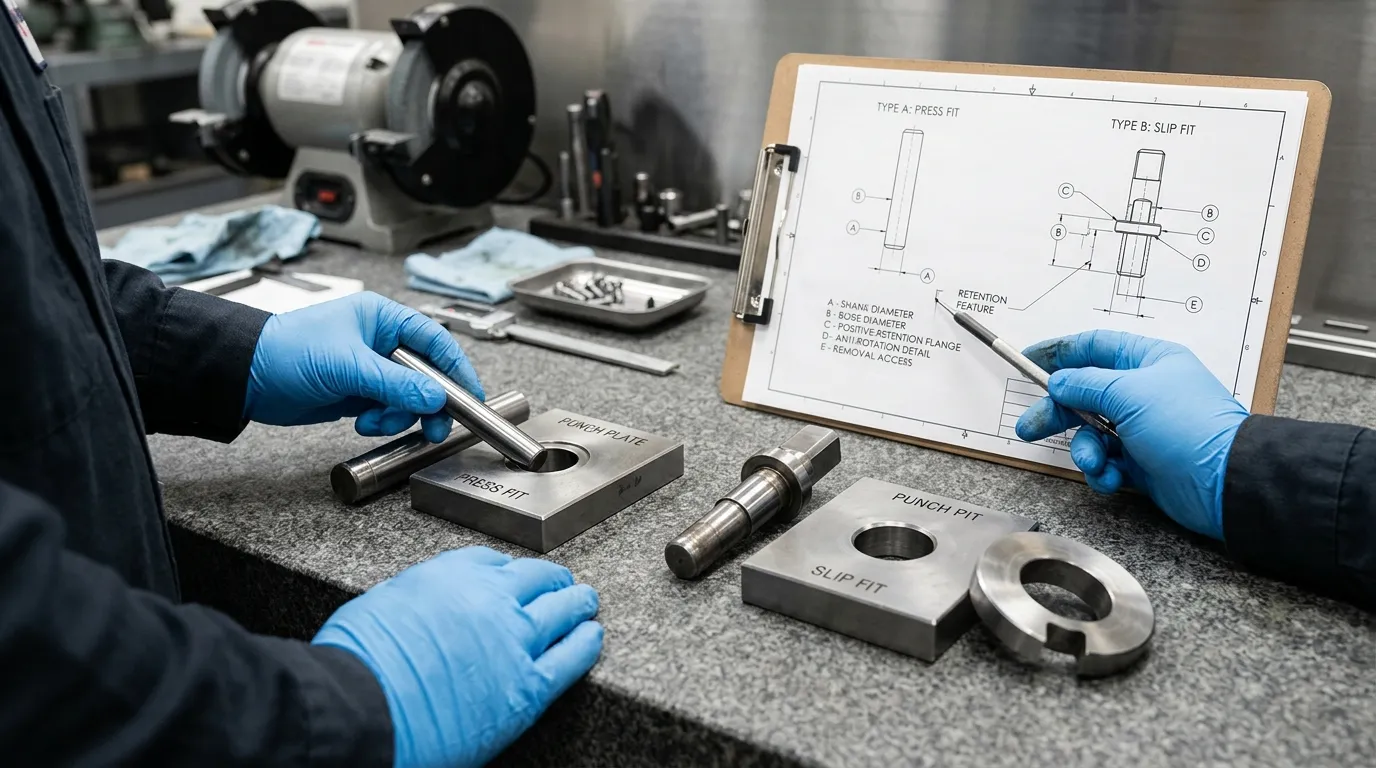
After choosing the fit concept, the drawing must define it clearly. Terms such as “tight fit” or “easy fit” are not precise enough for manufacturing or inspection.
Include the following information where relevant:
- Nominaler Durchmesser und Toleranz des Stanz-Schafts
- Nenndurchmesser und Toleranz des Verbindungsbohrungsdurchmessers
- Erforderliche Funktionsfreigabe oder Interferenz
- Anwendbare Passformstandard und Einheiten
- Stanzplatte oder Retainermaterial
- Plattendicke und Eingriffslänge
- Punchkopf, Schulter, Groove, Legende, or locking feature
- Anti-Rotations-Details für geformte Stempel
- Bohrungsposition und Senkrechte Anforderungen
- Relevant datums
- Rückplatten- oder Sitzanforderungen
- Freigabewerkzeug- oder Entfernungszugriff
- Erwartungen an Ersatz und Austauschbarkeit
- Inspektions- oder Spurweitenanforderungen
SunshinePro states that custom non-standard mould and die accessories can be produced from customer drawings or samples. The fit should still be defined by the customer’s die design or confirmed through an engineering review rather than inferred by the supplier from an ambiguous note.
Installations- und Inspektionsrisiken für jede Montage
Correct dimensions on a drawing do not guarantee a successful assembly if the components are dirty, beschädigt, misaligned, or inspected incorrectly.
Press-Fit-Risiken zu überprüfen
Before installation or replacement, inspect for:
- Grate oder Verunreinigungen am Schaft und Bohrrohr
- Falsches Einführen oder beschädigte Rohrkanten
- Schaft oder Bohrungsmaße außerhalb der Grenzen
- Kerbung oder Materialaufnahme durch die vorherige Entfernung
- Vergrößerung oder Verlust der Rundung der Bohrung
- Unvollständige Sitzung an Kopf oder Rückenfläche
- Falsche Ausrichtung
- Fehlstellung beim Pressen
Do not use installation force alone as proof that the correct fit has been achieved. Excessive force may indicate a dimensional, geometric, Oberfläche, or alignment problem.
Schlupfpass-Risiken zu überprüfen
For a slip-fit assembly, Inspizieren:
- Freigabe gegen die Ziehungsgrenzen
- Abnutzung im Halterrohr
- Condition of the head, Legende, bolt, ball, Groove, or holder
- Antirotationsregelung
- Genauigkeit bei Dübeln und Halterbefestigung
- Rückplattenkontakt
- Freigabe-Zugang
- Anzeichen unbeabsichtigter Bewegung
- Akkumulierte Positionsfehler im Retainer- und Führungssystem
Mounting problems can contribute to poor alignment or unfavourable punch loading, but they are not the only causes of failure. Material choice, Wärmebehandlung, Schnittfreiheit, side force, and punch geometry also matter. Those wider failure mechanisms are covered in Stanzbruch in Stempelwerkzeugen.
Häufige Fehler bei der Wahl der Lochstift-Passform
- Treating slip fit as uncontrolled looseness. A designed clearance can operate accurately when the retainer and guidance system control the punch.
- Assuming interference is the complete retention method. The head, backing surface, Abziehkraft, and removal direction still matter.
- Selecting from a generic fit chart only. ISO fit classes provide a dimensional framework, not an automatic punch-design answer.
- Ignoring punch guidance. A firm shank fit cannot compensate for every issue caused by punch length, Seitenbelastung, or poor working-end guidance.
- Orientierung ignorieren. Shaped punches need a reliable anti-rotation feature.
- Failing to plan removal access. A mechanically sound fit may still create an impractical maintenance process.
- Reusing a worn bore without inspection. The replacement punch may not achieve the intended fit or position.
- Applying one ball-lock specification to every supplier. Retainer geometries and clearances are system-specific.
- Confusing mounting fit with cutting clearance. The shank-to-bore relationship is separate from the clearance between the punch tip and die opening. The broader Leitfaden für Stanzenwerkzeuge covers the wider die-system context.
- Converting press fit to slip fit without redesigning retention. Increasing bore clearance changes how the punch is held, located, and guided.
Was Sie bei einem Punch-Pin-Lieferanten überprüfen sollten
Before ordering a replacement or custom punch pin, provide enough information for the supplier to understand the complete mounting arrangement:
- Lochzeichnung oder physikalische Probe
- Details der Stanzplatte oder des Halters
- Required press fit, slip fit, or explicit dimensional limits
- Retentions- und Anti-Rotationsmethode
- Punchkopf, Schulter, Groove, or locking geometry
- Required position, Senkrecht, and orientation
- Erwartungen an Ersatz und Austauschbarkeit
- Inspektionsanforderungen
- Relevante Anwendungs- und Nutzungsbedingungen
SunshinePro-Listen Stempelwerkzeuge und Stifte among its product categories and accepts enquiries for standard or tailored component requirements. For a custom or replacement project, submit the punch drawing or sample together with the mating-bore, Verbleib, Orientierung, and service requirements through the Kontaktseite.
Freigeben:



Geschrieben von Sunshine
Bei Sunshine, Wir sind ein professioneller Hersteller und Lieferant von Präzisionsformkomponenten, bietet ein breites Produktsortiment für Stange- und Spritzgussanwendungen. Unser Kernfokus liegt auf dem Stanzen von Stempeln, Auswurfstifte und -hülsen, sowie Führungspfosten und Buchsen. Mit fortschrittlicher CNC-Bearbeitung, Strenge Qualitätskontrolle, und starke Produktionskapazitäten, Wir sorgen für Zuverlässigkeit, Hochpräzisionsteile, zusammen mit vorrätigen Standardkomponenten für schnelle und effiziente weltweite Versorgung.
NACHRICHTEN
EMPFANG SERVICE
Mit hochwertigen Teilen für jedes Budget und freundlichem Personal, das geschult ist, um Ihren Besuch informativ und unkompliziert zu gestalten.
