



Stempelstiftbeschichtungen für Stanzwerkzeuge: Auswahl nach Verschleißmodus
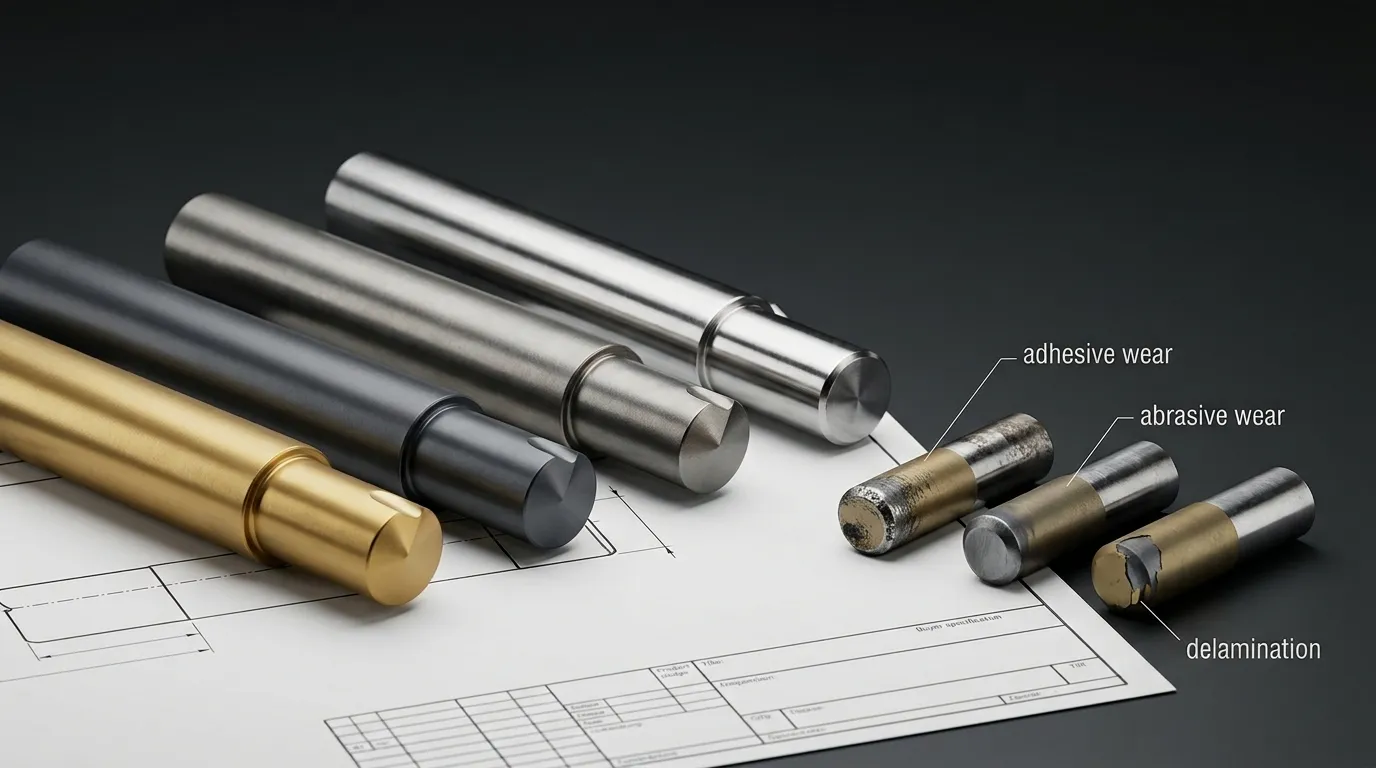
Es gibt keine universell beste Beschichtung für einen Stempelstempel. Die richtige Wahl hängt davon ab, warum der Punch sich abnutzt, welches Material es berührt, Wie der Punch unterstützt wird, und ob das Chip-Setup mechanisch einwandfrei ist.
Beginnen Sie damit, den Verschleißmodus zu identifizieren. Dann korrigiere die Freigabe, Ausrichtung, Substrat, Edge, Finish, oder Schmiermittelprobleme, die eine dünne Beschichtung nicht lösen kann. Erst danach sollten Sie Beschichtungsfamilien wie TiN vergleichen, TiCN, CrN, DLC, TiAlN, oder AlCrN.
Für eine umfassendere Orientierung zu Stempeltypen, Stanzmaterialien, Freigabe, Toleranzen, und Beschaffung, Siehe die Leitfaden für Stanzenwerkzeuge (Schlussfolgerung). Dieser Leitfaden konzentriert sich speziell auf die Auswahl von Stempelstiftbeschichtungen für das Stanzformen.
Beginnen Sie mit dem tatsächlichen Abnutzungsmuster des Stempels
Eine beschädigte Stempelfläche offenbart nicht automatisch die Ursache. Abgeschiedenes Werkstücksmaterial kann die ursprüngliche Oberfläche bedecken, während eine abgeplatzte Beschichtung Verformungen oder Risse im darunterliegenden Substrat verbergen kann..
Vor der Auswahl einer weiteren Beschichtung, Aufzeichnung:
- Wo der Schaden auftritt
- Ob es einheitlich oder einseitig ist
- Ob das Material auf die Stanz übertragen wurde
- Ob die Schneide abgerundet ist, gechippt, gerissen, oder deformiert
- Wie sich der Schaden mit der Produktionszeit ändert
- Ob die Grathöhe, Abziehkraft, oder die Teiloberfläche ändert sich gleichzeitig
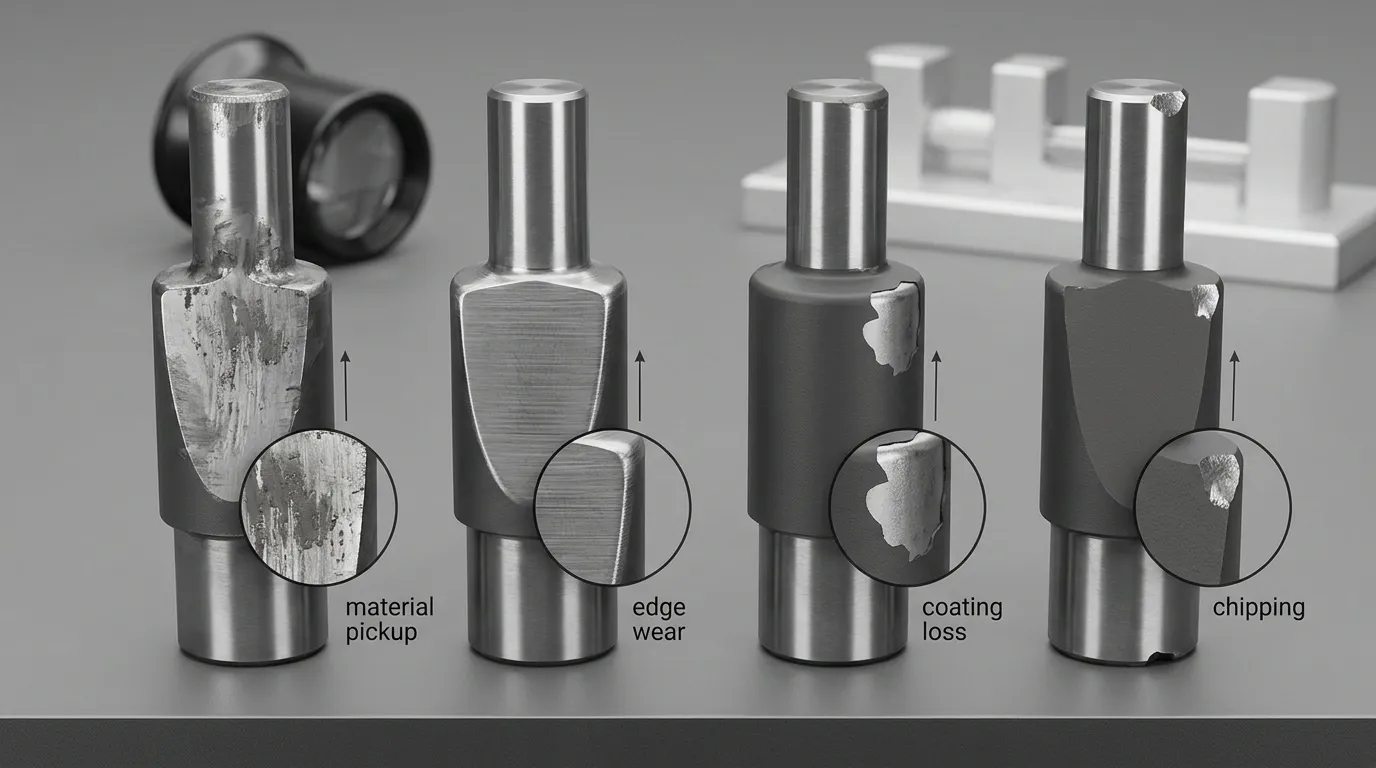
Verwendung von Fotografien, Dimensionsaufzeichnungen, Produktionszählungen, und fehlgeschlagene Proben, wo praktikabel. Standardisierte Terminologie wie die in ASTM G40 kann helfen, Verschleißkategorien zu unterscheiden, Die sichtbaren Symptome müssen jedoch weiterhin im Kontext der Stanzoperation interpretiert werden.
| Beobachteter Zustand | Kategorie des wahrscheinlichen Versagens | Was man zuerst untersuchen sollte |
|---|---|---|
| Verschmierung, Übertragenes Material, Lokale Lagerstätten, oder Punktewertung | Klebstoffverschleiß oder Galling | Werkstücksoberfläche, Finish, lubrication, Druck, und materielle Affinität |
| Richtungsrillen, Kantenrundung, oder fortschreitenden Materialverlust | Abrasiver Verschleiß | Werkstückhärte, Teilchen, Beschichtungsunterstützung, Freigabe, und Kantenbedingung |
| Beschichtungsschläge, freiliegendes Substrat, oder um lokale Schäden herumzuziehen | Delaminierung oder Kohäsivbeschichtungsversagen | Haftung, Oberflächenvorbereitung, Substratdeformation, Auswirkungen, und Prozesskompatibilität |
| Risse, Große Chips, Biegen, oder plötzlicher Bruch | Mechanischer oder Substratversagen | Trasse, Zähigkeit, Geometrie, Freigabe, Auswirkungen, und Pressladung |
| Abgeflachte oder gerollte Kante ohne offensichtlichen Beschichtungsverlust | Plastic deformation | Substrathärte, Wärmebehandlung, Last, und Kantengeometrie |
Klebeverschleiß, Galling, und Material Pickup
Klebstoffverschleiß tritt auf, wenn Werkstück und Stanzfläche so stark miteinander interagieren, dass Material zwischen ihnen übertragen werden kann. Beim Stanzen, dies kann als Verschmieren erscheinen, Aufbau, Punktewertung, oder lokalisierte Ablagerungen auf dem Stempel.
Galling wird nicht allein durch die Beschichtungshärte kontrolliert. Es hängt vom vollständigen Kontaktpaar ab:
- Stanzfläche und Beschichtung
- Werkstücklegierung und Oberflächenbehandlung
- Kontaktdruck
- Gleitstrecke
- Oberflächenrauheit
- Schmierung
- Temperatur
Eine reibungsarme Beschichtung kann in einem Materialpaar helfen, funktioniert aber unter einer anderen Last schlecht, Schmiermittel, oder Werkstücksoberfläche. Forschungen zur Blechformung zeigen, dass sich die Galling-Leistung mit Werkzeugmaterial verändert, Polnisch, Werkstückszustand, Betonung, und Oberflächenbehandlung anstatt einer einzigen Beschichtungsbewertung zu folgen. Siehe die Studie auf Werkzeugmaterialien und Oberflächenbehandlungen für die Galling-Leistung.
Für Klebeverschleiß, Die nützlichen Beschichtungseigenschaften umfassen in der Regel:
- Geringe Tendenz zur Bindung mit dem Werkstück
- Geeignetes Reibungsverhalten unter dem tatsächlichen Schmierstoffzustand
- Starke Haftung am Punch-Substrat
- Ein geschmeidiges und kontrolliertes Endergebnis
- Widerstand gegen lokale Schäden nach Beginn der Abholung
Materialaufnahme sollte nicht als Beweis dafür behandelt werden, dass die aktuelle Beschichtung chemisch ungeeignet ist. Rauheit, Trümmer, inkonsistente Schmierung, übermäßiger Seitendruck, oder eine Verunreinigung der Werkstücksoberfläche kann dasselbe Symptom verursachen.
Abrasiver Verschleiß und progressiver Kantenverlust
Abrasiver Verschleiß entfernt das Material allmählich aus dem Stempel oder der Beschichtung. Typische Schilder enthalten gerichtete Kratzer, Rillen, Kantenrundung, und ein langsamer Verlust der Maßgenauigkeit.
Mögliche Quellen sind:
- Harte Werkstücksmaterialien
- Oxide oder Schuppen
- Harte Partikel oder Ablagerungen
- Beschichtete Plattenoberflächen
- Wiederholtes Schneiden unter hohem Druck
- Schlecht gestützte Schneidkanten
Eine härtere Beschichtung kann Abrieb widerstehen, aber nur, wenn die Beschichtung haftet bleibt und das Substrat sie tragen kann. Eine sehr harte Folie über einer Verformungs- oder Absplitterbasis liefert keinen stabilen Dienst.
Für abrasive Abschlüsse, Priorisieren Sie das gesamte System:
- Verschleißfestigkeit der Beschichtung
- Coating adhesion
- Substrathärte
- Substratzähigkeit
- Korrekte Stanz-zu-Matrix-Freigabe
- Stabile Kantengeometrie
- Geeignete Beschichtungsdicke
- Kontrollierte Oberflächenvorbereitung
Veröffentlichte Härtezahlen sind nur dann nützlich, wenn ihre Testmethoden und Beschichtungssysteme verstanden sind. Sie sollten nicht als eigenständiges Ranking verwendet werden.
Delaminierung, Chipping, und Deformation sind nicht dasselbe Versagen
Beschichtungsdelamination kann als Abblättern auftreten, Abblättern, oder freiliegendes Substrat. Mögliche Ursachen sind schwache Verwachsungen, Schlechte Oberflächenvorbereitung, Übermäßige Substratverformung, Aufprallbelastung, Lokale Kantenspannung, oder ein inkompatibler Ablagerungsprozess.
Die Haftung kann durch Methoden wie Kratztests oder Einkerbungen bewertet werden, je nach Beschichtungssystem und Spezifikation. ISO 20502 deckt Kratztests für die Klebung der keramischen Beschichtung ab, während ISO 26443 behandelt qualitative Bewertung mittels Rockwell-Einrückung. Diese Standards bedeuten nicht, dass jeder beschichtete Stempel beide Tests benötigt, Sie bieten jedoch anerkannte Methoden, die angefordert werden können, wenn eine Adhäsionsverifikation wichtig ist.
Rissen, Große Chips, Biegen, oder ein plötzlicher Stempelversagen meist über die Beschichtung hinaus zeigt. Sie können darauf hinweisen:
- Unzureichende Substratzähigkeit
- Übermäßiger Aufprall
- Schlechte Lochgeometrie
- Falsche Freigabe
- Fehlstellung
- Seitenbelastung
- Probleme der Wärmebehandlung
Eine Beschichtung kann die Kernfestigkeit eines schwachen oder überladenen Schlags nicht wiederherstellen. Für eine tiefere mechanische Diagnose, Siehe Stanzbruch in Stempelwerkzeugen.
Ausschließen Sie Probleme, die eine Beschichtung nicht beheben kann
Eine Stanzbeschichtung ist ein dünnes Oberflächensystem. Es kann die Reibung verändern, Adhäsionsverhalten, Verschleißfestigkeit, und thermische Stabilität, aber sie kann die Geometrie oder den Lastweg des Chips nicht korrigieren.
Bevor du eine neue Beschichtung beantragst, Überprüfen Sie die unten stehenden Bedingungen.
Überprüfung der Freigabe, Trasse, und Seitenladung
Falscher oder ungleichmäßiger Durchstand zwischen Stanz und Stanz kann zu ungewöhnlichem Kantendruck führen, Übermäßige Gratbildung, Einseitige Abnutzung, und vorzeitige Schäden an der Beschichtung.
Check:
- Ob der Freiraum um den Stempel gleichmäßig ist
- Ob der Stempel konzentrisch in den Stempel eintritt
- Ob Führungspfosten und Buchsen abgenutzt sind
- Ob der Stripper ungleichmäßige Kraft anwendet
- Ob die Blattpositionierung stabil ist
- Ob Schmutz im Arbeitsbereich eingeschlossen ist
- Ob der Verschleiß auf eine Seite des Lochs konzentriert ist
Ein einseitiger Beschichtungsverlust ist besonders wichtig. Es kann auf eine Fehlausrichtung und nicht auf eine ungeeignete Beschichtung hinweisen.
Die Beziehung zwischen den Schlägen, Führer, Buchsen, Stripperinnen, und Verschleißkomponenten werden in der Leitfaden für die Stanzenkomponenten.
Substrat prüfen, Wärmebehandlung, Kantengeometrie, Ziel, und Schmierung
Die Beschichtung benötigt eine stabile Grundlage. Bestätigen Sie das Stanzmaterial, Härtebedingungen, und Wärmebehandlungsgeschichte vor der Auswahl der Beschichtung.
Rezension:
- Substratqualität
- Endhärte
- Erforderliche Zähigkeit
- Kantenradius und Schärfe
- Lokale Spannungskonzentrationen
- Oberflächenrauheit
- Polierungsrichtung
- Schmierstofftyp
- Konsistenz der Schmierstoffabgabe
- Ob der Prozess absichtlich trocken ist
Eine hochpolierte Oberfläche kann die Aufnahme bei einer Anwendung verringern, während eine ungeeignete Oberfläche die lokale Haftung erhöhen oder verhindern kann, dass die Beschichtung richtig haftet. Die Oberflächenvorbereitung muss sowohl den Stanzkontakt als auch den Beschichtungsprozess erfüllen.
Die Schmierung ist ebenfalls Teil des Beschichtungssystems. Eine Beschichtung, die unter kontrollierter Schmierung gut funktioniert, kann bei der Trockenproduktion versagen. Die Beschichtung sollte nicht als automatischer Ersatz für Schmiermittel behandelt werden, es sei denn, anwendungsspezifische Tests zeigen, dass der Trockenprozess stabil ist.
Passen Sie den Verschleißmodus an die Eigenschaften der Oberfläche an
Fang nicht damit an, zu fragen, "Soll ich TiN oder DLC benutzen.?"Beginnen Sie damit, zu fragen, was die Oberfläche tun muss.
| Verschleiß oder Betriebszustand | Prioritätseigenschaften | Hauptwarnungen |
| Galling or material pickup | Geringe Materialaffinität, Geeignetes Reibungsverhalten, Glattes Finish, starke Haftung | Niedrige Laborreibung garantiert keine geringe Aufnahme in der Produktion |
| Abrasiver Kantenverschleiß | Unterstützte Härte, Verschleißfestigkeit, Adhäsion, Stabile Kantengeometrie | Die maximale Härte kann die Sprödigkeit erhöhen oder die Schwäche des Substrats ignorieren |
| Abblättern oder Abblättern der Beschichtung | Haftung, Oberflächenvorbereitung, Substratstabilität, Kompatible Prozesstemperatur | Eine Neubeschichtung ohne Diagnose der Verformung kann das Versagen wiederholen. |
| Hohe Temperatur oder schnelle Zyklen | Thermische Stabilität, Oxidationsbeständigkeit, Adhäsion, Ausgewogene Zähigkeit | Die Betriebstemperatur muss auf dem tatsächlichen Prozess basieren |
| Mischadhäsion und Abrieb | Balanced Multilayer- oder Composite-Verhalten | Eine veröffentlichte Eigenschaft kann das vollständige System nicht repräsentieren |
| Auswirkungen, Chipping, or fracture | Substratzähigkeit, Geometrie, Ausrichtung, Laststeuerung | Eine härtere Beschichtung ist nicht das Hauptmittel |
Immobilienprioritäten für Klebstoffverschleiß
Für Klebeverschleiß, Konzentrieren Sie sich auf die Wechselwirkung zwischen Beschichtung und Werkstück und nicht nur auf die Härte der Beschichtung.
Nützliche Fragen sind unter anderem:
- Hat die Beschichtung eine geringe Tendenz, mit der Werkstückoberfläche zu interagieren??
- Welcher Reibungstest wurde verwendet, um die Daten des Lieferanten zu erzeugen.?
- War der Test trocken oder geschmiert.?
- Welches Material wurde als Gegenseite verwendet??
- Welches Finish wird der beschichtete Punch haben?
- Wie verhält sich die Beschichtung, wenn sich kleine Ablagerungen bilden beginnen?
Reibungswerte von verschiedenen Anbietern sind möglicherweise nicht direkt vergleichbar. Testlast, Geschwindigkeit, Luftfeuchtigkeit, Gegenseite, Oberflächenrauheit, Schmiermittel, und Messmethoden können das Ergebnis alle verändern.
Immobilienprioritäten für Abrasivverschleiß
Für abrasive Abschlüsse, Die Beschichtung muss Materialverlust widerstehen und dabei vom Stempel gestützt bleiben.
Priorisieren:
- Verschleißfestigkeit bei wiederholtem Kontakt
- Starke Haftung von Beschichtung auf Substrat
- Ausreichende Substrathärte
- Ausreichende Zähigkeit für die Kantenlast
- Stabile Beschichtungsdicke
- Kontrollierte Schneidkantenvorbereitung
Wenn sich das Substrat unter Last verformt, Selbst eine hoch verschleißfeste Beschichtung kann reißen oder sich lösen.
Immobilienprioritäten für Hot oder Mixed Wear
Hochgeschwindigkeitsstanzen, Dickes Material, Hochfestes Blatt, und starkes Gleiten kann Wärme verbinden, Abschleiß, Adhäsion, und zyklische Spannung.
In diesen Fällen, Die Shortlist könnte benötigt werden:
- Höhere thermische Stabilität
- Oxidationsbeständigkeit
- Starke Haftung
- Eine Mehrschichtarchitektur
- Ausgewogene Härte und Zähigkeit
- Kompatibilität mit dem Wärmebehandlungszustand des Punchs
Eine proprietäre Mehrschichtbeschichtung könnte geeignet sein, Aber sein Markenname allein ist keine Spezifikation. Der Lieferant sollte genügend Informationen offenlegen, um die Prozesstemperatur zu bewerten, Dicke, Oberflächenoberfläche, Empfohlenes Substrat, und beabsichtigte Verschleißbedingungen.
Vergleichen Sie gängige Beschichtungsfamilien, ohne nach einem universellen Gewinner zu suchen
Die folgende Tabelle zeigt Beschichtungsfamilien als Kandidaten, keine festen Antworten. Die tatsächliche Leistung hängt von der Beschichtungsarchitektur ab, Absetzungsprozess, Substrat, Finish, Werkstück, lubrication, und Pressebedingungen.
| Beschichtungsfamilie | Warum es in Betracht gezogen werden könnte | Zu überprüfende Bedingungen | Hauptbegrenzung |
| TiN | Gemeinsame Referenzbeschichtung; kann eine nützliche allgemeine Verschleiß- und Reibungsleistung bieten. | Substrat, Adhäsion, Finish, Dicke, Werkstückswechselwirkung | Nicht automatisch geeignet für starke Galling oder gemischte Abnutzung |
| TiCN | Oft untersucht dort, wo Abrasivität eine wichtige Rolle spielt | Zähigkeit, Adhäsion, Kantenbelastung, Abnehmungsdetails | Hohe Härte allein garantiert keine stabile Kantenleistung |
| CrN | Kann für ausgewählte Haftverschleiß- und Umformkontakte in Betracht gezogen werden. | Workpiece material, Finish, Schmiermittel, Druck | Die Ergebnisse bleiben anwendungsabhängig |
| DLC | Kann in ausgewählten Anwendungen Vorteile mit geringer Reibung und Anti-Pickup bieten. | DLC-Typ, Absetzungsprozess, Adhäsion, Temperatur, Substrat | "DLC" beschreibt eine Familie, Nicht eine einheitliche Beschichtung |
| TiAlN | Kann dort betrachtet werden, wo die thermische Stabilität zählt | Prozesstemperatur, Architektur, Werkstück, Adhäsion | Kann ungeeignet sein, wenn Galling statt Hitze das Hauptproblem ist |
| AlCrN | Kann auf anspruchsvolle Abnutzungs- oder Temperaturbedingungen untersucht werden | Lieferantensystem, Dicke, Substrat, Kantenbelastung | Die generische Zusammensetzung definiert nicht die vollständige Beschichtung |
| Proprietäres Mehrschichtsystem | Kann die Haftung ausgleichen., Verschleißfestigkeit, Zähigkeit, oder Temperaturverhalten | Vollständige technische Daten und Produktionsnachweise | Schwierig allein anhand der Marke zu vergleichen |
TiN und TiCN
TiN wird oft als Grundlage in Diskussionen über Stanzbeschichtungen verwendet. Es kann in ausgewählten Stanzanwendungen ein praktisches Gleichgewicht bieten, Aber es sollte trotzdem mit dem tatsächlichen Verschleißmodus bewertet werden, Werkstück, Schmiermittel, Oberflächenoberfläche, und Substrat.
TiCN wird häufig dort positioniert, wo Verschleißfestigkeit ein großes Problem darstellt. Das macht es jedoch nicht zur automatischen Wahl für jede abrasive Anwendung. Eine harte Beschichtung kann trotzdem versagen, wenn:
- Das Substrat verformt sich
- Die schneidenden Chips
- Die Haftung ist schwach
- Freigabe ist falsch
- Das Werkstück verursacht einen starken Materialtransfer
- Der Beschichtungsprozess beeinflusst den wärmebehandelten Stanz
SunshinePros Lochstift-Produktseite führt TiN und TiCN zu seinen verfügbaren Oberflächenbehandlungsoptionen auf. Verfügbarkeit und Kompatibilität sollten weiterhin für das exakte Lochmaterial bestätigt werden, Geometrie, Abmessungen, und Produktionsbedingungen.
CrN und DLC
CrN kann betrachtet werden, wenn Materialübertragung, Ärger, oder Gleitkontakt ist ein Problem. Die Eignung hängt vom jeweiligen Werkstück ab, Polnisch, Schmiermittel, Kontaktdruck, und Beschichtungssystem.
DLC kann relevant sein, wo ein reibungsarmes Verhalten oder eine reduzierte Haftwechselwirkung erforderlich sind. Aber, DLC ist kein festes Material. Verschiedene DLC-Systeme können variieren in:
- Zusammensetzung
- Schichtarchitektur
- Ablagerungsprozess
- Adhäsionsschicht
- Härte
- Temperaturtoleranz
- Oberflächenfinish
- Substratkompatibilität
Ein DLC-beschichteter Stanzer sollte nicht als trocken angenommen werden, nur weil der Lieferant einen niedrigen Reibungskoeffizienten meldet.
SunshinePro listet DLCs auf ausgewählten Seiten mit Edelstahl- und Hartmetall-Stanzen auf, Dies stellt jedoch nicht die universelle Verfügbarkeit für jedes Stanzmaterial oder jede Geometrie dar. Bestätigen Sie vor der Bestellung das genaue Beschichtungssystem und den Prozess.
TiAlN, AlCrN, und proprietäre Mehrschichtsysteme
TiAlN, AlCrN, und verwandte Mehrschichtsysteme können untersucht werden, wobei die thermische Stabilität untersucht werden, Oxidationsbeständigkeit, oder kombinierte Verschleißfestigkeit ist wichtig.
Diese Systeme sind in der Regel sinnvoller, wenn der Käufer es weiß:
- Die Betriebstemperatur oder das Wärmemuster
- Der dominante Verschleißmodus
- Das Lochsubstrat
- Die Beschichtungsdicke
- Die Prozesstemperatur
- Die Schichtarchitektur
- Das erforderliche Endergebnis
Ein proprietärer Name sollte die technische Spezifikation nicht ersetzen. Zwei Beschichtungen mit ähnlicher Zusammensetzung können unterschiedliche Adhäsionsschichten verwenden, Dicken, Zubereitungsmethoden, oder Ablagerungsbedingungen.
Behandle die Beschichtung und das Punch-Substrat als ein System
Eine Stanzbeschichtung funktioniert nur so gut wie das sie tragende Substrat. Die gleiche Beschichtung kann sich bei Werkzeugstahl unterschiedlich verhalten, Hochgeschwindigkeitsstahl, oder Wolframkarbid, weil jedes Substrat eine unterschiedliche Härte hat, Zähigkeit, Kantenverhalten, und Wärmebehandlungsbeschränkungen.
SunshinePro listet Werkzeugstahl auf, Hochgeschwindigkeitsstahl, ASP-Qualität, und Kategorien von Hartmetallmaterialien für Stanzprodukte. Es listet außerdem die Bearbeitung auf, Präzisionsschleifen, und Vakuum-Wärmebehandlung auf relevanten Lochseiten. Diese Fähigkeiten bestimmen den verfügbaren Kontext der Stanzfertigung, aber sie beweisen nicht, dass jedes Material jede Beschichtung erhalten kann.
Werkzeugstahl, Hochgeschwindigkeitsstahl, und Karbid erfordern unterschiedliche Prüfungen
| Substratklasse | Hauptkontrollen vor der Beschichtung | Typisches Risiko zu managen |
| Werkzeugstahl | Genaue Steigung, Endhärte, Zähigkeit, Härtungsbedingung, Oberflächenvorbereitung | Unzureichende Unterstützung, Verformung, oder Chipping |
| Hochgeschwindigkeitsstahl | Wärmebehandlungsbedingung, bewahrte Zähigkeit, Kantenintegrität, Prozesstemperatur | Sprödes Kantenverhalten oder Inkompatibilität des Beschichtungsprozesses |
| Wolframkarbid | Hartmetallqualität, binder system, Kantengeometrie, Aufprallbelastung, Zubereitung | Kantenbruch, Aufprallempfindlichkeit, oder Haftschwierigkeit |
Hartmetall kann eine starke Abrasivverschleißfestigkeit bieten., Aber es ist nicht automatisch das beste Substrat, bei dem Aufprall oder Fehlausrichtung vorliegen. Werkzeugstahl oder HSS kann in manchen Operationen eine angemessenere Zähigkeitsbalance bieten.
Der Beschichtungsanbieter sollte die genaue Substratspezifikation erhalten und nicht ein breites Etikett wie "gehärteter Stahl".
Bestätigung des Abscheidungsprozesses und der Temperaturkompatibilität
Gängige Beschichtungsrouten sind PVD, PACVD, und CVD. Der Leser muss kein Depositionsspezialist werden, Aber mehrere Prozessfragen beeinflussen den Punch:
- Welcher Ablagerungsprozess wird verwendet?
- Welche Temperatur wird der Punch erleben?
- Ist diese Temperatur mit der Wärmebehandlung des Punchs kompatibel??
- Kann die Geometrie eine ausreichende Beschichtung erhalten??
- Will die Cutting Edge, Shank, Kopf, oder Montageflächen werden maskiert?
- Wird das Polieren vor oder nach dem Auftragen durchgeführt??
- Wird der Prozess die endgültigen Abmessungen oder die Oberflächenoberfläche verändern??
Gehen Sie nicht davon aus, dass der Stempelhersteller die Beschichtung hausintern aufträgt. Die Website von SunshinePro listet Beschichtungsoptionen auf, etabliert jedoch keinen internen PVD öffentlich, PACVD, oder CVD-Einrichtung.
Vorbereitung der Steuerungsfläche, Dicke, Maskierung, und Endmaße
Die Beschichtungsdicke ist gering, Aber auf präzisen Stanzflächen kann es trotzdem eine Rolle spielen. Die RFQ sollte festlegen, ob die Maße vor oder nach der Beschichtung gelten.
Spezifizieren:
- Vorbeschichtungszustand der Oberflächen
- Erforderliche endgültige Oberflächenoberfläche
- Kantenvorbereitung
- Zu beschichtete Bereiche
- Bereiche, die maskiert werden müssen
- Endkritische Durchmesser
- Modernste Anforderungen
- Inspektionsverantwortung
- Erlaubtes Nachlackieren
SunshinePro nennt eine Toleranzfähigkeit bis zu ±0.002 mm auf ausgewählten Lochseiten. Diese Zahl sollte nicht als universelle Garantie für jedes beschichtete Teil gelten. Die endgültige Fähigkeit hängt vom Material ab, Länge, Geometrie, Beschichtungsdicke, Maskierung, und Inspektionsanforderungen.
Passen Sie die Shortlist für das Werkstück und die Produktionsbedingungen an
Allein das Werkstückmaterial reicht nicht aus, um eine Stanzbeschichtung auszuwählen. Eine Edelstahlqualität, Zum Beispiel, Verhalten kann sich je nach Härte unterschiedlich verhalten, Dicke, Oberflächenoberfläche, lubrication, und Produktionsgeschwindigkeit.
Zeichnen Sie die tatsächlichen Kontaktbedingungen auf, bevor Sie eine Empfehlung anfordern.
Erfassen Sie das Werkstücksmaterial und die Oberfläche, Nicht nur der Name der Legierung
Stellen Sie bereit:
- Materialqualität
- Härte oder Härtung
- Blechdicke
- Nackte oder beschichtete Oberfläche
- Verzinkt, galvannealed, Zinnbeschichtet, Gemalt, oder eine andere Behandlung
- Oxide oder Schuppen
- Bekannte Schadstoffe
- Material-Batch-Variation
Forschung zu Zinnbeschichtete Stahlprägung zeigt, warum die Werkstücksoberfläche wichtig ist. Materialtransfer, lubrication, Beschichtungsadhäsion, und die Substratvorbereitung interagieren auf eine Weise, die vereinfachte Laborbewertungen möglicherweise nicht erfassen.
Eine Beschichtung, die sich gegen blanken Stahl gut aussetzt, kann sich anders verhalten als eine metallische Oberflächenbeschichtung.
Schmierung enthalten, Geschwindigkeit, Last, und Kontakttyp
Der Lieferant benötigt außerdem Prozessdaten:
- Trocken- oder geschmierte Produktion
- Schmierstofftyp
- Anwendungsmethode
- Lieferkonsistenz
- Schläge pro Minute
- Presseladung
- Blechdicke
- Schneid- oder Formkontakt
- Gleitstrecke
- Abnormale Hitze
- Zeit oder Schlaganzahl vor dem Ausfall
Das Piercing beinhaltet ein anderes Kontaktmuster als das Langgleitformen. Eine für einen Umformstanz empfohlene Beschichtung sollte nicht als identisch an einer scharfen Schneide angenommen werden.
Beachten Sie, wann das Problem auftritt. Ein Versagen, das erst nach dem Erhitzen der Chips beginnt, kann eine andere Untersuchung erfordern, da der Schaden beim Start sichtbar ist.
Bereiten Sie eine Coated-Punch-RFQ vor, die ein Anbieter bewerten kann
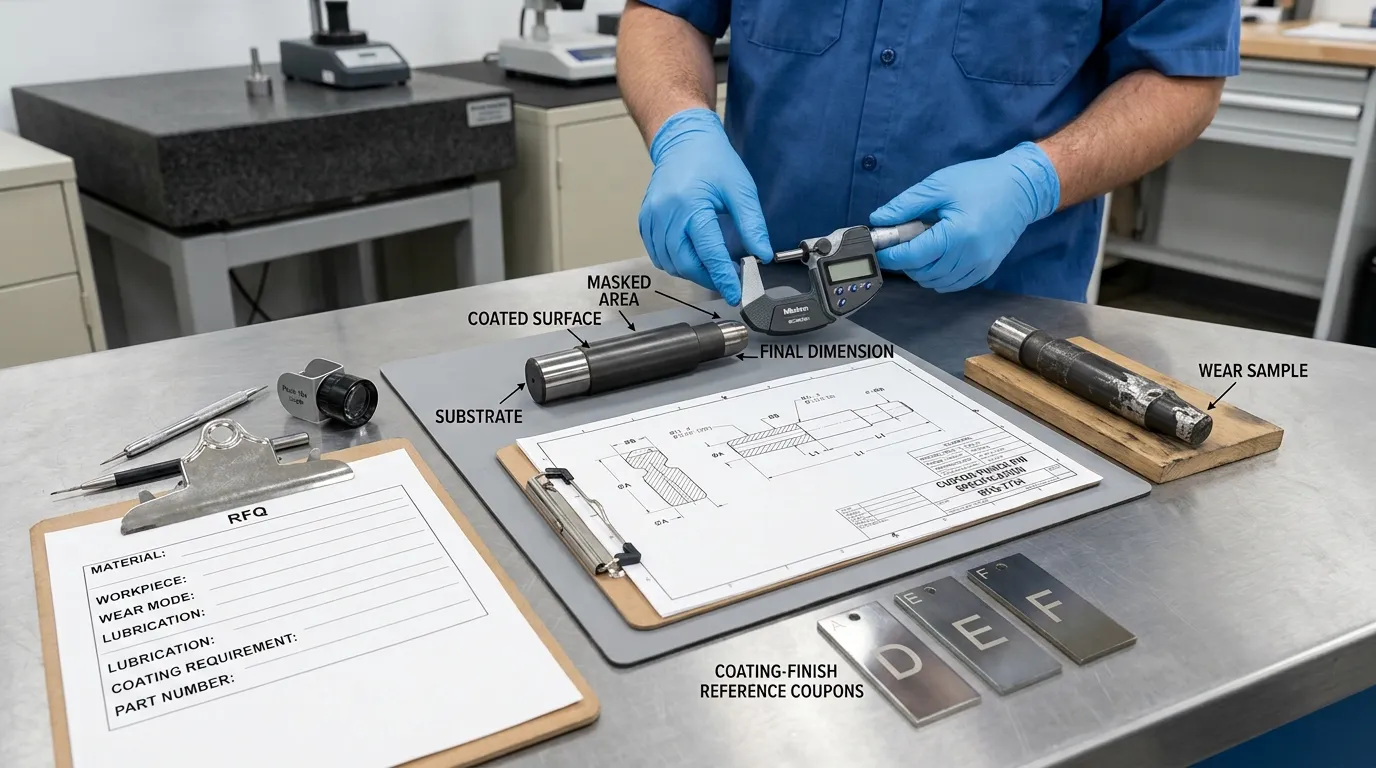
Ein Zulieferer kann eine Beschichtung nicht allein anhand des Stanzdurchmessers und des Werkstücksnamens verantwortungsvoll auswählen. Die RFQ sollte die Lochdaten zusammenfassen, Beweise für das Versagen, Produktionsbedingungen, und Inspektionsanforderungen.
SunshinePro gibt an, dass es maßgeschneiderte, nicht standardisierte Komponenten aus Zeichnungen oder Mustern produziert. Es Stempel-Lochseite und Lochstiftseiten bieten relevanten Material- und Herstellungskontext für eine individuelle Anfrage.
Anwendungs- und Lochdaten zur Bereitstellung
Einbeziehen:
- Lochzeichnung und Überarbeitung
- Critical dimensions and tolerances
- Lochgeometrie und Kopfkonfiguration
- Substratqualität
- Endhärte oder Wärmebehandlungsbedingung
- Bestehende Beschichtung oder Oberflächenbehandlung
- Werkstücksqualität
- Werkstücksoberflächenbeschichtung
- Blechdicke
- Schlagen, Piercing, oder eine Formungsoperation
- Stans-zu-Die-Freigabe
- Trassenstatus
- Schmierung
- Pressgeschwindigkeit
- Aktueller Ausfallmodus
- Aktuelles Produktionsintervall vor dem Ausfall
- Fotos von abgenutzten Punches
- Fehlgeschlagene Stanzproben, wo praktikabel
- Zielausgabe
- Akzeptanzkriterien
Beschreiben Sie den Verschleiß, anstatt nur mit "kurzer Werkzeuglebensdauer" zu schreiben. Geben Sie an, ob das Problem die Aufnahme ist, Kantenrundung, Abblättern, Chipping, Verformung, Gratwachstum, Teil-Kratzen, oder eine andere messbare Bedingung.
Beschichtungs- und Inspektionsdaten angefordert
Bitten Sie den Lieferanten, dies zu identifizieren:
- Generische Beschichtungsfamilie
- Name des proprietären Beschichtungssystems, Falls zutreffend
- Ablagerungsprozess
- Nominale Beschichtungsdicke
- Prozess-Temperatur-Kompatibilität
- Oberflächenvorbereitungsmethode
- Adhäsionsschicht oder Mehrschichtarchitektur, wo relevant,
- Maskierte Oberflächen
- Endgültige Rauheitsanforderung
- Enddimensionale Verantwortung
- Inspektionsmethode
- Beschichtungszertifikat oder Prozessprotokoll
- Nachschleifanleitung
- Einschränkungen beim Strippen und Neubeschichten
Nicht jede Bestellung erfordert einen Laboradhäsionstest, Aber der Käufer sollte wissen, welche Beweise verfügbar sind, wenn das Risiko sie rechtfertigt.
Der Stempelhersteller und der Beschichtungsanbieter sollten, wenn möglich, die Anwendung gemeinsam prüfen. Der Hersteller kennt sich mit Geometrie aus., Substrat, Wärmebehandlung, und endgültige Abmessungen, während der Beschichtungsanbieter die Abscheidungskompatibilität und die Einschränkungen des Beschichtungssystems kennt.
Validiere die Empfehlung in einer kontrollierten Produktionsstudie
Lieferantendaten und Labortests können die Shortlist eingrenzen, aber sie können die Stempelleistung nicht garantieren. Validierung vielversprechender Kandidaten unter produktionsrepräsentativen Bedingungen.
Ein nützlicher Versuch sollte nur eine kleine Anzahl verteidigungsfähiger Optionen vergleichen. Zu viele Beschichtungen zu testen und andere Variablen zu verändern, macht das Ergebnis schwer zu interpretieren.
Verwenden Sie dieselben Bedingungen und definieren Sie vor dem Versuch das Scheitern
Wo praktisch, halten diese Variablen konstant:
- Lochgeometrie
- Stanzsubstrat
- Wärmebehandlung
- Kantenvorbereitung
- Die clearance
- Trasse
- Werkstückscharge
- Schmiermittel
- Presseeinstellungen
- Inspektionsmethode
Definieren Sie das Scheitern vor Produktionsbeginn. Mögliche Endpunkte sind unter anderem:
- Maximaler dimensionsverschleiß
- Grabengrenze
- Material-Aufnahmegrenze
- Oberflächenbeschichtungsfehler
- Beschichtungsdelamination
- Übermäßige Abziehkraft
- Werkzeugabsplitterung oder -bruch
Überprüfen Sie den Stempel in geplanten Abständen und nicht erst nach vollständigem Versagen. Ein Verschleißfortschritt kann zeigen, ob eine Beschichtung den Schaden verzögert, ändert den Ausfallmechanismus, oder verbirgt lediglich die frühen Symptome.
Vergleichen Sie Kosten pro akzeptablem Teil, Nicht nur der Deckpreis
Die günstigste Beschichtung ist nicht immer die kostengünstigste Option, und die langlebigste Beschichtung ist nicht automatisch die wirtschaftlichste.
Einbeziehen:
- Herstellung von Stanzen
- Beschichtungskosten
- Kosten für das Nachschleifen
- Kosten für Entfernung und Neubeschichtung
- Pressepausen
- Reinigung und Entfernung von Abnehmern
- Schrott
- Überarbeitung
- Akzeptable-Teil-Ausgabe
Eine praktische Berechnung ist:
Gesamtkosten für Werkzeuge und Unterbrechung ÷ akzeptable produzierte Teile
Dies vermeidet nicht unterstützte Werkzeuglebensdauer-Multiplikatoren und hält die Entscheidung an die tatsächliche Produktionsleistung gebunden.
Verwenden Sie eine fünfstufige Beschichtungsauswahlsequenz
Eine verlässliche Entscheidung zur Stanzbeschichtung folgt dieser Reihenfolge:
- Klassifizieren Sie das Versagen. Separater Klebstoffverschleiß, Abschleiß, Delamination, Chipping, und Deformation.
- Korrekte nicht-beschichtete Ursachen. Überprüfung der Freigabe, Ausrichtung, Geometrie, Substrat, Wärmebehandlung, Finish, und Schmierung.
- Definiere die erforderlichen Eigenschaften. Priorisieren Sie die Haftung, Verschleißfestigkeit, Reibungsverhalten, Materialaffinität, Zähigkeit, oder thermische Stabilität entsprechend der diagnostizierten Bedingung.
- Systemkompatibilität bestätigen. Überprüfe die Beschichtungsfamilie, Substrat, Absetzungsprozess, Dicke, Maskierung, Finish, und endgültige Abmessungen.
- Validieren in der Produktion. Vergleichen Sie ausgewählte Systeme unter kontrollierten Bedingungen und messen Sie Kosten pro akzeptablem Teil.
SunshinePro liefert individuelle Stanzkomponenten basierend auf Zeichnungen oder Mustern und listet auf seinen Produktseiten mehrere Stanzmaterialien und Beschichtungsoptionen auf. Um eine sinnvolle Überprüfung zu beantragen, Schick die Lochzeichnung, Substrat, Werkstücksdetails, Verschleißnachweis, lubrication, und Produktionsbedingungen durch die SunshinePro-Kontaktseite. Das Ziel sollte eine technisch gerechtfertigte Shortlist und ein Testplan sein – nicht eine universelle Empfehlung für die Beschichtung.
Teilen:



Geschrieben von Sunshine
Bei Sunshine, Wir sind ein professioneller Hersteller und Lieferant von Präzisionsformkomponenten, bietet ein breites Produktsortiment für Stange- und Spritzgussanwendungen. Unser Kernfokus liegt auf dem Stanzen von Stempeln, Auswurfstifte und -hülsen, sowie Führungspfosten und Buchsen. Mit fortschrittlicher CNC-Bearbeitung, Strenge Qualitätskontrolle, und starke Produktionskapazitäten, Wir sorgen für Zuverlässigkeit, Hochpräzisionsteile, zusammen mit vorrätigen Standardkomponenten für schnelle und effiziente weltweite Versorgung.
NACHRICHTEN
EMPFANG SERVICE
Mit hochwertigen Teilen für jedes Budget und freundlichem Personal, das geschult ist, um Ihren Besuch informativ und unkompliziert zu gestalten.
