



Material der Stiftpositionierung der Formen und Auswahl der Härte
Mold positioning pin material and hardness should be selected as a complete specification, not as a steel name followed by the highest available HRC value. The correct choice depends on contact frequency, Seitenbelastung, Aufprallrisiko, Korrosion, lubrication, Stiftdurchmesser, Oberflächenoberfläche, and the material of the mating bushing.
Hardness improves resistance to indentation and wear, but excessive hardness or an unsuitable heat-treatment condition can reduce toughness and increase the risk of chipping or cracking. For wider context on alignment, Passform, lubrication, and system wear, Siehe Formstifte und Buchsen (Schlussfolgerung). This guide focuses specifically on selecting and purchasing the pin’s material and hardness condition.
Bestätigen Sie zuerst die Position des Stifts
Manufacturers do not always use positioning pin terminology consistently. A positioning pin may also be described as a locating pin or centring pin, while some suppliers use guide pin or leader pin for a related component.
| Komponententerm | Typische Rolle | Materialselektionsimplikation |
|---|---|---|
| Positionierungs- oder Zielstift | Stellt eine wiederholbare Endposition zwischen den Formkomponenten her | Genauigkeit, Kontaktabnutzung, Auswirkungen, and mating-bushing properties are critical |
| Leitstift oder Führungsstift | Führungen formen die Bewegung über eine größere Eingriffsdistanz | Geradlinigkeit, sliding wear, lubrication, and bushing engagement become more prominent |
| Allgemeiner Dübelstift | Stellt feste Bauteilposition in einer Baugruppe fest | Es kann sein, dass sie nicht die gleichen wiederholten Gleit- oder Aufprallbedingungen erleben |
| Ejector, Kern, or punch pin | Performs ejection, Bildung, Schneiden, or cavity-related work | Erfordert einen anderen Materialauswahlprozess |
A component can perform both guiding and final positioning functions, but the designer should confirm its actual loading before specifying the steel. A long guide pin exposed to sliding friction may need different properties from a short locating pin that receives repeated impact during mold closure.
For a broader explanation of guiding components, use the dedicated guide to Formführungsstifte. The material decisions below assume a pin used for repeatable mold positioning through engagement with a matching hole, Insert, or bushing.
Start With the Operating Conditions, Nicht die Stahlqualität
Before comparing materials, define how the pin will operate. A supplier cannot reliably select a material from diameter and length alone.
Review these conditions first:
- Contact frequency and production demand: Repeated engagement increases accumulated wear, even when each individual cycle produces only moderate contact stress.
- Impact and side loading: Fehlstellung, heavy mold sections, or abrupt engagement may require more core toughness than a lightly loaded precision locator.
- Pin diameter and section size: A steel that hardens effectively in a small pin may not produce the same through-section properties in a larger component.
- Required repeatability: Higher positioning accuracy increases the importance of dimensional stability, Rundung, Finish, and controlled wear.
- Mating-bushing design: The pin and bushing should be selected as a material pair rather than as isolated parts.
- Schmierung: Limited lubrication increases friction and the risk of adhesive wear, Ärger, or seizure.
- Kontamination: Dust, metal particles, and molding residue can create abrasive wear.
- Corrosive exposure: Luftfeuchtigkeit, Kondensation, washdown, or chemical exposure may justify hardened stainless steel or a qualified protective treatment.
- Temperatur: Elevated operating temperatures can affect hardness retention, lubricant performance, and coating suitability.
- Standard or custom sourcing: A catalog component may be adequate for common conditions, while unusual loading, Größe, or documentation requirements may require a drawing-defined part.
Material selection cannot correct poor alignment, ungeeigneter Freiraum, or an unstable layout. Those issues should be resolved separately before increasing pin hardness.
Vergleichen Sie die wichtigsten Materialstrategien
The useful comparison is not simply “steel versus stainless steel.” Buyers should compare material families together with their final heat-treatment condition.
| Materialstrategie | Hauptvorteil | Hauptbegrenzung | Typische Selektionslogik |
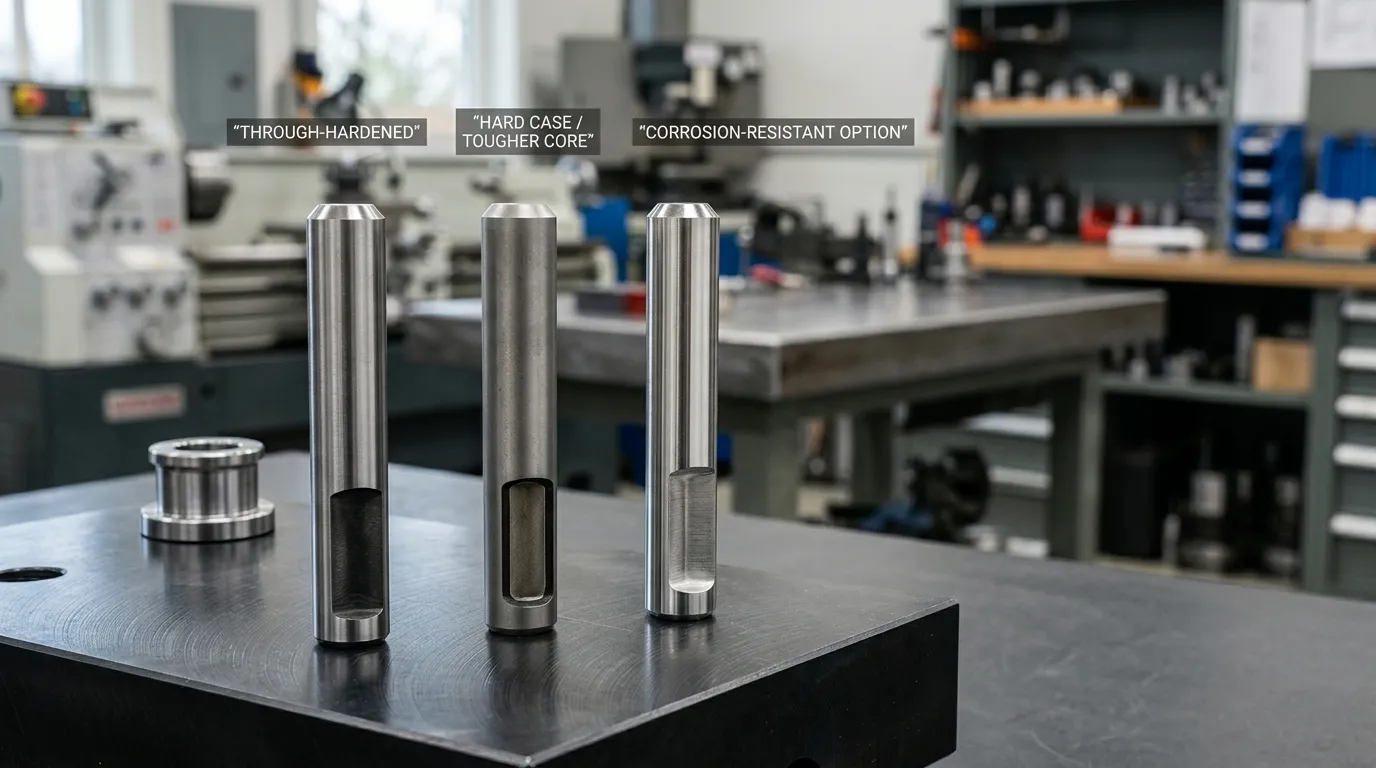
| Durchgehärteter Lagerstahl | Hohe Härte über weite Teile des Abschnitts und starkes Verschleißpotenzial | May be less forgiving under impact or severe misalignment; corrosion protection may be needed | Repeated, controlled contact with good alignment and lubrication |
| Aufgusshärtungslegierungsstahl | Harte, verschleißfeste Oberfläche mit einem robusteren tragenden Kern | Gehäusetiefe, Verzerrung, and final grinding must be controlled | Repeated contact combined with shock, Seitenbelastung, or impact risk |
| Gehärteter Werkzeugstahl | Gute Verschleißfestigkeit und potenzielle Maßstabilität bei korrekter Verarbeitung | Die Leistung variiert stark je nach Klasse und Wärmebehandlung | Individuelle Geometrie oder anspruchsvolle Verschleißbedingungen, die eine definierte Werkzeug-Stahl-Lösung erfordern |
| Gehärteter Edelstahl | Bessere Korrosionsbeständigkeit als konventionelle gehärtete Kohlenstoff- oder legierte Stähle | Erreichbare Härte, galling behavior, Zähigkeit, and cost must be assessed | Humid, washed, condensed, or corrosion-prone environments |
Durchhärtungsstahl der Lagerstähle
Through-hardening bearing steels can provide high hardness, Stärke, and wear resistance across a meaningful portion of the pin section. Ovako describes 100Cr6 as a through-hardening bearing steel intended for applications requiring high hardness and high-cycle fatigue performance.
This strategy can suit a well-aligned positioning system with repeated contact and controlled lubrication. Aber, the grade name alone does not define the finished pin. The drawing still needs a final hardness range, Wärmebehandlungsbedingung, dimensional requirements, und Inspektionsmethode.
Regional designations such as SUJ2, GCr15, 100Cr6, and AISI 52100 may be treated as related bearing-steel families in commercial discussions, but they should not be substituted automatically. The governing material standard, Chemie, cleanliness requirements, and approved heat-treatment condition should be confirmed.
Aufgusshärtende Legierungsstähle
Case-hardening steels are selected when the designer wants a hard contact surface supported by a tougher core. Beim Vergasern, carbon is introduced into the surface before hardening, creating a wear-resistant case while retaining a different core condition.
Bodycotes technische Beschreibung von Flächenhärtung und Verkohlung explains how this approach can combine surface hardness with core toughness. That balance is useful when a positioning pin experiences repeated engagement, Auswirkungen, oder Seitenbelastung.
A case-hardened specification should not stop at surface HRC. It may also need:
- Anforderungen an die Kernhärte
- Effektive Hülsentiefe
- Testorte
- Nachbehandlungs-Mahlzusatz
- Geradlinigkeit und Durchmesser nach der Endbearbeitung
A very hard but shallow case may wear through prematurely. A deep case may be unnecessary or may complicate processing. The required depth should therefore be based on load, expected wear, Pingeometrie, and the chosen steel.
Gehärtete Werkzeugstähle und Edelstahloptionen
Hardened tool steels can be appropriate where wear resistance and dimensional control are important, but their performance depends heavily on the exact grade, Härte, Härtungsbedingung, and section size. “Tool steel” is not a complete purchase specification.
Hardened stainless steel is more relevant when corrosion exposure could damage a conventional hardened steel pin. A stainless option should still be evaluated for:
- Erreichbare Härte
- Kernkraft
- Galling-Tendenz
- Oberflächenfinish
- Material zur Verbindungsbuchse
- Umweltschwere
A stainless pin with inadequate hardness may resist rust but wear too quickly. A highly hardened stainless pin may still gall against an unsuitable mating material when lubrication is poor.
SunshinePro lists SUJ2, GCr15, SKD11, and alloy steel on its Ortung der Stiftführungsbuchsen page. Those are stated specifications for that bushing product and should not be interpreted as universal material options for every positioning pin.
Choose the Hardness Architecture, Not Just the Highest HRC
Two pins with the same measured surface hardness can behave differently because their hardness profiles and core conditions are different.
A through-hardened pin aims to develop hardness across the section, subject to the steel’s hardenability and the pin diameter. A case-hardened pin concentrates high hardness near the surface while maintaining a different core condition. Nitriding creates a hard surface layer through nitrogen diffusion and is sometimes chosen where wear, scuffing, Galling-Resistenz, or lower process distortion is important.
Bodycote stellt fest, dass Gasnitriterung can improve resistance to wear, scuffing, Ärger, and seizure. Its suitability still depends on the base steel and the required layer characteristics.
| Selektionsfaktor | Durch Härtung | Aufeiferhärtung | Nitritern |
| Härteverteilung | Erstreckt sich über weite Teile des Abschnitts | Harte Oberfläche über einem anderen Kern | Gehärtete Diffusionsschicht nahe der Oberfläche |
| Tough-Core-Potenzial | Das hängt von der Qualität und der Endhärte ab | Zentraler Designvorteil | Das hängt hauptsächlich vom vorbehandelten Grundmaterial ab |
| Gehäusetiefenanforderung | Meistens nicht auf dieselbe Weise anwendbar | Oft unerlässlich | Es kann erforderlich sein, wenn die Schichttiefe die Leistung beeinflusst |
| Verzerrungskontrolle | Depends on grade, Abschrecken, und Geometrie | Erfordert Berücksichtigung für Verkohlen und Abschrecken | Oft ausgewählt dort, wo geringere Verzerrungen wertvoll sind. |
| Bester Einsatz | Kontrollierter Hochverschleißkontakt | Verschleiß kombiniert mit Stoß oder Aufprall | Oberflächenverschleiß- oder Galling-Kontrolle an einem geeigneten Stahl |
No process is universally superior. Geometrie, Laden, distortion tolerance, final grinding, Verbindungsmaterial, and supplier capability all affect the decision.
Oberflächenhärte, Core Hardness, and Effective Case Depth
A complete specification may need three separate properties:
- Oberflächenhärte: The hardness at or near the working surface. It strongly influences resistance to indentation and contact wear.
- Kernhärte: The hardness beneath the treated layer. It affects support, Stärke, und Zähigkeit.
- Effektive Hülsentiefe: The depth at which the material still meets a defined hardness criterion.
These values answer different questions. Surface hardness indicates how the contact area resists wear. Core hardness indicates whether the pin can support the surface under load. Effective case depth indicates how much usable hardened material exists before wear reaches a softer region.
For a through-hardened pin, a surface measurement may still be insufficient if section hardness is important. For a carburized pin, surface HRC without case-depth evidence does not fully describe the treated condition.
Geben Sie die Härte an, damit ein Anbieter sie überprüfen kann
A requirement such as “hardened to HRC 60” leaves several questions unanswered:
- Is 60 a target, Minimum, or nominal value?
- What range is acceptable?
- Where should the test be taken?
- Does it apply to the surface, Kern, oder beides?
- Which test method should be used?
- Is case depth required?
- Is the result measured directly or converted from another scale?
A stronger drawing or RFQ requirement should identify:
- Materialqualität und Führungsstandard
- Wärmebehandlungsweg
- Akzeptabler Härtebereich
- Härteskala
- Teststandort
- Anwendbarkeit von Oberfläche oder Kern
- Effektive Hülsentiefe bei Bedarf
- Erforderlicher Inspektions- oder Testbericht
For hardened steels, Rockwell C is commonly used. ISO 6508-1:2023 defines the Rockwell hardness-test method, während ISO 6508-2:2023 addresses verification and calibration of Rockwell testing equipment and indenters.
Vickers testing may be more useful for localized measurements, thin treated zones, or a hardness profile across a section. The relevant method is defined in ISO 6507-1:2023.
Hardness conversions should be handled cautiously. ISO 18265 provides conversion principles, but a converted value is not automatically equivalent to a direct measurement under the required method. Materialtyp, treatment condition, and measurement range can affect the relationship.
An incomplete requirement might state:
Hardened alloy steel, HRC 60.
A more usable requirement would define the material standard, Behandlung, acceptable HRC range, Messort, core condition, case depth if applicable, and reporting expectations. The exact values must come from the application rather than a generic template.
Stift und Buchse als Verschleißsystem anpassen
The positioning pin and its mating bushing form one contact system. Selecting each component independently can create avoidable wear or seizure.
A common design approach is to make the replaceable bushing the preferred wear component. That may involve selecting a pin that is harder than the bushing, but there is no universal hardness difference that suits every material pair and load condition.
Check the following together:
- Stiftmaterial und Härte
- Buchsmaterial und Härte
- Oberflächenbehandlung beider Bauteile
- Engagementlänge
- Freiraum und Ausrichtung
- Schmiermethode
- Kontaminationsexposition
- Korrosionsrisiko
- Beschichtungs- oder Behandlungsdicke
- Ersatzstrategie
Two hard surfaces can still gall if their material pairing, Finish, or lubrication is unsuitable. A rough or misaligned bushing can also damage a correctly hardened pin. Coatings and diffusion treatments may alter final dimensions, so diameter and fit should be verified after all relevant processing is complete.
SunshinePro’s locating-pin guide-bushing page states HRC 58–62, a precision-ground finish, and standard or custom sizes for that specific product. Those details may help when evaluating a matching bushing, but the final pin-and-bushing combination still needs project-specific review.
Wählen Sie nach Anwendungsrisiko
The table below provides selection directions rather than fixed material prescriptions.
| Betriebszustand | Ausgangsmaterial oder Behandlungsrichtung | Hauptprüfungen |
| Hochzykluskontakt mit guter Ausrichtung und Schmierung | Durchgehärteter Lagerstahl oder eine andere hochhärte Stahlstrategie | Section hardness, Finish, bushing pairing, Dimensionsstabilität |
| Wiederholte Aufprall- oder Seitenbelastung | Aufgusshärtender legierter Stahl mit harter Hülse und kontrolliertem Kern | Core toughness, Gehäusetiefe, Verzerrung, final grinding |
| Humid, condensed, or frequently cleaned environment | Gehärteter Edelstahl oder qualifizierte Korrosionsschutzstrategie | Erreichbare Härte, Ärger, Chemische Exposition, Verbindungsmaterial |
| Begrenzte Schmierung | Suitable material pair, fine finish, and possible nitriding or other qualified surface treatment | Galling, Beschlagnahme, treatment compatibility, Endabmessungen |
| Abrasive Verunreinigung | Hohe Oberflächenverschleißfestigkeit plus Verschmutzungskontrolle | Ziel, sealing or cleaning strategy, Gehäusetiefe, bushing replacement |
| Großer Stiftdurchmesser | Stahl mit ausreichender Härtbarkeit oder einer Flächenhärtungsstrategie | Through-section properties, core condition, heat-treatment uniformity |
| Enge Dimensionsregelung nach Wärmebehandlung | Material und Verfahren für die stabile Endschleifung ausgewählt | Grinding allowance, Geradlinigkeit, Rundung, inspection after treatment |
These directions should be confirmed against the actual pin geometry, Last, Formkonstruktion, and supplier process. Material selection should reduce risk, not replace engineering validation.
Fügen Sie die vollständige Anforderung in die Zeichnung oder Ausschreibung ein.
A useful RFQ gives the supplier enough information to evaluate material availability, Wärmebehandlung, Inspektion, und Herstellbarkeit.
Einbeziehen:
- Bauteilfunktion und Zeichnungsrevision
- Stiftdurchmesser, Länge, Geometrie, and engagement area
- Exakte Materialqualität und Führungsstandard
- Genehmigte oder verbotene Ersatznoten
- Wärmebehandlungsweg und Endzustand
- Oberflächenhärtebereich und Skalierung
- Kernhärte-Anforderung, wo nötig
- Effektive Hülsentiefe, wo nötig
- Ort und Methode des Härtetests
- Oberflächenfinish
- Durchmessertoleranz
- Anforderungen an Geradeheit und Rundheit
- Beschichtung oder Oberflächenbehandlung
- Dimensionszuschlag für Beschichtungsdicke
- Material und Härte der Verbindungsbuchse
- Erforderliches Materialzertifikat
- Wärmebehandlungsnachweis oder Zertifikat
- Härtetestbericht
- Falltiefenbericht, wo anwendbar,
- Endgültiger Maßinspektionsbericht
- Rückverfolgbarkeit und Stichprobenerwartungen
Standard catalog components may already have fixed material and hardness conditions. A custom pin needs clearer drawing control because the buyer is defining the final properties. The guide to Formstandardteile provides additional context on deciding between standard and customized mold components.
Lieferanten-Warnsignale
Review the quotation carefully when it contains any of these problems:
- "Gehärteter Stahl" ohne Klasse oder Standard
- Eine Härtezahl ohne Skala oder Bereich
- Keine Wärmebehandlungsbedingung
- Oberflächenhärte als Beweis für die Kernhärte präsentiert
- Für ein gehärtetes Design gibt es keine Anforderung an die Gehäusetiefe
- Informelle Notenersatz ohne Genehmigung
- Umgewandelte Härtewerte werden als einziger Beleg verwendet
- Kein definierter Teststandort
- Beschichtung ohne endgültige Größenverifikation spezifiziert
- Service-life claims without load, Passform, lubrication, and environmental conditions
A lower-cost quotation is not comparable if it omits material traceability, treatment details, or inspection requirements included in another supplier’s offer.
SunshinePro-Kontext für Standard- und benutzerdefinierte Anforderungen
SunshinePro’s website lists guide pins and bushings, Führungspfosten und Buchsen, Standardformkomponenten, and custom mold accessories. It also states that non-standard accessories can be produced from customer drawings or samples and that material-selection support is available.
Its Locating Pin Guide Bushing page lists SUJ2, GCr15, SKD11, Legierter Stahl, HRC 58–62, a precision-ground finish, and standard or custom sizes. These are product-specific bushing details. They should not be applied automatically to every positioning-pin design or treated as proof that every material, Behandlung, or inspection method is available for every custom part.
A technical enquiry should therefore include the complete drawing and specification rather than only a requested diameter and hardness.
Material- und Härte-Auswahl-Checkliste
Before approving a mold positioning pin specification, confirm that you have:
- Identified whether the component performs final positioning, general guidance, oder beides.
- Defined contact frequency, Auswirkungen, Seitenbelastung, lubrication, Kontamination, and corrosion exposure.
- Reviewed the mating-bushing material, Härte, Finish, and replacement strategy.
- Selected a material family based on the operating risks.
- Chosen through hardening, case hardening, or another qualified treatment route.
- Defined surface hardness and core requirements separately where needed.
- Added effective case depth for a case-hardened or nitrided design when relevant.
- Specified the hardness scale, Verbreitung, Testmethode, und Teststandort.
- Controlled final finish, Durchmesser, Geradlinigkeit, Rundung, and coating allowance.
- Requested the material, Wärmebehandlung, Härte, case-depth, and dimensional records appropriate to the project.
Once these requirements are defined, submit the drawing and technical conditions through SunshinePro’s Kontaktseite for feasibility review or a quotation. The enquiry should make clear which requirements are mandatory and where qualified alternatives may be considered.
Teilen:



Geschrieben von Sunshine
Bei Sunshine, Wir sind ein professioneller Hersteller und Lieferant von Präzisionsformkomponenten, bietet ein breites Produktsortiment für Stange- und Spritzgussanwendungen. Unser Kernfokus liegt auf dem Stanzen von Stempeln, Auswurfstifte und -hülsen, sowie Führungspfosten und Buchsen. Mit fortschrittlicher CNC-Bearbeitung, Strenge Qualitätskontrolle, und starke Produktionskapazitäten, Wir sorgen für Zuverlässigkeit, Hochpräzisionsteile, zusammen mit vorrätigen Standardkomponenten für schnelle und effiziente weltweite Versorgung.
NACHRICHTEN
EMPFANG SERVICE
Mit hochwertigen Teilen für jedes Budget und freundlichem Personal, das geschult ist, um Ihren Besuch informativ und unkompliziert zu gestalten.
