



Tiefendesign des Tablet-Punch-Bechers: Form, Kraft, und Fehlerrisiko
Tablet punch cup depth helps determine the finished tablet’s face curvature, central band, and overall appearance. A deeper cup can create a more convex tablet, but it may also reduce punch-tip strength and increase sensitivity to capping, uneven density, or wear under certain operating conditions.
There is no universal best cup depth. The correct design depends on cup radius, Tablettendurchmesser, land geometry, required compression load, formulation behavior, und Pressebedingungen. Cup depth should therefore be evaluated as one part of the wider system of Typen der Tabletpress-Werkzeuge, not as an isolated dimension.
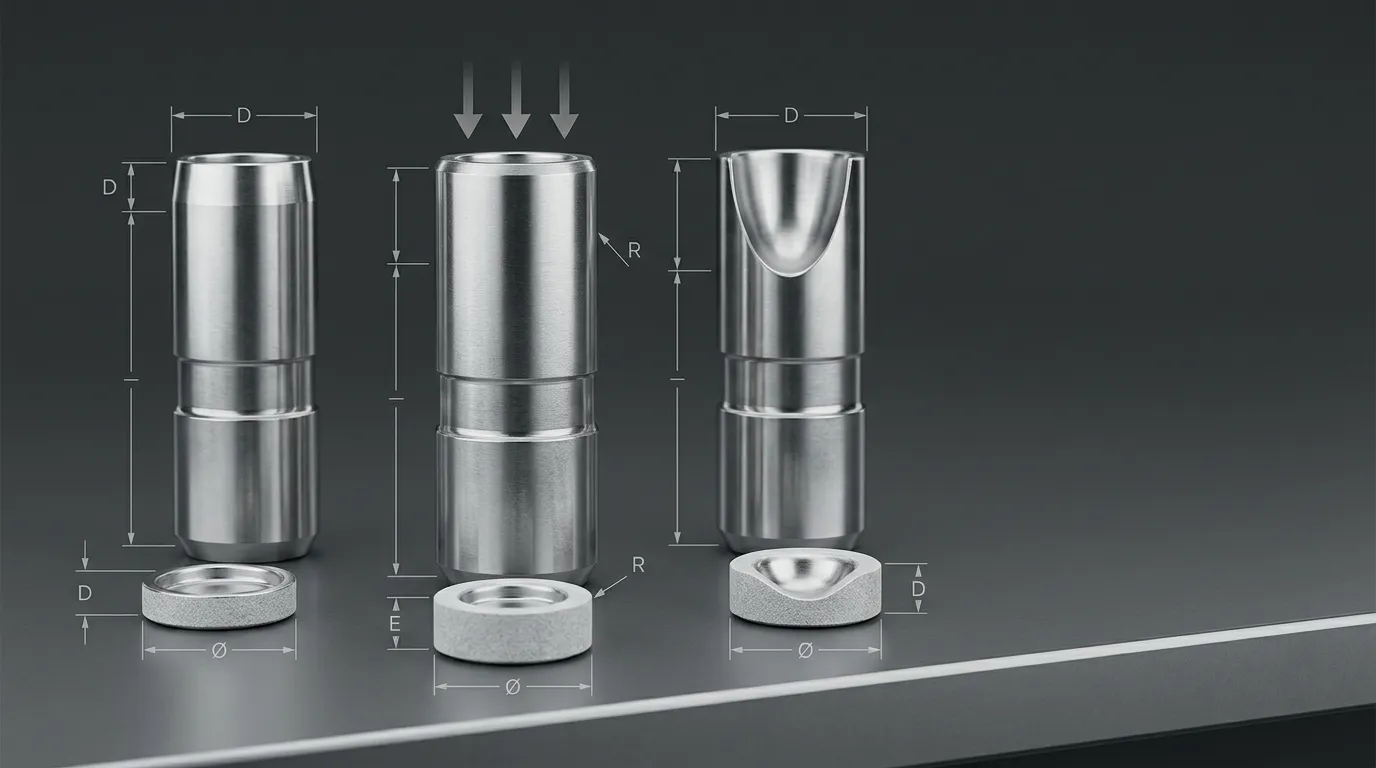
Was Tablet-Punch-Cup-Tiefe misst
The punch cup is the recessed area at the end of the punch tip. During compression, the upper and lower cups form the two main faces of the tablet while the die bore forms its central band or sidewall.
Cup depth is the vertical distance from the highest reference surface of the punch tip to the lowest point of the cup. Identification features such as embossed or debossed letters should not be included in this measurement. This distinction follows the terminology used in the APhA Tableting-Spezifikationshandbuch.
Cup depth is also separate from punch working length. Working length influences compression position and tablet consistency, while cup depth defines the shape of the tablet face.
Cup Depth, Cup Radius, and Cup Volume Are Different Variables
Cup depth alone does not fully describe the punch profile.
| Variable | Was es beschreibt | Warum es wichtig ist |
|---|---|---|
| Pokaltiefe | Der vertikale Abstand von der Referenzfläche zum tiefsten Punkt der Tasse | Influences face height, tablet convexity, and remaining punch-tip section |
| Cup-Radius | Die Krümmung, die zur Bildung der Tasse verwendet wurde | Bestimmt, wie allmählich oder scharf die Fläche sich krümmt |
| Bechervolumen | Das Volumen, das sich im versenkten Profil befindet | Beeinflusst, wie das Tablet-Volumen zwischen den Flächen und dem zentralen Band verteilt ist |
| R/D-Verhältnis | Becherradius geteilt durch den Tablet-Durchmesser | Hilft, die Krümmung über Tabletten verschiedener Größen zu vergleichen |
Two punches can have similar cup depths but different radii. One may use a smooth, broad curve, while another reaches the same depth through a steeper profile. Their tablet appearance, stress distribution, and punch-tip strength may therefore differ.
Compound cups make this distinction even more important. Instead of using one continuous radius, a compound profile combines two or more radii. This can create a smooth-looking tablet face while still producing a steep transition near the outer edge.
Wie obere und untere Körbchen das Tablettenband bilden und die Gesamtdicke
The finished tablet consists of three connected geometric regions:
- the upper cup-formed face;
- the lower cup-formed face;
- the central band formed inside the die.
For a given total tablet thickness, increasing the combined depth of the upper and lower faces generally leaves less thickness in the central band. A narrower band changes the tablet’s proportions and may influence die-wall contact, ejection behavior, and mechanical failure patterns.
Tablet diameter must also be considered. A 1 mm cup depth does not represent the same curvature on a small tablet and a large tablet. Durchmesser, Radius, depth, and band thickness must be reviewed together.
Upper and lower cup profiles do not always have to match. A tablet may use symmetrical faces, or one side may be flatter to support branding, Handhabung, Beschichtung, Verpackung, or application requirements. Any asymmetrical design should still be evaluated as one complete tablet geometry.
Wie sich gängige Punch Cup-Profile vergleichen
The names used for cup profiles describe general forms rather than one universal set of dimensions. A “deep concave” profile from one tooling system or supplier may not have exactly the same depth or radius as another.
| Pokalprofil | Allgemeiner Zustand | Haupt Designvorteil | Hauptbegrenzung oder Risiko |
| Flache Fläche | Flache Tabletoberfläche | Einfache Geometrie und relativ direkte Belastung | Bietet möglicherweise nicht das erforderliche Erscheinungsbild oder die Handhabungseigenschaften |
| Flat-faced bevel edge, or FFBE | Flaches Zentrum mit schräger Kante | Definiert die Tablet-Kante und kann eine scharfe Ecke reduzieren | Die Fasengeometrie beeinflusst den äußeren Spitzenabschnitt und die Tafelkante |
| Flat-faced radius edge, or FFRE | Flaches Zentrum mit abgerundeter Kante | Bietet einen glatteren Kantenübergang | Radiusdetails beeinflussen weiterhin Spannung und kompaktes Verhalten |
| Flache konkav | Leicht konvexe Tablettenfläche | Bietet Krümmung, während ein relativ erhebliches zentrales Band erhalten bleibt | Kann eine stark konvexe Erscheinungsanforderung möglicherweise nicht erfüllen |
| Standardkonkav | Mäßige Gesichtskrümmung | Ausgewogene Optik und allgemeine Praktikabilität der Werkzeuge | "Standard" stellt keine universelle Dimension dar |
| Tief konkav | Stark konvexe Fläche | Das erzeugt ein ausgeprägteres Tablet-Profil | Kann die Kraftkapazität der Stanzspitze verringern und die Empfindlichkeit gegenüber Kappen erhöhen |
| Extra-tiefe konkave | Stark konvexe Fläche | Trägt eine markante abgerundete Tafelform | Erzeugt aggressivere Geometrie und erfordert sorgfältige Überprüfung von Kraft und Formulierung |
| Compoundbecher | Gesicht, das aus mehreren Radien erstellt wird | Ermöglicht mehr Kontrolle über Aussehen und Kantenform | Allein die Tiefe kann ihre Auswirkungen auf Spannung oder Festigkeit nicht beschreiben |
A profile should not be selected solely from this classification. The actual drawing must specify the relevant depth, radius or radii, land, edge transition, Tablettendurchmesser, and total thickness.
Warum tiefere Cup-Geometrie die Schlagkraft verringern kann
The tablet press may be capable of applying a high compression force, but that does not mean every punch-tip design can safely carry that load.
A deeper or steeper cup removes more material from the punch-tip region and changes the path through which compression load passes. The allowable force can depend on:
- tip diameter and shape;
- cup depth and radius;
- single-radius or compound geometry;
- land width and transition geometry;
- punch material and heat treatment;
- existing wear or damage;
- the safety margin applied by the tooling designer.
Specialist tooling guidance consistently warns that machine capacity and punch-tip capacity are separate limits. A tooling design should therefore receive a drawing-specific force assessment rather than relying only on a generic press rating or tooling class.
SunshinePro listet Premium High-Speed Steel für seine Tabletpress-Werkzeuge. Material is one contributor to strength, but it does not replace a geometry-specific review of the punch tip.
Wie Land- und Cup-zu-Kanten-Übergänge die Spitzenstärke beeinflussen
The land is the narrow flat area around the perimeter of the punch tip. It provides support at the edge of the cup and influences wear, Blitz, and tablet-band appearance.
A wider or better-supported land may improve edge strength, but changing it can also alter the tablet profile. The transition between the cup and land matters as well. A smooth blend radius generally creates a less abrupt geometric change than a sharp corner.
These details cannot be selected independently:
- Cup depth affects how much material remains beneath the recessed face.
- Land width affects edge support.
- The blend radius affects the transition between the cup and land.
- Tablet appearance limits how much these features can be changed.
There is no universal minimum land width. The correct value depends on the punch shape, Material, compression requirement, tablet appearance, und Werkzeugstandard.
Compression Force, Pressure, Breaking Force, and Tensile Strength
Several different measurements are used in tablet design, and they should not be treated as synonyms.
| Begriff | Bedeutung |
| Druckkraft | The load applied by the tablet press, commonly expressed in kilonewtons |
| Verdichtungsdruck | Force divided by an applicable area, commonly expressed in megapascals |
| Tablettbruchkraft | Die gemessene Kraft, die erforderlich ist, um eine fertige Tafel in einem definierten Test zu brechen |
| Zugfestigkeit | Ein geometrieangepasstes Maß, das verwendet wird, um die mechanische Festigkeit von Tafeln zu vergleichen |
Compression pressure is often used in research because the same force produces different pressure conditions on tablets with different face areas.
Breaking force is a direct test result. Tensile strength attempts to account for tablet dimensions and geometry, making it more useful for some comparisons. Highly convex or unusual profiles may require an equation appropriate to that geometry rather than a formula developed for a flat cylindrical tablet.
Wie die Koppentiefe die Tablet-Mechanik und das Defektrisiko beeinflusst
During compression, powder does not densify uniformly in every region of a tablet. Punch shape affects how material moves, how pressure is transmitted, and where density or stress gradients develop.
Finite-element and experimental studies have found that convex punch profiles can produce more heterogeneous density distributions than flat punches. Reduced curvature radius and changes in tablet thickness may increase those gradients under the conditions studied. The effect is important because regions with different density or residual stress may respond differently during decompression and ejection.
These findings are directional, not universal. The actual result also depends on formulation properties, compression pressure, Geschwindigkeit, Schmierung, Luftfreigabe, Tablettendurchmesser, and band thickness.
Warum das Capping-Risiko nicht allein durch die Tiefe vorhergesagt werden kann
Capping occurs when part of the upper or lower crown separates from the tablet body. Research published in Pharmazeutische Forschung found that increasing punch cup depth was associated with a higher capping index in the studied acetaminophen formulation and compression conditions.
Eine separate Studie in der Internationale Zeitschrift für Pharmaceutik showed that tablet diameter, band thickness, curvature ratio, and their interactions influenced capping behavior. Greater curvature, a thinner band, and larger diameter increased capping susceptibility in that experimental system.
These studies do not prove that every deep cup will cap. They show that geometry can increase risk when combined with particular material and process conditions.
Cup-depth assessment should therefore include:
- Tablettendurchmesser;
- upper and lower curvature;
- central band thickness;
- formulation compactibility;
- elastische Rückgewinnung;
- target compression pressure;
- press speed and air-release conditions;
- existing capping history.
A shallower cup may reduce one geometric risk while failing to meet appearance, Beschichtung, Handhabung, or dosage-form requirements. The design decision is a trade-off, not a simple ranking.
Distinguishing Capping, Laminierung, Air Entrapment, and Tool Wear
Not every separation defect is caused by the cup profile.
| Beobachtung | Mögliche geometriebezogene Ursache | Weitere mögliche Ursache | Was zu überprüfen ist |
| Krone trennt sich von der Tafel | Aggressive curvature, thin band, Spannungskonzentration | Elastische Rückgewinnung, entrapped air, unsuitable pressure or speed | Ausfallort, cup profile, Formulierungsantwort, press conditions |
| Das Tablet trennt sich über eine innere Ebene | Ungleichmäßige Dichte- oder Spannungsverteilung | Schmierung, formulation weakness, air pressure | Fracture plane, density pattern, material and process history |
| Dünnes Material erscheint um das Tablet-Band herum | Damaged or worn land, clearance issue | Die wear, Ausrichtung, Übermäßige Gewalt | Punch edge, land condition, die bore, Ausrichtung |
| Defekte nehmen nach längerer Werkzeugnutzung zu | Die effektive Becher- oder Landgeometrie hat sich verändert | Prozessdrift oder Formulierungsvariation | Vergleichen Sie abgenutzte Werkzeuge mit den originalen Inspektionsunterlagen |
| Lokale Schäden erscheinen nahe dem Rand der Tafel | J-Haken oder beschädigte Stanzkante | Handhabungs- oder Auswurfproblem | Vergrößerte Spitzeninspektion und Auswurfverhalten |
Entrapped air is one important non-geometric factor. Research in the Zeitschrift für Pharmazeutische Wissenschaften shows that internal air pressure can rise during compression and contribute to cracking or capping. Powder permeability, compression speed, tablet size, and consolidation behavior all affect this mechanism.
Wie man die Bechertiefe für ein neues oder überarbeitetes Tablet auswählt
A useful selection process begins with the required tablet, not with a preferred punch profile.
- Define the finished tablet shape and dimensional limits.
- Select depth and radius together.
- Review the remaining band and edge geometry.
- Estimate the required production compression conditions.
- Confirm the allowable force for the proposed punch tip.
- Review formulation and process sensitivity.
- Compare less aggressive alternatives.
- Validate the final design through compression trials and inspection.
Beginnen Sie mit der gewünschten Form und dem Band der Tafel
Document the dimensions and functional requirements before choosing the cup profile:
- tablet diameter or major and minor axes;
- target total thickness;
- required band thickness;
- upper and lower face shape;
- edge style;
- coating and handling requirements;
- branding or identification area;
- packaging and feeding constraints.
The design team should then determine whether the appearance can be produced with a broader radius or shallower depth. A small geometric change may preserve the visual profile while increasing punch-force margin or reducing capping sensitivity.
Upper and lower profiles should also be assessed separately. A symmetrical tablet may be visually desirable, while an asymmetrical tablet may provide a flatter identification surface or better handling characteristics.
Formulierung und Prozesssensitivität prüfen
The same cup geometry can behave differently with two formulations. Relevant material properties include:
- compactibility;
- plastic or brittle deformation behavior;
- elastische Rückgewinnung;
- permeability;
- lubricant sensitivity;
- moisture condition;
- previous capping or lamination history.
Press conditions matter as well. Precompression may assist air release and early consolidation, while press speed affects the time available for densification and decompression. Detailed consolidation-time decisions belong to Tablett-Lochkopf flach und Verweilzeit, but cup depth should still be reviewed alongside those conditions.
Geometry cannot automatically compensate for a formulation that does not form a stable compact. It also should not be changed before confirming that the defect is not being caused by air entrapment, Schmierung, Druck, Geschwindigkeit, Ausrichtung, or worn tooling.
Bestätigung der Werkzeugkraftmarge und Validierung des endgültigen Entwurfs
Before manufacturing the full tooling set, Bestätigen:
- the press and tooling standard;
- the proposed upper and lower cup drawings;
- the material and heat-treatment specification;
- the expected operating-force range;
- the allowable punch-tip force for the proposed geometry;
- the required safety margin;
- the cup, land, Radius, and working-length tolerances;
- the trial and acceptance criteria.
Production trials should use the actual formulation, intended press, realistic operating speed, and expected pressure range. Evaluation should include tablet dimensions, Aussehen, breaking behavior, Begrenzung, Laminierung, Auswurf, und Stempelbedingung.
A profile is ready for approval only when both sides of the design are acceptable: the punch can withstand the operating conditions, and the formulation can produce a stable tablet with the required shape.
Was in der Lochzeichnung und RFQ angegeben werden soll
A tooling supplier cannot assess cup depth from a tablet image alone. The RFQ should separate the required tablet geometry from the tooling, press, und Produktionsbedingungen.
SunshinePro states that custom tablet tooling can be processed from drawings or samples and that its workflow includes drawing submission, design review, quotation, Produktion, Inspektion, and delivery. A controlled drawing remains the clearest way to define the required geometry.
Geometrie- und Anwendungsinformationen enthalten
| Informationen | Warum es wichtig ist |
| Tafeldurchmesser oder Haupt- und Nebenachsen | Legt den Maßstab der Flächengeometrie fest |
| Gesamtdicke des Ziels | Definiert das vollständige fertige Profil |
| Erforderliche Banddicke | Kontrolliert die zentrale Seitenwand und den Stanzenkontaktbereich |
| Obere und untere Schalentiefe | Definiert jede Fläche unabhängig |
| Becherradius oder zusammengesetzte Radien | Beschreibt die Krümmung und nicht nur die Tiefe |
| Landbreite | Definiert Stanskanten-Unterstützung und Tablet-Kante |
| Blend- oder Übergangsradius | Kontrolliert den Übergang vom Becher zum Land |
| Kantenstil | Beeinflusst die Geometrie der Tabletkante und der Locherstruktur |
| Prägung oder Prägung | Verändert lokale Geometrie und Identifikationsmerkmale |
| Tablet-Presse- und Werkzeugstandard | Bestätigt die physikalische Kompatibilität |
| Erwartete Kraft oder Druckbereich | Unterstützt die Überprüfung der Werkzeugfestigkeit |
| Formulierung und bekannte Defektgeschichte | Identifiziert anwendungsspezifische Risiken |
| Oberflächen- und Inspektionsanforderungen | Festlegung der Akzeptanzkriterien |
A supplier should also know whether an existing tablet or punch sample is being reproduced. A sample may help communicate shape, but it should not replace a controlled drawing when exact depth, Radius, land, and tolerance matter.
Toleranz, Inspektion, and Documentation Requirements
Feature-specific tolerances should be agreed on the drawing. A general supplier capability does not prove that every cup feature can or should use the same tolerance.
Define how the following will be checked:
- upper and lower cup depth;
- cup radius or profile;
- land width;
- tip dimensions;
- Arbeitsdauer;
- Gesamtlänge;
- consistency across the punch set;
- material identification;
- final inspection records.
SunshinePro’s tablet tooling page publishes a general tolerance capability of ±0.002 mm and states that material inspection reports can be provided. That figure should still be confirmed against the actual cup feature, drawing geometry, Inspektionsmethode, and production requirement.
Es wird angegeben Qualitätskontrollansatz includes raw-material inspection, In-Prozess-Überwachung, Endgültige Tests, and inspection reporting. Buyers should specify which records are required for the particular tooling order.
Wie Verschleiß die effektive Körbchentiefe und das Defektrisiko beeinflussen kann
An approved cup design can change during production life.
Repeated polishing may gradually reduce effective cup depth, alter the radius, narrow the land, or round the edge transition. Uneven wear across a punch set can also produce differences in tablet thickness or face shape.
Common wear-related warning signs include:
| Produktionssymptom | Werkzeugprüfung |
| Das Tablet-Gesicht wird weniger definiert | Vergleiche Cup-Tiefe und Profil mit der genehmigten Zeichnung |
| Änderungen des Tablet-Band-Aussehens | Inspect land width, edge transition, und Stempelzustand |
| Das Kappen tritt nach einer Phase stabiler Produktion auf | Check for J-hooking, worn land, altered cup geometry, and process drift |
| Die Abmessungen variieren je nach Station | Vergleichen Sie Schläge über das gesamte Set hinweg |
| Blitze erscheinen rund um die Band | Inspect punch-tip edges, die clearance, Verschleiß, und Ausrichtung |
J-hooking occurs when the punch-tip edge becomes deformed or develops a hooked profile. This damaged edge may disturb tablet release and contribute to capping, Laminierung, or flashing.
Before redesigning the cup, compare the current tooling with its original measurement and inspection records. A design that performed correctly when new may be experiencing a maintenance or wear problem rather than a fundamental geometry error.
Häufige Konstruktionsfehler bei der Bechertiefe
- Tiefenauswahl allein anhand des Tablet-Aussehens
Appearance does not reveal punch-tip strength, density distribution, or formulation sensitivity. - Behandlung von Tiefe und Radius als austauschbar
Two profiles with the same depth can have different curvature and stress behavior. - Tablettendurchmesser ignorieren
A fixed depth has a different meaning on different tablet sizes. - Das zentrale Band ignorieren
Deeper faces may reduce band thickness and change mechanical behavior. - Verwendung der Maschinenkapazität als Stanzkraftgrenze
The press may be able to apply more load than the punch tip can safely withstand. - Land- und Übergangsdetails bleiben undefiniert
The cup edge is part of the structural design, not a minor finishing feature. - Vorausgesetzt, alle tiefen Becher verursachen Deckel
Depth may increase susceptibility, but formulation and process conditions determine the actual result. - Angenommen, flache Becher beseitigen Defekte
Capping and lamination can still result from air, elastische Rückgewinnung, Schmierung, Druck, Verschleiß, or other causes. - Kopieren eines Profils aus einem anderen Tablet-Durchmesser
The depth-to-diameter and radius-to-diameter relationships may be different. - Werkzeugverschleiß ignorieren
A worn punch may no longer match the approved cup profile. - Anwendung einer allgemeinen Toleranz auf jedes Merkmal
Pokaltiefe, Radius, land, and working length may require different controls. - Genehmigung der Zeichnung ohne produktionsrelevante Versuche
Dimensional correctness does not prove formulation compatibility.
Wann sollte man einen Lieferanten für Tablet-Werkzeuge einschalten
Supplier review is useful when the cup is deep, compound, asymmetrical, unusually small, intended for high compression load, or associated with recurring tablet defects. It is also appropriate when an existing punch or tablet sample must be reproduced.
SunshinePros Tabletpress-Werkzeuge page confirms punches and dies, Premium-Hochgeschwindigkeitsstahl, standard and non-standard size options, and customization based on drawings or samples. It also states that material inspection reports are available.
Vor der Bestellung, request drawing-specific confirmation of:
- upper and lower cup geometry;
- Material;
- feature tolerances;
- press and tooling compatibility;
- Inspektionsmethode;
- Dokumentation;
- allowable punch-tip force.
SunshinePro does not publicly confirm formulation testing, finite-element analysis, capping trials, or pharmaceutical-process validation. Those requirements should be discussed and verified separately rather than assumed from its general tooling capabilities.
Once the tablet geometry, expected operating conditions, and inspection requirements are defined, Reichen Sie die Werkzeugzeichnung oder die Probe ein for manufacturing review and quotation.
Freigeben:



Geschrieben von Sunshine
Bei Sunshine, Wir sind ein professioneller Hersteller und Lieferant von Präzisionsformkomponenten, bietet ein breites Produktsortiment für Stange- und Spritzgussanwendungen. Unser Kernfokus liegt auf dem Stanzen von Stempeln, Auswurfstifte und -hülsen, sowie Führungspfosten und Buchsen. Mit fortschrittlicher CNC-Bearbeitung, Strenge Qualitätskontrolle, und starke Produktionskapazitäten, Wir sorgen für Zuverlässigkeit, Hochpräzisionsteile, zusammen mit vorrätigen Standardkomponenten für schnelle und effiziente weltweite Versorgung.
NACHRICHTEN
EMPFANG SERVICE
Mit hochwertigen Teilen für jedes Budget und freundlichem Personal, das geschult ist, um Ihren Besuch informativ und unkompliziert zu gestalten.
