



Tafelwerkzeug-Stahlauswahl nach Verschleiß, Korrosion, und Load
Tablet tooling steel selection should start with the application, not a familiar grade name. The right material depends on three main pressures: abrasive wear from the formulation, corrosion from product or cleaning exposure, and mechanical load from compression, Auswirkungen, Biegen, and tablet ejection.
Material selection also comes after the tooling format and press compatibility have been established. For that broader context, review the available Typen der Tabletpress-Werkzeuge. This guide focuses only on choosing the steel or material family for the punches and dies.
No single steel is best in every condition. A wear-resistant grade may chip in a high-impact application, while a tough grade may wear too quickly against an abrasive formulation. The goal is to identify the dominant risk, account for secondary risks, and specify the material condition clearly enough for a supplier to evaluate it.
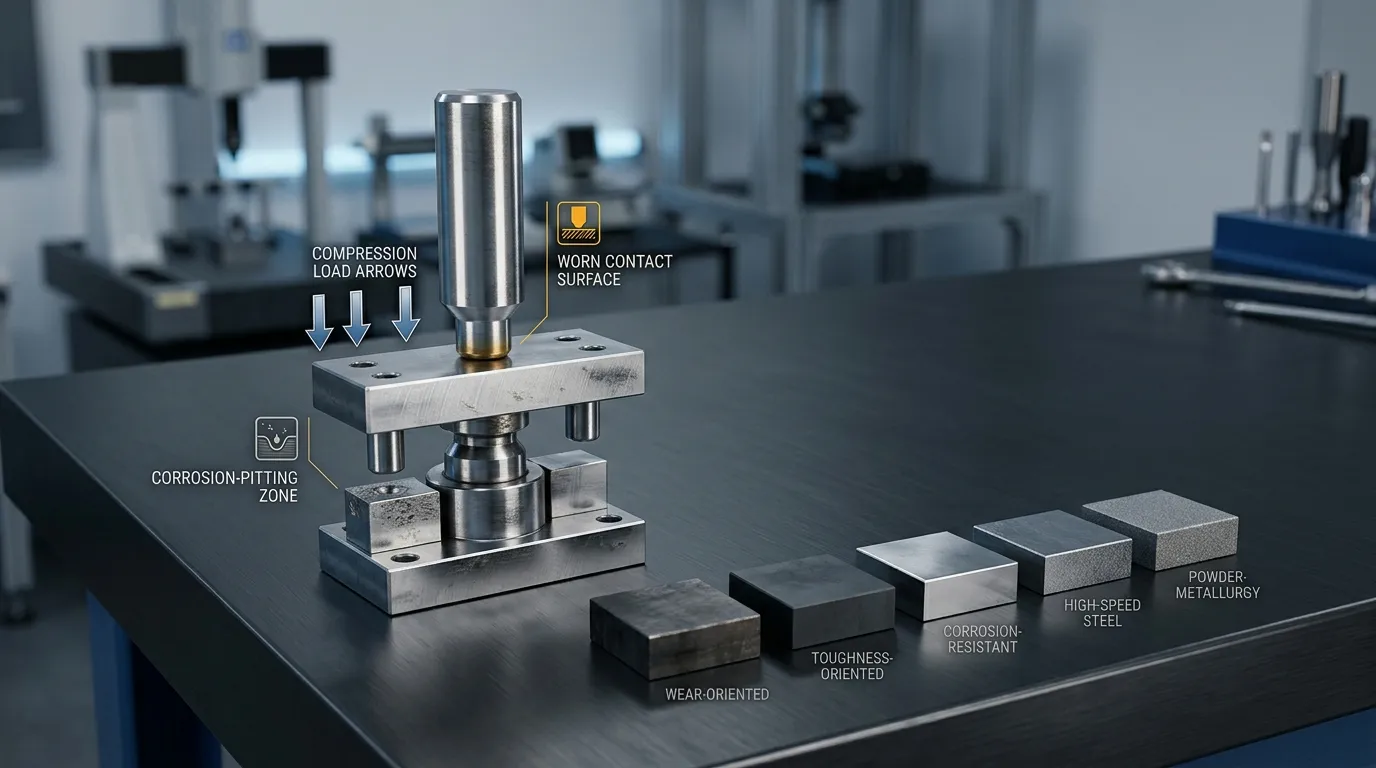
Start With the Application, Not the Steel Grade
A material name alone does not describe the conditions the tooling must survive. Before comparing D2, S7, 440C, Hochgeschwindigkeitsstahl, or powder-metallurgy grades, collect the application data that controls the decision.
Review the following factors:
- Formulation characteristics: Identify hard minerals, crystalline ingredients, salts, acids, chlorides, Feuchtigkeit, and other substances that may cause wear or corrosion.
- Tablet-Geometrie: Record the cup depth, punch-tip diameter, Prägung, Spielergebnisse, narrow features, and sharp transitions that may concentrate stress.
- Compression conditions: Document the operating load, Geschwindigkeit, pre-compression arrangement, and any history of overloaded or damaged tooling.
- Ejection behavior: High ejection resistance can increase stress on the lower punch and friction against the die bore.
- Cleaning exposure: Include cleaning chemicals, water quality, contact time, drying method, and storage conditions.
- Current failure symptoms: Note where wear, Gruben, Chipping, Knacken, Verformung, or dimensional change appears.
- Production demand: Consider run length, changeover frequency, inspection intervals, and the cost of unplanned tooling replacement.
These inputs are more useful than simply telling a supplier that the tablets are pharmaceutical, Nutraceutical, or chemical products. Two formulations in the same category can create very different tooling conditions.
Identifizieren Sie das dominante Versagensrisiko
The first step is deciding which failure mechanism deserves the highest priority.
| Beobachteter Zustand | Wahrscheinliches Risiko | Materielle Eigenschaft zu priorisieren | Weitere Faktoren zu überprüfen |
|---|---|---|---|
| Allmählicher Verlust von Stanzflächendetails oder Durchmessergröße | Abrasiver Verschleiß | Verschleißfestigkeit und erhaltene Härte | Particle hardness, Oberflächenoberfläche, Produktionsvolumen |
| Verschmierung, Ärger, or metal transfer | Haftverschleiß | Oberflächenkompatibilität und Finish | Schmierung, Ausrichtung, Beschichtung, Kontaktdruck |
| Staining, rough spots, or localized pits | Korrosion | Korrosions- und Lochfestigkeit | Formulation chemistry, cleaning agent, drying |
| Wiederholtes Absplittern oder Rissen der Spitze | Bruch | Zähigkeit und Belastungsbeständigkeit | Pokaltiefe, Prägung, Ausrichtung, Wärmebehandlung |
| Permanente Deformation | Übermäßige Last | Druckfestigkeit und Endhärte | Presseeinstellungen, Werkzeugmaße, overload history |
| Ungleichmäßiger Verschleiß um das Werkzeug herum | Fehlausrichtung oder ungleichmäßige Belastung | Nicht unbedingt ein Stahlproblem | Pressezustand, Führer, Aufbau, tooling geometry |
Verschleiß, Korrosion, and fracture can produce similar early symptoms. A rough punch face, Zum Beispiel, may result from corrosion, abrasive attack, poor polishing, coating damage, or adhesive transfer. Changing steel before confirming the failure mechanism may replace one problem with another.
Kombinierte Bedingungen bewerten
Many applications do not fit into one category.
An abrasive and corrosive formulation needs more than maximum hardness. A highly wear-resistant grade may still suffer surface attack, while a corrosion-resistant steel may lose dimensions too quickly under severe abrasion.
A high-load and abrasive application creates a different balance. Wear resistance matters, but the punch must also tolerate impact, Biegen, and local stress around deep cups, narrow tips, Spielergebnisse, or detailed embossing.
Use three questions to frame the shortlist:
- Which condition is most likely to stop production first?
- Which secondary condition could eliminate an otherwise suitable grade?
- Can the risk be controlled through component-specific materials, Wärmebehandlung, Oberflächenoberfläche, or coating?
Where all three risks are high, published grade descriptions may not be enough. A supplier review, sample tooling, and controlled production trial may be more reliable than a universal recommendation.
Balance Wear Resistance, Zähigkeit, Korrosionsbeständigkeit, and Strength
Tool steel properties interact. Improving one property does not guarantee better overall performance.
Verschleißfestigkeit helps the punch face and die bore retain dimensions against hard particles and repeated contact. It is especially important when the formulation contains abrasive minerals or crystalline ingredients.
Zähigkeit describes the steel’s ability to tolerate impact, Biegen, and stress without chipping or cracking. It becomes more important around thin punch tips, Tiefe Becher, sharp engraving, and other stress-concentrating features.
Druckfestigkeit helps the tooling resist permanent deformation under compaction pressure. This is different from toughness: a material can resist deformation yet remain vulnerable to brittle fracture.
Korrosionsbeständigkeit matters when the tooling contacts moisture, acids, salts, chlorides, reactive ingredients, or aggressive cleaning chemicals. The actual exposure conditions matter more than a broad label such as “stainless.”
Dimensionsstabilität affects whether the tooling retains critical geometry after heat treatment and during repeated use. It also influences the consistency of tablet dimensions and tooling interchangeability.
Polierbarkeit und Oberflächenbindung affect friction, product release, cleaning, embossing definition, and the tendency for material to adhere to the working surface.
Warum härter nicht automatisch besser ist
Hardness is easy to compare, which is why buyers sometimes use it as the primary specification. That can be misleading.
Higher hardness may improve resistance to abrasive wear, but it does not automatically improve toughness, corrosion behavior, Dimensionsstabilität, or resistance to impact. A very hard punch can still fail early if its geometry creates a sharp stress concentration or the press applies an uneven bending load.
The final decision should consider four items together:
- Exakte Stahlqualität
- Wärmebehandlungsbedingung
- Endhärte
- Tatsächliche Bauteilgeometrie und -funktion
A hardness number without the grade, Wärmebehandlungsbilanz, and application context is an incomplete specification.
Vergleichen Sie Stahlfamilien nach ihren besten Bedingungen
Common tablet-tooling materials are better understood as conditional options rather than a ranked list.
| Material family | Typische Selektionsstärke | Hauptbeschränkung bei der Überprüfung | Mögliches Anwendungssignal | Was der Käufer überprüfen sollte |
| D2-Typ Kaltarbeitsstahl | Starke Abrasiv-Verschleißfestigkeit | Geringere Risstoleranz als zähigkeitsorientierte Qualitäten | Verschleiß-dominante Anwendung mit kontrolliertem Aufprall | Genaue Steigung, Wärmebehandlung, Härte, Geometrie |
| S7-Typ stoßbeständiger Stahl | Hohe Zähigkeit und Stoßfestigkeit | Bietet möglicherweise nicht die höchste Abnutzungsfestigkeit | Chipping, shock, Biegen, or fracture is the main risk | Final condition, wear demand, Oberflächenbehandlung |
| 440C Edelstahl | Korrosionsbeständigkeit mit hoher erreichbarer Härte | Not corrosion-proof; wear and toughness still require review | Produkt- oder Reinigungseinwirkung birgt ein erhebliches Korrosionsrisiko | Exposure chemistry, Härte, passivation or finish |
| Hochgeschwindigkeitsstahl | Useful hardness, Verschleißfestigkeit, and strength depending on grade | "HSS" umfasst viele Kompositionen und Bedingungen | Der Lieferant bietet eine definierte HSS-Klasse an, die der Anwendung entspricht | Exact designation, chemistry, Wärmebehandlung, reports |
| Powder-metallurgy tool steel | Potentially strong balance of wear, Zähigkeit, Stärke, und Stabilität | Kosten und Immobilien variieren stark je nach Steigung | Die kombinierten Bedingungen übersteigen die Fähigkeit konventioneller Qualität | Exact PM grade, published data, trial evidence |
| Karbid oder mit Hardmetall ausgekleidete Matrize | Sehr hoher Verschleiß und Druckfestigkeit | Sprödigkeit und Anwendungskompatibilität | Starker Verschleiß an der Die-Bohrung ist das dominierende Problem | Insert design, impact risk, formulation compatibility |
Offizielle technische Dokumentation für eine D2-äquivalente Note wie Uddeholm Sverker 21 describes a profile centered on abrasive-wear resistance, with cracking resistance remaining an important limitation. An S7-based grade such as Uddeholm Compax Supreme places more emphasis on toughness and heavy-duty impact conditions.
That distinction is useful, but it should not become a universal D2-versus-S7 verdict. A more focused comparison belongs in D2 vs S7 Stahl für Tablet-Punches.
For corrosion-oriented applications, BÖHLER N695 und Carpenter 440C provide useful reference information for 440C-type martensitic stainless steel. The material can achieve high hardness while offering stainless characteristics, but its suitability still depends on the specific chemical exposure and final condition.
Powder-metallurgy steel is also not one uniform category. A specific grade such as Uddeholm Vanadis 4 Extra is designed around a particular balance of ductility, Verschleißfestigkeit, Druckfestigkeit, und dimensionale Stabilität. Those attributes cannot be assumed for every steel produced through a PM process.
Behandle generische Etiketten als unvollständige Spezifikationen
Terms such as “HSS,” “stainless steel,” and “PM steel” identify broad families, not complete tooling specifications.
Bitten Sie den Lieferanten um Bestätigung:
- Genaue Note oder anerkanntes Äquivalent
- Whether the material applies to the punch, die, insert, or complete tooling set
- Wärme- oder Losrückverfolgbarkeit
- Wärmebehandlungsbedingung
- Endhärte
- Oberflächenfinish
- Beschichtung oder andere Oberflächenbehandlung
- Anforderungen an die Maßprüfung
SunshinePros Tablet-Presswerkzeuge page lists Premium High-Speed Steel, CNC-Bearbeitung, Wärmebehandlung, und individuelle Verarbeitung aus Zeichnungen oder Proben. The page does not identify the exact HSS grade, so that detail should be confirmed for the specific application rather than assumed.
Wählen Sie Stanz- und Matrismaterialien nach Bauteilanforderungen aus
Punches and dies operate as a set, but they do not experience identical conditions.
| Bauteilbereich | Hauptaufgabe | Typische materielle Bedenken |
| Obere Stempelspitze | Komprimiert und formt die obere Tafelfläche | Face wear, Chipping, embossing damage, local stress |
| Untere Stanzspitze | Unterstützt Kompression und wirft das Tablet aus | Verschleiß, ejection load, Reibung, edge damage |
| Lochhals und -lauf | Überträgt Last und hält die Ausrichtung aufrecht | Biegen, Ermüdung, Maßgenauigkeit |
| Punchkopf | Kontakte, Pressnocken und Walzen | Auswirkungen, Kontaktabnutzung, head-profile accuracy |
| Die bore | Enthält Pulver und Führungen, Kompression und Auswurf | Abrasiver Verschleiß, Radialdruck, Korrosion, dimensional enlargement |
A punch with a deep concave cup or narrow tip may require greater fracture resistance than a broad, shallow punch used under similar compression conditions. Detailed embossing and break lines can also create local stress concentrations.
The die bore has a different priority. It experiences repeated contact with powder and the tablet edge, radial pressure during compression, and friction during ejection. Gradual die-bore wear may change tablet diameter and ejection behavior even when the punches remain usable.
For severe applications, the most suitable solution may involve different material priorities for punches and dies rather than one grade for the entire set.
Check Heat Treatment, Oberflächenfinish, Beschichtung, and Press Condition
A correct nominal grade can still perform poorly when its final condition or operating environment is unsuitable.
Wärmebehandlung develops the steel’s working hardness, Zähigkeit, Dimensionsstabilität, and residual-stress condition. Two tools made from nominally the same grade may behave differently if their heat treatment differs.
Schleifen und Polieren influence friction, Adhäsion, cleaning, and local stress. Schleifschaden, sharp transitions, or an unstable polished finish can shorten service life.
Oberflächenbeschichtungen may reduce friction, adhesive pickup, Verschleiß, or corrosion under appropriate conditions. They remain part of a material system, not a replacement for the base steel. A coating cannot correct inadequate substrate toughness, poor heat treatment, ungeeignete Geometrie, or press misalignment.
Pressezustand can overload an otherwise appropriate tool. Die begutachtete Begutachtung Ein Update zu Fortschritten in der Tablet-Werkzeugtechnologie discusses the interaction among tooling design, Stahl, Beschichtungen, Verschleiß, Korrosion, und Fehlausrichtung. That interaction is why material changes should follow a root-cause review rather than replace one.
Gib dem Stahl nicht die Schuld, bevor du die Ausrichtung und Geometrie überprüft hast
Repeated breakage in the same location may indicate an alignment, Aufbau, or geometry problem.
Check for:
- Ungleichmäßige Abnutzung um den Stempel oder die
- Kontaktspuren auf einer Seite des Werkzeugs
- Wiederholtes Versagen an einer schmalen Spitze oder einem scharfen Übergang
- Übermäßig tiefe Becher
- Feine Prägung oder Unterbrechung von Linien, die lokalen Stress verursachen
- Beschädigte Führungen oder inkonsistente Pressaufstellung
A tougher steel may tolerate more abuse, but it cannot correct misalignment. Similarly, a harder steel may slow surface wear while making a stressed punch feature more vulnerable to chipping.
Verwenden Sie eine Verschleiß-Korrosions-Last-Matrix, um die Shortlist zu erstellen
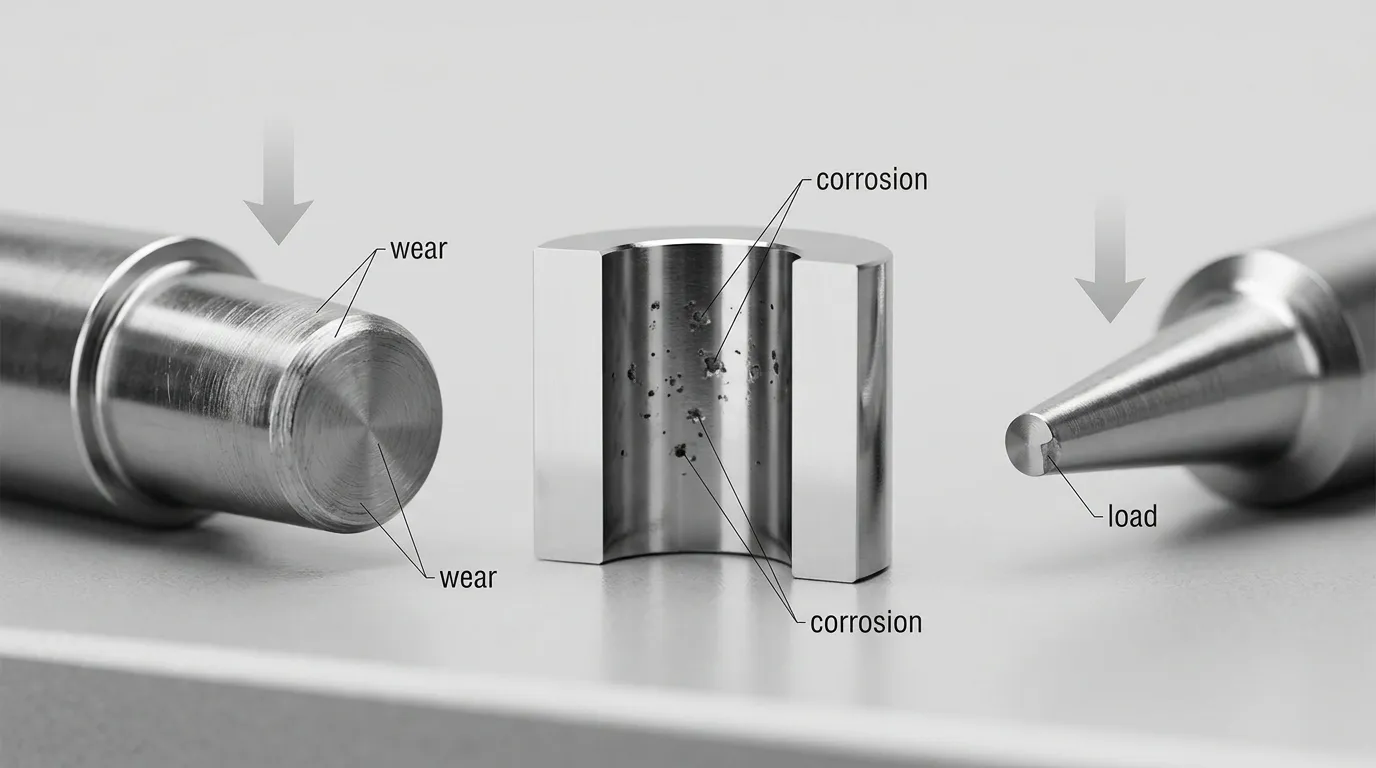
The following matrix is a practical starting point. It does not replace an application-specific material review.
| Verschleißrisiko | Korrosionsrisiko | Lastrisiko | Anfängliche Auswahlrichtung |
| Hoch | Niedrig | Niedrig bis mäßig | Investigate wear-oriented tool steel; confirm adequate toughness |
| Niedrig bis mäßig | Niedrig | Hoch | Untersuchen Sie zähigkeitsorientierten Stahl und überprüfen Sie die Geometrie des Stanzes |
| Niedrig | Hoch | Niedrig bis mäßig | Investigate corrosion-resistant steel; verify hardness and wear demand |
| Hoch | Hoch | Moderat | Investigate balanced stainless or PM options, surface strategy, and trial tooling |
| Hoch | Niedrig | Hoch | Balance wear with toughness; consider component-specific materials |
| Moderat | Hoch | Hoch | Prioritize corrosion behavior and fracture resistance; validate under actual cleaning and load conditions |
| Hoch | Hoch | Hoch | Require supplier engineering review, documented properties, and controlled testing |
Use the matrix in five steps:
- Rate the relative wear, Korrosion, and load risks.
- Identify the condition most likely to stop production first.
- Remove materials that cannot tolerate the secondary risk.
- Check whether punches and dies need different priorities.
- Confirm the shortlist through documentation, Inspektion, and testing.
The matrix should produce a shortlist, not an automatic approval. Wärmebehandlung, Geometrie, Finish, Beschichtung, Pressezustand, and supplier process control can still change the result.
Bereiten Sie die Ausschreibung vor und überprüfen Sie die Beweise des Lieferanten
A supplier can make a more defensible recommendation when the RFQ includes the actual operating conditions rather than only the tablet dimensions.
Senden Sie mit der RFQ
Stellen Sie bereit:
- Werkzeugzeichnung, tablet drawing, or physical sample
- Press make, Modell, and tooling format
- Tablet diameter, Form, Bechertiefe, score, and embossing
- Abrasivität der Formulierung und bekannte chemische Exposition
- Reinigungschemikalien und Trocknungsverfahren
- Kompressions- und Auswurfbedingungen
- Erwartete Produktionsnachfrage
- Current tooling material, falls bekannt
- Fotos und Orte früherer Ausfälle
- Erforderliche Oberflächenoberfläche oder Beschichtung
- Anwendbare Inspektions- und Maßanforderungen
SunshinePro states that its tablet tooling can be customized from drawings or samples and that material-selection advice is available. Those capabilities can support the discussion, but the exact grade and final specification still need to be confirmed for the order.
Anfrage vom Lieferanten
Ask for:
- Genaue Stahlqualität oder gleichwertige Bezeichnung
- Materialzertifikat oder Materialinspektionsbericht
- Wärme- oder Grundstücksidentifikation
- Wärmebehandlungsbedingung
- Endgültiger Härtebericht
- Maßsinspektionsbericht
- Oberflächen-Finish-Spezifikation
- Coating specification, Wo zutreffend
- Bestätigung des verwendeten Maßstandards
- Von der Anbieter identifizierte Anwendungsbeschränkungen
Der offizielle Anwendungsbereich von ISO 18084:2011 covers the main dimensions, Toleranzen, Eigenschaften, sowie die Austauschbarkeit von Tablet-Stanzen und Stanzen. It should not be treated as approval of a particular steel grade.
For pharmaceutical manufacturing, 21 CFR 211,65 requires product-contact surfaces to avoid being reactive, additive, or absorptive in a way that affects the drug product. The regulation does not provide a universal list of “FDA-approved” tablet-tooling steels. Material, Beschichtung, Schmiermittel, cleaning, and contamination risks still require application-specific assessment.
Wann man eine Prüfung anfordern sollte statt einer universellen Empfehlung
Trial tooling is appropriate when:
- Verschleiß, Korrosion, and load are all significant
- Die derzeitige Ausfallursache ist unklar
- Eine neue Formulierung wird eingeführt
- Eine proprietäre oder unbekannte Klasse wird vorgeschlagen
- Die Werkzeuge umfassen hochbelastete Geometrie
- Veröffentlichte Materialdaten stellen nicht die reale Betriebsumgebung dar
Define the trial criteria before production starts. Inspect dimensional change, Oberflächenzustand, Korrosion, Chipping, Knacken, coating damage, Auswurfverhalten, and tablet quality at agreed intervals.
Do not evaluate the trial using an unsupported cycle-life expectation. Compare it against a documented baseline under controlled conditions.
Endgültige Auswahl-Checkliste
Before approving the material, Bestätigen Sie:
- The dominant wear, Korrosion, or load risk has been identified.
- Secondary risks have been documented.
- Punch and die duties have been considered separately.
- The exact grade or accepted equivalent is stated.
- Heat treatment and final hardness are defined.
- Surface finish and coating are specified separately from the base steel.
- Tablet geometry and press alignment have been reviewed.
- Material traceability and inspection evidence are available.
- Standards are applied within their actual scope.
- A trial is planned where combined conditions create uncertainty.
The strongest specification is not the one with the hardest or most expensive material. It is the one that connects formulation, component duty, Geometrie, Pressezustand, Materialeigenschaften, and supplier evidence.
For a tooling review or quotation, submit the drawing or sample together with the application details above through the SunshinePro-Kontaktseite. This gives the supplier enough information to discuss a suitable material and manufacturing approach without relying on a generic grade recommendation.
Teilen:



Geschrieben von Sunshine
Bei Sunshine, Wir sind ein professioneller Hersteller und Lieferant von Präzisionsformkomponenten, bietet ein breites Produktsortiment für Stange- und Spritzgussanwendungen. Unser Kernfokus liegt auf dem Stanzen von Stempeln, Auswurfstifte und -hülsen, sowie Führungspfosten und Buchsen. Mit fortschrittlicher CNC-Bearbeitung, Strenge Qualitätskontrolle, und starke Produktionskapazitäten, Wir sorgen für Zuverlässigkeit, Hochpräzisionsteile, zusammen mit vorrätigen Standardkomponenten für schnelle und effiziente weltweite Versorgung.
NACHRICHTEN
EMPFANG SERVICE
Mit hochwertigen Teilen für jedes Budget und freundlichem Personal, das geschult ist, um Ihren Besuch informativ und unkompliziert zu gestalten.
